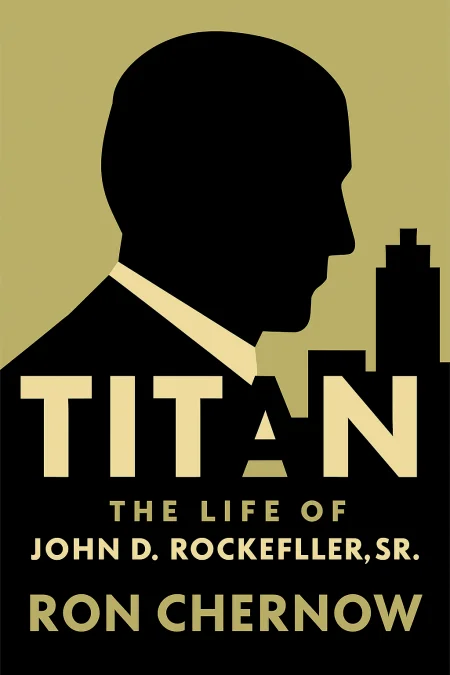
Titan
The Life of John D. Rockefeller, Sr.
Book Edition Details
Summary
In the annals of American history, few figures loom as large as John D. Rockefeller, Sr., the enigmatic force behind Standard Oil's ironclad grip on the industry. In "Titan," Ron Chernow peels back the layers of myth and notoriety to reveal a man of startling complexity. From his humble beginnings as the son of an erratic snake-oil salesman to his ascension as the world's first billionaire, Rockefeller's life is a study in contrasts—ruthless tycoon and devout philanthropist, public villain and private benefactor. Chernow's masterful narrative weaves a rich tapestry of the era, spotlighting the seismic shifts in America's economic landscape, while unraveling the personal scandals and strategic maneuvers that defined Rockefeller's legacy. This biography offers a nuanced portrait of a man who reshaped the corporate world, challenging readers to reconsider the very nature of power and ambition.
Introduction
In the winter of 1917, an elderly man sat in his Georgian mansion overlooking the Hudson River, revisiting the most controversial chapters of his extraordinary life. At nearly eighty years old, John D. Rockefeller Sr. remained as composed as ever, his pale blue eyes still sharp with the calculating intelligence that had once made him the most feared businessman in America. This was the same man who had transformed a chaotic, wasteful industry into a model of efficiency, who had built the world's first great industrial monopoly, and who had given away more money than any individual in history. Born into poverty in rural New York, Rockefeller would become the richest man who ever lived, accumulating wealth that would be worth over $400 billion in today's dollars. Yet his story transcends mere accumulation of riches. Through his rise from a struggling bookkeeper to the master of Standard Oil, we witness the birth of modern corporate America and the complex moral questions that accompanied the nation's industrial transformation. His journey reveals the intricate relationship between ruthless business ambition and genuine philanthropic vision, between the pursuit of order in a chaotic marketplace and the exercise of monopolistic power. Most profoundly, Rockefeller's life illuminates how a man could simultaneously embody both the promise and the perils of American capitalism, leaving a legacy that continues to shape our understanding of wealth, power, and responsibility in the modern age.
From Humble Beginnings to Oil Empire Builder
John Davison Rockefeller entered the world on July 8, 1839, in a modest farmhouse in Richford, New York, born into circumstances that seemed to promise little more than rural obscurity. His father, William Avery Rockefeller, was a charismatic but unreliable peddler of patent medicines who disappeared for months at a time, leaving his wife Eliza to raise five children with remarkable fortitude and faith. The contrast between his parents would prove formative: where his father was flamboyant and irresponsible, his mother was steady, devout, and utterly dependable. From Eliza, young John inherited an iron discipline and an unwavering Baptist faith that would anchor him throughout his tumultuous career. When financial pressures forced him to abandon his college dreams, the sixteen-year-old methodically canvassed Cleveland's business district for six weeks until he secured a position as an assistant bookkeeper at Hewitt and Tuttle. His meticulous attention to detail and preternatural calm under pressure quickly distinguished him from his peers. Even as a teenager, he displayed the traits that would define his business philosophy: an obsession with efficiency, a talent for seeing the larger patterns within complex systems, and an ability to remain focused on long-term goals while others panicked over short-term setbacks. Rockefeller's early partnership with Maurice Clark in the produce business revealed his emerging genius for organization and his instinctive understanding of how transportation costs could determine success or failure in commodity trading. When the oil boom began in Pennsylvania in 1859, he approached the chaotic new industry with the methodical precision of an accountant and the vision of a strategist. While others saw only the immediate profits to be made from refining crude oil, Rockefeller perceived the fundamental problem that would plague the industry: ruinous overproduction and wild price swings that enriched no one in the long run. His decision to enter oil refining in 1863 marked the beginning of his systematic campaign to bring order to what he saw as a wasteful and self-destructive industry.
The Standard Oil Monopoly and Public Controversy
The formation of Standard Oil in 1870 represented more than just another business incorporation; it was Rockefeller's declaration of war against the chaos and inefficiency that plagued the petroleum industry. With $1 million in capital, the company was immediately the largest refining operation in the world, but Rockefeller's ambitions extended far beyond mere size. He envisioned a completely integrated enterprise that would control every aspect of oil production, from the wellhead to the consumer's lamp, eliminating the waste and duplication that he believed were bankrupting the entire industry. The notorious South Improvement Company scheme of 1872, though ultimately unsuccessful, revealed the audacious scope of Rockefeller's thinking. By negotiating secret rebates with the railroads that would have given Standard Oil crushing advantages over competitors, he demonstrated both his strategic brilliance and his willingness to operate in the gray areas of business ethics. When the scheme collapsed amid public outrage, Rockefeller characteristically turned the crisis to his advantage, using the chaos to acquire twenty-two of Cleveland's twenty-six refineries in what became known as the Cleveland Massacre. Rockefeller's genius lay not just in his ability to eliminate competitors, but in his talent for converting them into allies. Rather than simply destroying rival firms, he typically retained their management and operations, creating a vast network of nominally independent companies that were secretly controlled by Standard Oil. The construction of Standard Oil's pipeline network represented perhaps his most decisive strategic move. By controlling the means of transporting crude oil from the wells to the refineries, he gained the power to determine which producers prospered and which failed. As Standard Oil's dominance became complete, controlling roughly 90 percent of America's oil refining capacity by the 1880s, Rockefeller found himself transformed from an obscure Cleveland businessman into the most hated man in America. The very efficiency that he prized became, in the eyes of critics, evidence of his ruthless suppression of competition. Ida Tarbell's devastating exposé in McClure's Magazine portrayed him as the embodiment of corporate greed, a cold-blooded monopolist who had crushed the dreams of thousands of independent businessmen.
Transformation into America's Greatest Philanthropist
The final chapters of Rockefeller's life revealed a man grappling with the moral implications of his vast wealth and seeking to transform his legacy from that of a robber baron to that of a benefactor of humanity. His systematic approach to giving away his fortune was as methodical and ambitious as his approach to building it had been. The establishment of the Rockefeller Foundation, the University of Chicago, and numerous other institutions represented his belief that concentrated wealth carried with it the obligation to serve the broader good of society. Rockefeller's philanthropy was revolutionary not just in its scale but in its approach. Rather than simply giving money to existing charities, he sought to attack the root causes of human suffering through scientific research and systematic intervention. His funding of medical research led to breakthroughs in the treatment of hookworm, yellow fever, and other diseases that had plagued humanity for centuries. The Rockefeller Institute for Medical Research became a model for how private wealth could advance scientific knowledge for the benefit of all mankind. The relationship between Rockefeller's business practices and his charitable giving remained a source of controversy throughout his life. Critics argued that no amount of philanthropy could wash the stains from money earned through monopolistic practices, while supporters contended that his efficient accumulation of wealth had simply enabled him to do more good than would have been possible if the money had remained scattered among thousands of smaller competitors. Rockefeller himself never saw any contradiction between his business methods and his charitable goals, viewing both as expressions of his fundamental belief in the importance of efficiency and organization. Perhaps most significantly, Rockefeller's approach to wealth established patterns that would influence American philanthropy for generations. His insistence that giving should be systematic, strategic, and focused on long-term impact rather than immediate relief became the foundation of modern foundation work. The Rockefeller family's continued prominence in philanthropy, public service, and business demonstrated how great wealth, properly managed, could serve not just private interests but public purposes across multiple generations.
Legacy of Wealth, Power, and Social Responsibility
John D. Rockefeller's death in 1937 at the age of 97 marked the end of an era that had witnessed America's transformation from an agricultural nation to an industrial superpower. His legacy was as complex and contradictory as the man himself, embodying both the creative and destructive forces of American capitalism. The business empire he built had demonstrated the incredible efficiency possible through large-scale organization, while simultaneously revealing the dangers of unchecked corporate power that could stifle competition and innovation. The Standard Oil companies that emerged from the 1911 antitrust breakup, including what would become Exxon, Mobil, and Chevron, dominated the global oil industry throughout the twentieth century, validating Rockefeller's vision of integrated, efficient operations. His innovations in corporate structure and management became standard practices that shaped modern business organization worldwide. More broadly, his career had forced America to confront fundamental questions about the relationship between private enterprise and public welfare, leading to the regulatory frameworks that still govern business today. Yet it was perhaps in philanthropy that Rockefeller's most enduring legacy emerged. His systematic approach to giving established principles that continue to guide major foundations: the importance of addressing root causes rather than symptoms, the value of expert knowledge in directing charitable efforts, and the potential for private wealth to tackle problems on a global scale. The institutions he founded continued to advance human knowledge and welfare long after his death, creating a form of legacy that transcended mere business success. The complexity of Rockefeller's story reflects the fundamental tensions inherent in American capitalism itself. His life demonstrated how the same drive and intelligence that can create enormous wealth and innovation can also concentrate dangerous power and perpetuate inequality. His transformation from controversial monopolist to pioneering philanthropist suggested that even the most criticized figures could find redemption through service to others, establishing a tradition of large-scale charitable giving that remains one of America's most distinctive characteristics.
Summary
John D. Rockefeller's extraordinary life embodies the fundamental paradox of American capitalism: the same qualities that enable the accumulation of great wealth can be equally powerful when directed toward serving humanity's needs. His journey from reviled monopolist to beloved philanthropist reveals the potential for personal transformation and demonstrates that true legacy lies not in what we accumulate for ourselves, but in what we contribute to the world's betterment. Perhaps most importantly, Rockefeller showed that with great fortune comes the opportunity and perhaps the obligation to ensure that prosperity serves purposes far greater than personal aggrandizement. For anyone seeking to understand the complex relationship between private success and public service, Rockefeller's story offers both inspiration and caution. His life suggests that the highest achievement may not be building an empire, but rather using that empire's resources to solve problems that benefit all humanity. In an age when wealth inequality again dominates public discourse, his example reminds us that the measure of success should ultimately be determined not by the wealth we accumulate, but by the positive change we create in the world and the institutions we leave behind to continue that work for future generations.
Related Books
Download PDF & EPUB
To save this Black List summary for later, download the free PDF and EPUB. You can print it out, or read offline at your convenience.
By Ron Chernow
