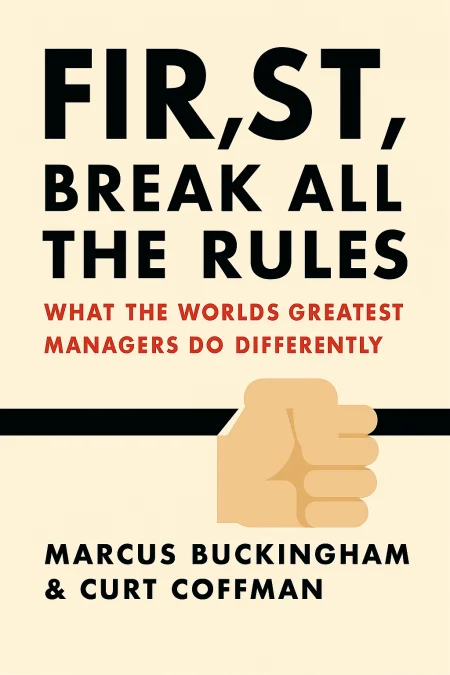
First, Break all the Rules
What the World’s Greatest Managers Do Differently
byMarcus Buckingham, Curt Coffman
Book Edition Details
Summary
What happens when the playbook for success gets tossed out the window? In "First, Break All the Rules," Gallup unveils the secrets of the world's most effective managers, shattering the conventional wisdom that has long dictated the corporate landscape. This groundbreaking tome distills the insights from a massive study of over 80,000 managers, spotlighting the innovative tactics that distinguish top-tier leaders from the rest. With a treasure trove of performance-enhancing strategies and career-transforming lessons, this book is an essential read for managers aiming to break free from outdated paradigms. Discover the unorthodox principles that fuel excellence and redefine what it means to lead.
Introduction
Why do some managers consistently outperform others despite having similar resources, training, and organizational support? The conventional wisdom of management suggests that with the right systems, processes, and techniques, any manager can achieve excellence. Yet in practice, we observe striking variations in performance across teams, departments, and organizations that challenge this assumption. This disconnect points to a fundamental gap in our understanding of what truly drives managerial effectiveness. At the heart of this inquiry lies a systematic examination of management philosophy grounded in extensive empirical research spanning decades and involving over 80,000 managers across diverse industries. The theoretical framework presented challenges the prevailing orthodoxies of management practice by proposing that exceptional managers operate according to fundamentally different principles than their conventional counterparts. This paradigm shift moves beyond surface-level techniques to examine the underlying beliefs and mental models that guide managerial decision-making. The core theoretical questions this framework addresses include: What distinguishes talent from skill, and why does this distinction matter for selection and development? How should managers balance standardization with individualization to maximize performance? What role does strength-based development play versus traditional weakness-focused improvement approaches? How can organizations create career paths that honor individual talents while meeting business needs? These questions form the foundation of a comprehensive theory of management that prioritizes human individuality over systematic uniformity.
The Four Keys to Great Management
The theoretical foundation of exceptional management rests upon four interconnected principles that collectively form a coherent system for transforming individual potential into organizational performance. This framework represents a departure from traditional management models that emphasize control, standardization, and deficit correction. Instead, it proposes a talent-centric approach that recognizes and leverages the unique patterns of thought, feeling, and behavior that each individual brings to their role. These four principles operate as sequential yet interdependent elements within a larger management philosophy. The first principle centers on recognizing that sustainable performance advantages emerge from identifying and hiring individuals whose natural talents align with role requirements. This moves beyond conventional selection criteria focused on experience and credentials toward a deeper understanding of innate behavioral patterns and psychological predispositions. The remaining principles build upon this foundation by establishing outcome-focused expectations rather than process-driven mandates, cultivating individual strengths rather than attempting to eliminate weaknesses, and creating development paths that honor individual talents while meeting organizational needs. Together, these elements form a management theory that treats each employee as a unique constellation of abilities requiring individualized approaches to maximize their contribution. The power of this theoretical framework lies not in its individual components but in their systematic integration. When managers operate according to all four principles simultaneously, they create environments where natural talents flourish, leading to higher levels of engagement, performance, and retention. This represents a fundamental shift from viewing management as a control mechanism to understanding it as a catalyst for human potential.
Select for Talent, Define Right Outcomes
The first principle of exceptional management involves a fundamental reconceptualization of human capability and its relationship to performance. Rather than viewing ability as a malleable characteristic that can be developed through training and effort, this approach recognizes that certain patterns of thought, feeling, and behavior are relatively fixed aspects of personality that emerge early and remain stable throughout an individual's career. These recurring patterns, defined as talents, represent the raw material from which exceptional performance is built. This talent-based selection model distinguishes between three distinct categories of human capability: skills, knowledge, and talents. Skills represent the procedural how-to's that can be taught and learned through practice. Knowledge encompasses both factual information and experiential wisdom gained through exposure and reflection. Talents, however, are the deeper psychological patterns that influence how individuals naturally approach situations, process information, and interact with others. While skills and knowledge can be acquired, talents are largely innate and resistant to change. The practical implications of this distinction become evident when considering roles that require specific behavioral patterns for success. A salesperson who naturally forms quick emotional connections with strangers possesses a relating talent that cannot be taught to someone who is naturally reserved and analytical. A manager who intuitively notices individual differences among team members has a talent for individualization that training alone cannot instill. Organizations that select for these natural patterns rather than attempting to develop them create immediate performance advantages while reducing the frustration that comes from trying to change fundamental aspects of personality. The outcome-focused expectation setting that follows talent selection represents a sophisticated balance between organizational consistency and individual expression. Rather than mandating specific processes or behaviors, exceptional managers define clear results while allowing each employee to find their own path to achievement. This approach recognizes that there are often multiple routes to the same destination, and that individuals perform best when they can leverage their natural strengths in pursuit of defined goals. The key lies in identifying which outcomes truly matter for organizational success and then creating measurement systems that track progress while preserving individual autonomy in execution.
Focus on Strengths, Find Right Fit
The third and fourth principles of exceptional management work in tandem to create development approaches that honor individual nature while driving organizational performance. Strength-based development represents a radical departure from traditional deficit-focused improvement models that emphasize identifying and correcting weaknesses. Instead, this approach recognizes that individuals achieve excellence by doing more of what they naturally do well, rather than by attempting to become well-rounded generalists. The strength-focused philosophy acknowledges that every individual possesses areas of natural talent alongside areas of non-talent or weakness. Rather than viewing weaknesses as problems to be solved, this approach treats them as areas to be managed around through support systems, complementary partnerships, or role redesign. The energy traditionally devoted to weakness correction is redirected toward strength development, creating accelerated performance improvements and higher levels of job satisfaction. This strength-based approach requires managers to become skilled at recognizing and articulating individual talents, even when those talents manifest differently across people in similar roles. A customer service representative who excels through warm personal connection operates from different talents than one who excels through technical expertise and problem-solving capability. Both can achieve outstanding results, but they require different development approaches and different performance environments to reach their potential. The concept of right fit extends beyond traditional notions of career advancement to encompass a more nuanced understanding of individual fulfillment and organizational effectiveness. Rather than assuming that everyone aspires to climb a predetermined hierarchy, this approach recognizes that individuals thrive when their talents align with their responsibilities. Career development becomes a process of finding increasingly better fits between individual capabilities and role requirements, whether through vertical advancement, lateral movement, or deepened expertise within current roles. The practical implementation of right fit thinking requires organizations to create multiple pathways to success, recognition, and reward. This might involve developing parallel career tracks that allow technical experts to advance without moving into management roles, creating project-based opportunities that allow individuals to apply their talents in new contexts, or establishing mentoring relationships that help individuals better understand their own patterns of excellence. The goal is not to limit individual aspirations but to help people find sustainable paths to success that build upon their natural strengths.
Turning Keys into Performance Excellence
The integration of these four principles creates a management approach that transforms organizational culture by changing how decisions are made about people. Rather than relying on standardized approaches that treat all employees identically, this framework provides tools for making individualized decisions that honor both human uniqueness and business requirements. The practical application requires managers to develop new skills in observation, conversation, and decision-making that support talent-based thinking. Implementation begins with structured approaches to talent identification through behavioral interviewing techniques that reveal recurring patterns of thought, feeling, and behavior. These conversations focus less on past accomplishments and more on understanding how individuals naturally approach challenges, what energizes them, and what patterns of behavior they demonstrate consistently across different situations. The goal is to predict future performance by understanding the underlying talents that drive behavior rather than simply cataloging past experiences. The ongoing management relationship evolves into a series of individualized partnerships where each employee receives different treatment based on their unique combination of talents, motivations, and development needs. This might mean providing more frequent feedback to someone who thrives on recognition while giving greater autonomy to someone who prefers independence. It could involve creating stretch assignments that challenge specific talents or establishing support systems that manage around areas of weakness. The art lies in treating each person as they need to be treated while maintaining fairness in outcomes and opportunities. Measurement systems aligned with this approach track both individual progress and team performance while allowing for different paths to success. Rather than evaluating everyone against the same behavioral standards, these systems focus on results while providing feedback that helps individuals understand their patterns of effectiveness. This creates accountability without forcing conformity, ensuring that organizational goals are met while individual talents are honored. The long-term impact of implementing these principles extends beyond immediate performance improvements to create organizational cultures that naturally attract and retain high-performing individuals. When people experience work environments where their talents are recognized, developed, and applied toward meaningful outcomes, they become more engaged, productive, and loyal. This creates competitive advantages that are difficult for other organizations to replicate because they are based on the fundamental human desire to express one's authentic capabilities in service of worthy goals.
Summary
The greatest insight emerging from decades of management research is elegantly simple: exceptional results come not from trying to fix people's weaknesses but from identifying and leveraging their natural strengths. This talent-centric approach to management recognizes that sustainable performance advantages are built upon the foundation of human individuality rather than systematic uniformity. By selecting for talent, defining clear outcomes, focusing on strengths, and finding the right fit for each individual, managers create environments where natural abilities flourish and organizational goals are achieved through the full expression of human potential. The profound implications of this framework extend far beyond management technique to touch the fundamental question of how organizations can create conditions for human flourishing while achieving business success, suggesting that the highest levels of performance emerge when we learn to work with human nature rather than against it.
Related Books
Download PDF & EPUB
To save this Black List summary for later, download the free PDF and EPUB. You can print it out, or read offline at your convenience.
By Marcus Buckingham
