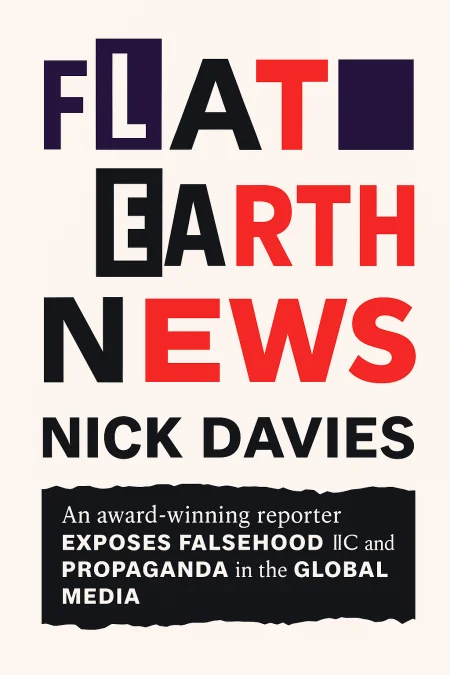
Flat Earth News
An Award-Winning Reporter Exposes Falsehood, Distortion, and Propaganda in the Global Media
Book Edition Details
Summary
Nick Davies throws open the curtains on the shadowy world of modern journalism, revealing an unsettling reality that cuts through the veneer of objectivity. "Flat Earth News" delivers a jarring exposé of an industry steeped in manipulation and deceit, where truth is often sacrificed at the altar of profit. Davies doesn’t shy away from naming names, detailing how revered publications have become unwitting pawns in the hands of intelligence agencies, or how stories are concocted to sway public opinion and policy. The book is a powerful indictment of media malpractices, where the quest for headlines often buries integrity. It's a gripping read that challenges the romanticized notion of journalism, urging readers to question the very foundations of the news they consume.
Introduction
The contemporary media landscape operates as a sophisticated machine for producing and distributing falsehoods, where the very institutions entrusted with informing democratic societies have become conduits for systematic misinformation. This transformation represents not merely isolated failures of individual journalists or news organizations, but a comprehensive structural breakdown that has converted truth-seeking enterprises into profit-driven content factories. The investigation reveals how commercial pressures, corporate ownership models, and the infiltration of public relations professionals have fundamentally altered the nature of news production, creating an environment where speed trumps accuracy and convenience overrides verification. The analysis employs forensic examination of newsroom practices, corporate decision-making processes, and the relationship between media organizations and external influence operations. Through detailed case studies and systematic documentation of industry practices, the evidence demonstrates how well-intentioned journalists have become unwitting participants in manufacturing ignorance rather than knowledge. This systematic approach reveals patterns of behavior that transcend individual malice or incompetence, pointing instead to institutional structures that make truth-telling increasingly difficult and falsehood increasingly inevitable. Understanding these mechanisms becomes essential for anyone seeking to navigate the modern information environment with clarity and discernment.
The Corporate Takeover: How Profit Motives Destroyed Truth-Telling
Corporate consolidation has fundamentally transformed journalism from a public service institution into a profit-maximizing enterprise, creating structural conditions that make truth-telling economically unsustainable. The mathematical reality of modern newsrooms reveals the impossibility of maintaining journalistic standards under current ownership models: skeleton crews attempt to produce the same volume of content that once required significantly larger editorial teams, while simultaneously facing pressure to increase output and reduce costs. This equation forces journalists to abandon time-intensive investigation in favor of rapid content processing, creating dependency on readily available information sources regardless of their reliability or agenda. The factory model of news production emerges when corporate owners demand higher profit margins while reducing investment in editorial resources. Time becomes the defining constraint, transforming journalism into what can only be described as "churnalism" - the mechanical reproduction of information without genuine reporting. Journalists working under these conditions cannot afford the luxury of skepticism or the time required for proper fact-checking, making them dependent on sources who provide pre-packaged information that can be quickly processed and published. Commercial imperatives have also led to the prioritization of stories that generate audience engagement at minimal cost, abandoning complex issues requiring sustained investigation in favor of simple narratives that can be produced quickly and cheaply. This systematic degradation of journalistic standards creates an environment where falsehood can flourish unchecked, as the institutional mechanisms that once caught and corrected errors have been eliminated in the name of efficiency. The consequences extend far beyond individual news organizations to encompass the breakdown of journalism's watchdog function. When democratic institutions operate with reduced scrutiny and the public loses access to reliable information necessary for informed decision-making, the foundation of democratic governance itself becomes threatened. This represents one of the most significant yet underrecognized crises of contemporary democratic society.
The PR-Intelligence Complex: Manufacturing Consent Through Media Manipulation
Public relations has evolved from a peripheral industry into the primary supplier of raw material for modern journalism, creating a systematic infiltration of democratic discourse by commercial and political interests. The sophistication of contemporary PR operations extends far beyond traditional press releases to encompass the creation of entire pseudo-events designed specifically for media consumption, the establishment of fake grassroots organizations, and the deployment of psychological techniques that would make Cold War propagandists envious. These operations exploit the structural weaknesses of corporate-owned media, providing cash-strapped newsrooms with ready-made content that serves their clients' interests while appearing to be legitimate journalism. Intelligence agencies have similarly adapted their methods for the digital age, using media organizations as weapons in what they term "information warfare." Declassified documents reveal extensive programs designed to influence public opinion through planted stories, manipulated sources, and coordinated disinformation campaigns that exploit journalism's weakness for exclusive information and authoritative sources. These operations turn journalists into unwitting agents of state propaganda, corrupting the very institutions meant to provide independent oversight of government activities. The dependency relationship between media outlets and PR-generated content has reached extraordinary levels, with studies showing that more than half of news stories originate from public relations sources. This creates a fundamental power imbalance where those with resources to hire professional communicators can effectively purchase media coverage, while those without such resources struggle to have their voices heard. The result is systematic bias toward the perspectives of the wealthy and powerful, disguised as objective journalism. The symbiotic relationship between media organizations and these external actors has created a system where truth becomes secondary to narrative control. Stories are shaped not by facts but by the strategic interests of those with the resources and expertise to manipulate the information environment, representing a fundamental corruption of the democratic process where public debate is guided by sophisticated manipulation techniques rather than genuine discourse.
Churnalism in Action: Case Studies of Systematic Journalistic Failure
The millennium bug hysteria provides a paradigmatic example of how uncertainty can be transformed into certainty through the news production process, revealing consistent patterns that transcend individual incompetence to demonstrate structural problems inherent in contemporary media production. What began as legitimate technical concerns about computer systems was amplified through successive iterations of reporting until it became an apocalyptic narrative that bore little relationship to actual risks involved. Each stage of this amplification followed predictable patterns: journalists relied on easily accessible sources, simplified complex technical issues, and favored dramatic narratives over nuanced analysis. The Iraq War represents perhaps the most catastrophic failure of modern journalism, where major news organizations across the Western world abandoned their critical function and became cheerleaders for military intervention. The case reveals how false intelligence was laundered through respected newspapers and broadcasters, creating a false consensus that made dissent appear unpatriotic or naive. Journalists who should have been skeptical of government claims instead competed to publish the most alarming stories about weapons of mass destruction that never existed, demonstrating how the system's structural weaknesses can be exploited for political manipulation. International reporting provides particularly stark examples of churnalism in action, as news organizations lacking foreign correspondents rely heavily on wire services and official sources for information about distant events. This dependency creates opportunities for governments and other interested parties to shape coverage by controlling the flow of information to centralized sources. The result is often coverage that reflects the perspectives of powerful actors rather than complex realities of situations being reported. The speed of modern news cycles prevents the kind of careful fact-checking that might catch errors before they become embedded in public consciousness. Once false information enters the system, it tends to be recycled and reinforced rather than corrected, creating feedback loops of misinformation that can persist for years or even decades, shaping public understanding of critical issues through repetition rather than verification.
Democratic Collapse: The Political Consequences of Information Breakdown
The systematic failure of journalism has created a crisis of democratic legitimacy that extends far beyond media organizations themselves, threatening the foundation of democratic participation by depriving citizens of reliable information necessary for informed decision-making. When different segments of society operate from entirely different sets of "facts," compromise and consensus become impossible, creating political paralysis that serves the interests of those who benefit from social division while undermining collective problem-solving capacity that democratic societies require to address complex challenges. The breakdown of shared factual reality has made rational political discourse increasingly difficult, contributing to the rise of authoritarian movements that exploit information chaos for their own purposes. This fragmentation creates market incentives for increasingly extreme and polarizing content, while punishing the kind of careful, nuanced reporting that democracy requires. The self-reinforcing nature of this crisis means that as public trust in traditional media declines, audiences fragment into echo chambers that reinforce existing beliefs rather than challenging them. International implications prove equally troubling, as major democracies lose their ability to provide moral leadership on the global stage when they cannot maintain reliable information systems. The corruption of Western media has provided authoritarian regimes with powerful propaganda tools, allowing them to dismiss legitimate criticism as "fake news" while promoting their own distorted narratives. This represents a fundamental shift in global information warfare, where democratic societies find themselves at a disadvantage due to their own institutional failures. The evidence suggests that this crisis has already begun to manifest in declining trust in institutions, political polarization, and the erosion of democratic norms that depend on shared understanding of basic facts. Without fundamental structural changes to how democratic societies produce and consume information, these trends are likely to accelerate, potentially leading to the collapse of democratic governance itself in favor of authoritarian alternatives that promise certainty in an environment of manufactured confusion.
Summary
The investigation reveals a comprehensive system for manufacturing ignorance that has replaced journalism's traditional truth-telling function with a sophisticated apparatus for distributing falsehoods and propaganda. Through detailed analysis of corporate structures, newsroom practices, and external manipulation techniques, the evidence demonstrates that what appears to be isolated media failures actually represents systematic institutional breakdown that threatens the foundation of democratic society. The transformation of news organizations from public service institutions into profit-driven content factories has created structural conditions where truth-telling becomes economically unsustainable, while the infiltration of public relations professionals and intelligence operatives has corrupted the information supply chain at its source. Understanding these mechanisms of systematic deception becomes essential not only for media literacy but for the preservation of democratic governance itself, as societies that cannot distinguish between truth and falsehood lose the capacity for rational collective decision-making that democracy requires to survive and thrive.
Related Books
Download PDF & EPUB
To save this Black List summary for later, download the free PDF and EPUB. You can print it out, or read offline at your convenience.
By Nick Davies
