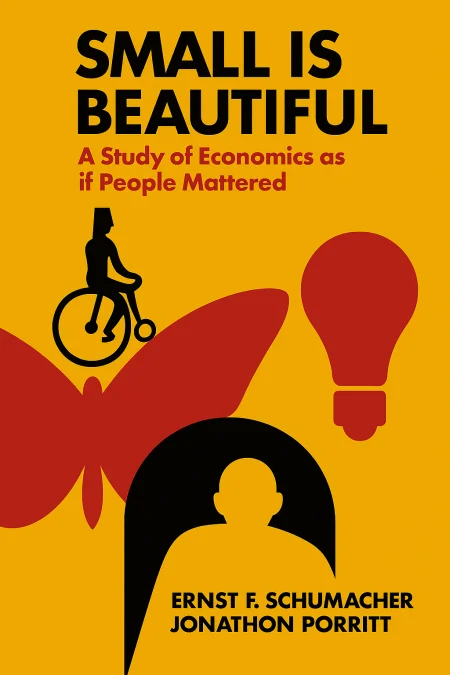
Small is Beautiful
A Study of Economics as if People Mattered
byErnst F. Schumacher, Jonathon Porritt
Book Edition Details
Summary
Envision a world where economies serve people, not profit margins. E. F. Schumacher, with his groundbreaking insights, peels back the layers of modern economics to reveal a poignant truth: our relentless chase for growth may be leading us astray. In "Small Is Beautiful," Schumacher critiques the Western obsession with consumption, advocating instead for economies that nurture communities. This seminal work, celebrated as one of the most influential of the post-war era, resonates powerfully today as it did in the 1970s. By urging us to reconsider the true purpose of economic systems, Schumacher presents a radical yet feasible vision for a more humane future.
Introduction
Modern economic thinking has reached a critical juncture where its fundamental assumptions require thorough reexamination. The prevailing belief that technological progress and economic growth automatically translate into human prosperity has created a paradox: societies have never been wealthier by conventional measurements, yet problems of alienation, environmental destruction, and spiritual emptiness continue to multiply. This contradiction suggests that something essential is missing from our economic framework—namely, a genuine consideration of human needs and natural limits. The analysis presented here challenges the dominant materialist philosophy that reduces all value to quantifiable metrics and treats nature as merely a resource to be exploited. Through careful examination of production methods, consumption patterns, and organizational structures, a compelling case emerges for intermediate-scale solutions that honor both human dignity and ecological wisdom. The argument unfolds systematically, moving from philosophical foundations through practical applications, ultimately proposing concrete alternatives to gigantic industrial systems that have lost their human dimension.
The Failure of Modern Economics and Production
The fundamental error plaguing contemporary economic thought lies in the dangerous assumption that production problems have been definitively solved. This illusion pervades academic circles, government planning departments, and corporate boardrooms alike, creating a false confidence that technological advancement has permanently overcome scarcity. Yet this belief rests on a catastrophic confusion between income and capital, treating irreplaceable natural resources as if they were renewable streams of wealth. The modern industrial system operates by consuming three distinct types of capital while accounting for them as mere operating expenses. First, fossil fuels represent stored solar energy accumulated over millions of years, yet economic models treat their depletion as routine business costs rather than the liquidation of irreplaceable assets. Second, the tolerance margins of natural ecosystems—their capacity to absorb pollution and regenerate—are being systematically overwhelmed without appearing in any balance sheet. Third, the human substance itself, the psychological and spiritual foundation that makes civilization possible, deteriorates under production systems designed to eliminate the human factor entirely. This triple assault on the foundations of life reveals why conventional economic growth, despite its apparent success, generates increasing anxiety and instability. When production methods prioritize efficiency over human fulfillment, they create alienation and meaninglessness that no amount of material abundance can remedy. The obsession with eliminating human involvement from production processes reflects a fundamental misunderstanding of what constitutes genuine prosperity. Recognition of these deeper patterns points toward the necessity of economic frameworks that acknowledge natural limits and human needs as primary constraints rather than obstacles to be overcome through technological force.
Intermediate Technology and Human-Scale Development
The technological choices available to developing societies present a stark dilemma that conventional development theory fails to address adequately. On one extreme lies traditional technology with minimal productivity; on the other stands sophisticated modern equipment requiring enormous capital investment and eliminating employment opportunities. This false choice has trapped developing nations in dependency relationships while failing to address the fundamental challenge of creating meaningful work for millions of people. Intermediate technology emerges as a third path, designed specifically to bridge this gap through tools and methods that dramatically increase productivity while remaining accessible to communities with limited capital resources. Rather than simply transferring advanced industrial equipment to inappropriate contexts, this approach involves conscious innovation to create technologies that match the actual conditions and needs of developing societies. The goal is not to recreate primitive conditions but to develop sophisticated solutions scaled appropriately for local circumstances. The capital intensity required for modern industrial workplaces—often requiring thousands of pounds per position—makes it mathematically impossible to provide employment for the hundreds of millions who need it. If developing countries require millions of new jobs annually, the investment must average closer to hundreds rather than thousands of pounds per workplace. This constraint is not a limitation but an opportunity to develop production methods that emphasize human skill and creativity rather than capital substitution. Successful intermediate technology programs demonstrate that higher productivity and appropriate scale can be combined effectively. Small-scale cement production, intermediate-level agricultural processing, and decentralized manufacturing have proven viable in numerous contexts. These approaches create employment while building technical capacity and maintaining connection between producers and their communities, avoiding the social disruption characteristic of large-scale industrialization.
Buddhist Economics and Alternative Values
Economic theory traditionally treats work as an unfortunate necessity to be minimized through increased productivity and automation. This perspective reduces human labor to a cost factor while ignoring the fundamental human need for meaningful activity and creative expression. Buddhist economics offers a radically different framework that recognizes work as essential for human development, social cooperation, and spiritual growth. The Buddhist understanding identifies three primary functions of work beyond mere production: providing opportunities for individuals to develop their capabilities, creating bonds of cooperation and mutual support, and generating the goods and services necessary for dignified living. This perspective transforms the entire approach to economic organization, suggesting that methods which reduce work to monotonous, fragmented tasks represent a fundamental violation of human nature rather than progress toward efficiency. This alternative framework leads to dramatically different conclusions about consumption, production methods, and social organization. Rather than maximizing output per worker, the goal becomes optimizing human development and satisfaction while meeting material needs efficiently. Consumption appears not as an end in itself but as a means to human flourishing, suggesting that the optimal economic system would maximize well-being while minimizing resource use rather than the reverse. The principle of non-violence extends this analysis to encompass relationships with the natural environment. Production methods that devastate ecosystems or exhaust irreplaceable resources violate the fundamental interconnectedness that Buddhist philosophy recognizes as the foundation of existence. Local production for local needs emerges not as economic inefficiency but as the most rational approach to organizing human activity within natural limits.
Organization, Ownership and Social Transformation
Large-scale organizations face an inherent tension between the need for coordinated action and the preservation of human initiative and creativity. Traditional approaches oscillate between rigid centralization and chaotic decentralization, missing the possibility of structures that combine clear authority with genuine participation. The solution lies not in choosing between these alternatives but in creating organizational forms that incorporate both simultaneously. The principle of subsidiarity provides the foundation for such structures, establishing that higher levels should never absorb functions that lower levels can perform effectively. This approach creates networks of semi-autonomous units, each with substantial freedom to operate according to local conditions while maintaining coordination through shared purposes and mutual accountability. The resulting organizations resemble federations rather than hierarchies, with authority flowing from competence rather than position. Ownership patterns profoundly influence organizational behavior and social outcomes. Private ownership of large-scale enterprises creates concentrations of power that distort both economic relationships and democratic governance. Yet conventional nationalization often substitutes bureaucratic control for private dominance without addressing the fundamental problems of scale and accountability. Alternative ownership structures, exemplified by companies like Scott Bader, demonstrate possibilities for worker ownership combined with community responsibility. These experiments in democratic ownership reveal that economic enterprises can serve multiple purposes simultaneously without sacrificing efficiency. When workers share in both decision-making and financial results, while dedicating portion of profits to community purposes, the organization becomes a vehicle for social development rather than merely private enrichment. Such structures point toward economic systems designed to serve human development within ecological limits rather than abstract growth objectives.
Summary
The central insight emerging from this comprehensive analysis reveals that economic systems are not neutral tools but expressions of fundamental values about human nature and social purpose. The dominant materialist framework, despite its apparent practical success, generates contradictions that threaten both human dignity and ecological survival. These contradictions cannot be resolved through technical adjustments or policy reforms alone but require recognition that economic organization must serve purposes larger than wealth accumulation. The alternative approaches outlined here demonstrate that human-scale institutions, appropriate technologies, and democratic ownership structures can create prosperity without the destructive side effects of gigantic industrial systems.
Related Books
Download PDF & EPUB
To save this Black List summary for later, download the free PDF and EPUB. You can print it out, or read offline at your convenience.
By Ernst F. Schumacher
