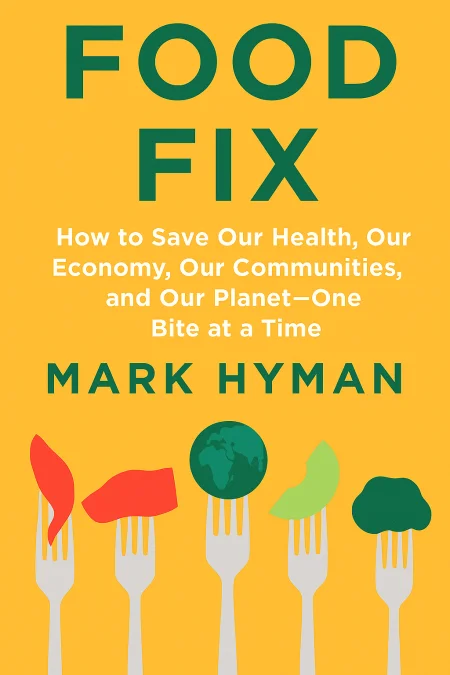
Food Fix
How to Save Our Health, Our Economy, Our Communities, and Our Planet – One Bite at a Time
Book Edition Details
Summary
In a world teetering on the brink of ecological and societal collapse, "Food Fix" emerges as a clarion call for transformation. Authored by the visionary Mark Hyman, MD, this groundbreaking work tackles the urgent crisis of our time: the food we consume and its profound ripple effects on health, environment, and economy. Hyman unravels the tangled web of politics and profiteering that fuels global maladies like obesity, climate disruption, and economic disparity. By melding cutting-edge nutritional insights with a daring critique of agricultural policies, he charts a bold course toward a future where food becomes the linchpin for healing. This manifesto is not just a book but a blueprint for change—compelling, enlightening, and brimming with hope for a sustainable tomorrow.
Introduction
Contemporary society confronts an alarming paradox where abundant food production coincides with escalating rates of chronic disease and environmental collapse. This contradiction exposes fundamental flaws within industrial agriculture that extend far beyond simple supply and demand economics. The current food system operates as an interconnected web of corporate interests, government policies, and consumer behaviors that collectively generate profits for a few while imposing devastating costs on public health and planetary ecosystems. The analysis reveals how seemingly disparate crises—obesity epidemics, soil degradation, climate change, and social inequality—stem from shared structural roots within food production and distribution systems. By examining the flow of influence from corporate boardrooms through regulatory agencies to individual dietary choices, patterns emerge that challenge conventional assumptions about personal responsibility and market efficiency. This systematic approach demonstrates how profit-maximizing strategies systematically externalize costs onto society while obscuring the true price of cheap food through sophisticated manipulation of science, policy, and public opinion.
Hidden Costs: Industrial Agriculture Externalizes Disease and Environmental Damage
Industrial food production operates through a cost-shifting mechanism that makes unhealthy products artificially inexpensive while society bears the burden of long-term consequences. The apparent affordability of processed foods masks enormous hidden expenses that manifest as healthcare costs, environmental remediation, and social disruption. Conservative estimates suggest diet-related chronic diseases will impose $95 trillion in economic burden over the next 35 years, representing nearly five times current national economic output. This economic catastrophe stems from fundamental misalignment between agricultural production and nutritional needs. While dietary guidelines recommend fruits and vegetables comprise half of daily food intake, only 2 percent of farmland grows these crops. Instead, 59 percent of agricultural land produces commodity crops that become building blocks for ultraprocessed foods engineered to trigger addictive consumption patterns. These products contain combinations of sugar, salt, and industrial additives that hijack neurochemical reward systems, creating physiological dependence that drives continued consumption regardless of health consequences. Environmental destruction follows similar patterns of externalized costs. Industrial farming practices release stored soil carbon into the atmosphere while depleting topsoil at rates that threaten long-term food security. Iowa loses one pound of precious topsoil for every pound of corn produced, while agricultural runoff creates oceanic dead zones spanning thousands of square miles. The Gulf of Mexico's 8,000-square-mile dead zone exemplifies how nitrogen fertilizer contamination destroys marine ecosystems that support millions of livelihoods. Water system contamination represents another massive externalized cost as agricultural pollution forces communities to invest billions in treatment infrastructure. Factory farms generate toxic waste lagoons that regularly overflow during storms, contaminating groundwater with antibiotic-resistant pathogens and heavy metals. These environmental damages impose costs on taxpayers while allowing corporations to maintain competitive pricing through systematic cost-shifting onto future generations.
Corporate Capture: How Big Food Manipulates Science and Policy
Food industry influence over scientific research and policy formation follows sophisticated strategies pioneered by tobacco companies to manufacture doubt about product dangers while maintaining market access. Through strategic funding of research institutions, professional organizations, and individual scientists, corporations shape the questions being investigated and influence how results are interpreted and communicated to the public. Industry-sponsored nutrition studies are eight to fifty times more likely to produce favorable outcomes compared to independent research, revealing systematic bias in the evidence base informing dietary guidelines. Professional health organizations have been systematically compromised through corporate partnerships that create institutional conflicts of interest. The American Diabetes Association accepts millions from candy manufacturers while the American Heart Association endorses sugar-laden cereals as heart-healthy choices. These relationships transform trusted health authorities into unwitting marketing channels for the very products causing epidemic disease, undermining public confidence in scientific expertise while advancing corporate messaging. Regulatory capture occurs through revolving door employment between government agencies and the industries they oversee. Former food company executives routinely receive appointments to key positions within agencies responsible for food safety and nutrition policy, while former regulators transition to lucrative industry roles. This personnel exchange ensures regulatory frameworks remain favorable to corporate interests while maintaining an appearance of independent oversight that legitimizes industry-friendly policies. Front groups and astroturf campaigns create the illusion of grassroots support for industry positions while attacking critics and independent researchers. Organizations with benevolent names like the Center for Consumer Freedom actually serve as attack dogs for junk food companies, spending hundreds of millions annually to manufacture doubt about established health risks. These sophisticated information warfare campaigns exploit democratic processes while systematically undermining genuine public participation in policy decisions that affect population health and environmental sustainability.
Systemic Failures: Government Policies Subsidize Harmful Food Production
Government agricultural and nutrition policies create perverse incentives that simultaneously promote disease-causing foods while discouraging healthy alternatives. The Farm Bill, authorizing nearly $1 trillion in spending, exemplifies these contradictions by subsidizing commodity crops used in processed foods while providing minimal support for fruit and vegetable production. Between 1995 and 2013, federal subsidies allocated over $170 billion to corn, soy, and wheat that become high-fructose corn syrup and refined oils, while fruits and vegetables became 40 percent more expensive. The Supplemental Nutrition Assistance Program illustrates how well-intentioned policies produce harmful outcomes when designed without consideration of food system dynamics. While successfully addressing hunger, SNAP allows $7 billion annually in taxpayer funds to purchase sugar-sweetened beverages, representing the largest single category of program expenditures. Recipients consuming the most subsidized processed foods show 40 percent higher obesity rates and significantly elevated risks of metabolic disease, demonstrating how social safety nets can inadvertently perpetuate health disparities. Dietary guidelines compound these contradictions by recommending foods the agricultural system doesn't prioritize producing. The same agency advising Americans to consume five to nine daily servings of fruits and vegetables simultaneously supports policies that make such recommendations practically impossible to follow affordably. This systematic misalignment between nutrition advice and agricultural reality reflects deeper structural problems where different government agencies work at cross-purposes, undermining public health while advancing corporate interests. Educational institutions have been transformed into marketing venues where corporate logos compete with educational materials for student attention. Schools receive funding from food companies in exchange for exclusive marketing access to captive audiences of children during critical developmental periods. The resulting epidemics of childhood obesity, diabetes, and behavioral disorders represent systematic assault on human capital development that threatens national competitiveness while imposing enormous costs on already strained public resources.
Regenerative Solutions: Evidence-Based Pathways to Food System Transformation
Regenerative agricultural practices offer the most promising pathway for simultaneously addressing climate change, environmental degradation, and public health crises through food system transformation. These approaches work with natural ecological processes rather than against them, creating productive systems that heal damaged landscapes while producing more nutritious food and supporting thriving rural communities. Soil restoration represents the foundation of regenerative agriculture and potentially the most powerful tool for reversing climate change through carbon sequestration. Healthy soils rich in organic matter can sequester massive quantities of atmospheric carbon while improving water retention, reducing erosion, and supporting diverse microbial communities essential for plant nutrition. Conservative estimates suggest regenerative practices applied globally could offset 15 to 100 percent of current greenhouse gas emissions while simultaneously improving food security and ecosystem resilience. Plants grown in healthy soils contain higher concentrations of vitamins, minerals, and antioxidants while showing lower levels of toxic residues compared to conventional products. Economic analyses consistently demonstrate that regenerative farms outperform conventional operations across multiple metrics once transition periods are complete. Reduced input costs, higher yields, premium prices, and improved resilience to weather extremes combine to create profit margins that can exceed conventional farming by 300 to 400 percent. These economic advantages accelerate adoption while providing pathways for rural economic revitalization that reduces dependence on costly synthetic inputs. Healthcare system integration represents another crucial leverage point for transformation through food as medicine programs that provide medically tailored meals and produce prescriptions. These interventions demonstrate 16 to 50 percent reductions in healthcare costs while improving health outcomes by addressing root causes of chronic disease rather than merely treating symptoms. Scaling such programs through Medicare and Medicaid could generate massive savings while creating stable markets for sustainably produced foods that support regenerative farming transitions.
Summary
The fundamental insight emerging from this comprehensive analysis reveals that food system dysfunction represents not merely a collection of separate problems but a coherent pattern of systemic failure where corporate profit maximization systematically externalizes costs onto public health, environmental sustainability, and social equity. The evidence demonstrates that current industrial agriculture practices, supported by captured regulatory agencies and perverse government incentives, create artificial market conditions that make harmful products appear inexpensive while imposing trillions in hidden costs on society through healthcare expenditures, environmental degradation, and social disruption, yet regenerative alternatives already exist that can simultaneously heal human health and planetary ecosystems while creating genuine economic prosperity within natural limits, suggesting that comprehensive food system transformation represents both an existential necessity and an unprecedented opportunity for addressing multiple converging crises through coordinated policy reform and market-based solutions.
Related Books
Download PDF & EPUB
To save this Black List summary for later, download the free PDF and EPUB. You can print it out, or read offline at your convenience.
By Mark Hyman
