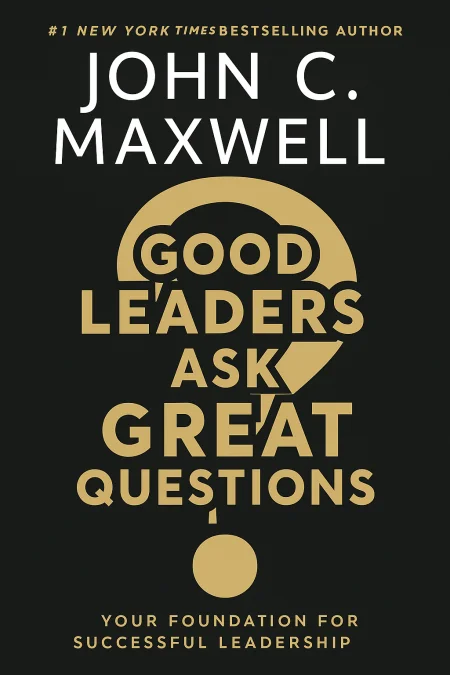
Good Leaders Ask Great Questions
Your Foundation for Successful Leadership
Book Edition Details
Summary
In the realm of leadership, it's not the answers but the questions that wield true power. John Maxwell, an undisputed authority on leadership, uncovers this profound truth in "Good Leaders Ask Great Questions." Through a tapestry of personal anecdotes and responses to seventy of the most insightful queries from leaders worldwide, Maxwell invites you to reshape your understanding of influence. What do you ask when motivation dwindles? How do you navigate leadership under trying circumstances? These are not just questions—they are catalysts for transformation. Whether you're climbing the first rungs of leadership or mastering the summit, Maxwell's wisdom will revolutionize your approach, illuminating the path to becoming not just a good leader, but a great one.
Introduction
Why do some leaders inspire unwavering loyalty while others struggle to gain basic compliance? The answer often lies not in what they know, but in what they ask. Leadership, at its core, is less about having all the answers and more about asking the right questions at the right moments. This approach transforms the traditional command-and-control model into a dynamic framework of inquiry, discovery, and collaborative growth. The art of strategic questioning represents a fundamental shift in leadership thinking. Rather than viewing leadership as a position of omniscience, this perspective positions leaders as master facilitators who unlock potential through carefully crafted inquiries. Questions become tools for building trust, fostering innovation, and developing others. They create space for authentic dialogue, reveal hidden assumptions, and guide teams toward breakthrough solutions. This inquiry-based leadership model addresses several critical challenges: how leaders can maintain influence without micromanaging, how they can develop others while achieving results, and how they can navigate complex decisions with wisdom rather than mere authority.
The Power of Questions in Leadership
Questions serve as the invisible architecture of effective leadership, creating frameworks for thinking that shape both individual and organizational outcomes. At its essence, strategic questioning represents a leadership methodology that prioritizes discovery over declaration, curiosity over certainty. This approach recognizes that the most powerful leaders are not those who provide all the answers, but those who ask questions that lead others to profound insights and breakthrough solutions. The questioning framework operates on multiple levels simultaneously. Surface-level questions gather information and clarify immediate concerns, while deeper inquiries challenge assumptions and reveal underlying patterns. The most transformative questions operate at the paradigm level, shifting how people fundamentally view problems and possibilities. This multi-layered approach creates a systematic method for accessing collective wisdom and fostering innovation within teams and organizations. Consider how great coaches operate in high-pressure moments. Rather than shouting instructions, they ask penetrating questions that help athletes discover solutions in real-time. A basketball coach might ask "What do you notice about their defense?" rather than dictating every play. This approach builds problem-solving capacity while maintaining engagement and ownership. The principle translates directly to organizational leadership, where questions become catalysts for employee empowerment and continuous improvement. The practical application of this framework extends beyond formal meetings into everyday interactions. Leaders who master strategic questioning create cultures of curiosity where innovation flourishes naturally. They understand that questions not only solve immediate problems but also develop the thinking capacity of their teams, creating sustainable competitive advantages through enhanced collective intelligence.
Self-Leadership Through Strategic Questioning
The foundation of external leadership effectiveness rests upon the leader's ability to engage in rigorous self-examination through systematic questioning. Self-leadership through strategic questioning represents an internal audit system that maintains leadership authenticity, drives personal growth, and ensures alignment between values and actions. This framework operates as a continuous feedback loop, enabling leaders to course-correct before external circumstances force adjustments. The self-questioning framework encompasses several critical dimensions that work in concert to create comprehensive self-awareness. Personal integrity questions examine the consistency between stated values and actual behaviors. Growth-oriented questions assess whether current activities contribute to long-term development. Effectiveness questions evaluate whether energy investments align with intended outcomes. Relationship questions probe the quality of connections with key stakeholders. Together, these inquiry categories create a holistic assessment system for leadership performance. The power of this approach becomes evident in crisis situations where external pressures intensify. Leaders who regularly engage in self-questioning possess internal compass systems that guide decision-making when circumstances become chaotic. Like pilots who conduct pre-flight checklists regardless of weather conditions, effective leaders maintain questioning disciplines that prepare them for unexpected challenges. This preparation creates the mental and emotional resilience necessary for sustained leadership effectiveness. Daily implementation of self-questioning rituals transforms this theoretical framework into practical leadership enhancement. Morning reflection questions set intentions and priorities. Midday check-ins assess progress and identify necessary adjustments. Evening reviews capture lessons and prepare for future improvements. This systematic approach ensures that self-leadership remains proactive rather than reactive, creating sustainable patterns of growth and effectiveness that compound over time.
Building Teams Through Effective Questions
Team development through strategic questioning represents a collaborative architecture that transforms groups of individuals into cohesive, high-performing units. This methodology recognizes that teams excel not because members share identical skills, but because they develop collective intelligence through structured inquiry processes. Effective questioning creates psychological safety while simultaneously challenging teams to exceed their perceived limitations. The team-building question framework operates through interconnected components that address different aspects of group dynamics. Discovery questions reveal individual strengths, motivations, and concerns, creating the foundation for mutual understanding. Alignment questions ensure that team members share common goals and understand their respective contributions. Challenge questions push the team beyond comfort zones while maintaining supportive relationships. Reflection questions capture learning and improve future performance. Real-world application of this framework can be observed in high-performing surgical teams where lives depend on flawless coordination. Rather than relying solely on hierarchical commands, effective surgical leaders use questions to ensure team readiness: "What concerns do you have about this procedure?" or "What have we learned from similar cases?" These inquiries create opportunities for team members to contribute critical information while maintaining the leader's ultimate responsibility for decisions. The questioning approach builds team capacity by developing each member's ability to think strategically about collective challenges. Unlike traditional team-building exercises that focus on artificial activities, question-based development addresses real work situations where teams must perform. This creates authentic relationships based on mutual respect and shared problem-solving experiences, resulting in sustainable team effectiveness that persists through changing circumstances and membership.
Developing Leaders by Asking the Right Questions
Leadership development through strategic questioning represents a mentoring methodology that cultivates leadership capacity rather than merely transferring leadership knowledge. This approach recognizes that leadership skills develop through guided discovery rather than passive instruction. Effective developmental questions create learning experiences that build confidence, enhance judgment, and expand leadership thinking patterns. The developmental questioning framework encompasses progressive stages that mirror natural learning processes. Foundation questions help emerging leaders understand their current capabilities and limitations. Exploration questions encourage experimentation with new approaches and perspectives. Challenge questions test decision-making abilities in increasingly complex situations. Integration questions help leaders synthesize experiences into coherent leadership philosophies. This progression ensures that leadership development occurs systematically rather than accidentally. The power of this methodology becomes apparent when contrasted with traditional training approaches that emphasize content delivery over capability development. Like master craftsmen who guide apprentices through increasingly sophisticated projects, developmental leaders use questions to create learning opportunities embedded within real work challenges. An experienced leader might ask a developing manager, "What would happen if we tried this approach?" rather than simply explaining what should be done. This creates ownership and builds problem-solving capacity. Implementation of developmental questioning requires patience and strategic thinking from mentoring leaders. The process involves identifying appropriate challenge levels, providing sufficient support during learning phases, and gradually increasing independence as capability grows. This approach produces leaders who think independently, make sound decisions under pressure, and continue developing throughout their careers. The investment in question-based development creates leadership pipelines that strengthen organizations over time.
Summary
Great leaders understand that questions are more powerful than answers because they unlock potential rather than merely providing information. The strategic use of inquiry creates leadership effectiveness that extends far beyond individual capability to encompass organizational transformation through collective intelligence and shared discovery. This questioning paradigm represents a fundamental evolution in leadership thinking that addresses the complexities of modern organizational life. By mastering the art of strategic questioning, leaders create sustainable competitive advantages through enhanced team capability, accelerated individual development, and improved decision-making processes. The long-term impact extends beyond immediate results to encompass cultural transformation that continues generating value long after specific leaders have moved on. For readers willing to embrace this approach, the potential exists to dramatically amplify leadership influence while simultaneously developing others to achieve similar impact.
Related Books
Download PDF & EPUB
To save this Black List summary for later, download the free PDF and EPUB. You can print it out, or read offline at your convenience.
By John C. Maxwell
