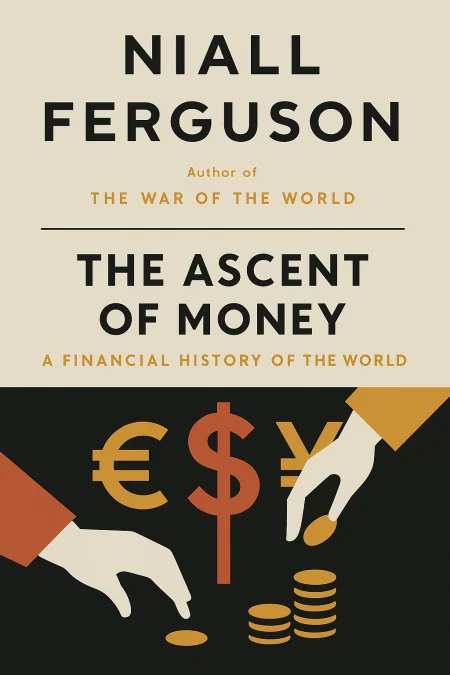
The Ascent of Money
A Financial History of the World
Book Edition Details
Summary
In the tapestry of human history, money is the golden thread that binds our past to our present, weaving stories of triumph and turmoil. "The Ascent of Money" by Niall Ferguson unravels this intricate narrative, tracing finance's evolution from ancient Mesopotamian markets to the modern-day maelstrom of Wall Street. Ferguson invites readers into the heart of financial history, where money morphs from mere currency into the backbone of civilization's progress. Through tales of banks, stocks, and hedge funds, he sheds light on finance's dual role as both architect of human achievement and harbinger of inequality. As the world reels from crises like the subprime mortgage debacle, Ferguson questions the free market's capacity to shield against disaster, making this not just a historical account but a pressing dialogue for our times.
Introduction
Picture this: a Spanish conquistador standing atop a mountain of pure silver in Bolivia, convinced he has found the key to eternal wealth, yet unknowingly setting in motion forces that would bankrupt his empire. Or imagine a Scottish gambler turned financier creating the world's first stock market bubble in 18th-century Paris, nearly bringing down the French monarchy in the process. These aren't tales from fantasy novels—they're pivotal moments in the extraordinary story of how money evolved from metal coins to the invisible digital transactions that power our modern world. This remarkable journey reveals how financial innovation has been the hidden engine behind humanity's greatest achievements and most spectacular failures. From the medieval Italian bankers who funded the Renaissance to the bond markets that determined the outcome of the Napoleonic Wars, from the insurance schemes that made global trade possible to the mortgage markets that both built and nearly destroyed the American dream, money has been far more than a mere medium of exchange. It has been a force that has shaped empires, toppled governments, and transformed the very fabric of human society. Understanding this history isn't just academic curiosity—it's essential survival knowledge for anyone navigating today's complex financial landscape. Whether you're a student trying to make sense of economic headlines, a professional seeking to understand market forces, or simply someone who wants to make smarter financial decisions, the patterns revealed in this historical journey offer invaluable insights into how money really works and where it might be heading next.
From Clay Tablets to Renaissance Banking (3000 BC-1600 AD)
The story of money begins not with gold or silver, but with clay tablets in ancient Mesopotamia, where merchants five thousand years ago recorded debts and credits in cuneiform script. These humble clay records, more durable than any precious metal, reveal a profound truth: money has always been about trust and relationships, not intrinsic value. When Spanish conquistadors discovered the silver mountain of Potosí in 1545, they thought they had found the ultimate source of wealth. Instead, they unleashed the world's first great inflation, as so much silver flooded European markets that prices rose dramatically across the continent. The real revolution came not from mining more metal, but from creating credit. In medieval Florence, the Medici family transformed themselves from small-time moneylenders into Europe's most powerful bankers by understanding that money could be created through careful bookkeeping and trust networks. They developed sophisticated techniques for foreign exchange, letters of credit, and international finance that allowed merchants to trade across vast distances without physically moving coins. Their success wasn't built on hoarding gold, but on facilitating the movement of money from where it was idle to where it was needed. The evolution accelerated in Renaissance Italy, where double-entry bookkeeping became the foundation of modern accounting. Venetian merchants created the first government bonds to finance their wars, essentially inventing the concept of public debt. This innovation would prove revolutionary—governments could now fund ambitious projects by borrowing against future tax revenues, dramatically expanding state power and capability. The Jewish quarter of Venice pioneered many lending practices still used today, while the Templars inadvertently became Europe's first international bankers during the Crusades. By 1600, these innovations had created a new class of merchant-bankers who wielded influence rivaling that of kings. The Fuggers of Augsburg financed emperors, while Italian banking houses established networks spanning from London to Constantinople. They had discovered fundamental principles that remain true today: the time value of money, the relationship between risk and return, and the power of compound interest to create vast fortunes over time.
Bonds, Bubbles and Market Revolution (1600-1914)
The 17th century witnessed the birth of modern financial markets, beginning with the Dutch East India Company's revolutionary decision to issue tradeable shares in 1602. Unlike earlier trading ventures that dissolved after each voyage, the VOC offered permanent shares that could be bought and sold, creating the template for modern capitalism. This democratization of investment transformed society, allowing ordinary citizens to own pieces of global enterprises and share in both profits and risks. The period's defining moment came with John Law's ambitious experiment in early 18th-century France. Law, a Scottish gambler turned economist, convinced the French government to back paper money with promises of riches from Louisiana. His Mississippi Company triggered history's first great stock market bubble, with shares soaring to astronomical heights before crashing spectacularly in 1720. Fortunes were made and lost overnight, and the French economy was left in ruins. Yet Law's experiment proved a crucial point: paper money could work, but only with careful management and public trust. England learned from France's mistakes, developing a more stable financial system centered on the Bank of England and government bonds called consols. These perpetual bonds, paying interest forever, became the bedrock of British public finance. They funded the wars against Napoleon, financed the Industrial Revolution, and underwrote the British Empire's global expansion. The Rothschild banking dynasty epitomized this era, using their international network and superior information systems to profit from government bonds across Europe. Nathan Rothschild's legendary coup during the Battle of Waterloo demonstrated how financial markets had become integral to national power. By 1914, the first great age of financial globalization had created an interconnected world economy. British capital flowed to every corner of the earth, building railways in Argentina, mines in South Africa, and plantations in Malaysia. The gold standard provided monetary stability, while stock exchanges allocated capital to the most promising enterprises. Yet this system also created new vulnerabilities, as the financial crisis triggered by Archduke Franz Ferdinand's assassination would dramatically demonstrate when stock markets worldwide closed for months.
Crisis, War and Financial Transformation (1914-1980s)
The guns of August 1914 shattered more than the peace of Europe—they destroyed the first era of financial globalization. Stock markets closed for months, international trade collapsed, and the gold standard crumbled under the pressures of total war. What had seemed like an unshakeable system of global finance evaporated almost overnight, replaced by government controls, currency restrictions, and economic nationalism. The interwar period brought financial chaos on an unprecedented scale. Germany's hyperinflation of 1923 wiped out the savings of millions, while the Wall Street Crash of 1929 triggered the Great Depression. The Federal Reserve's catastrophic monetary policy mistakes transformed a stock market correction into a decade-long economic nightmare, with unemployment reaching 25 percent and thousands of banks failing. These disasters discredited free-market finance and ushered in an era of government intervention that would last for decades. The Bretton Woods system, established in 1944, represented a conscious attempt to rebuild international finance on more stable foundations. Fixed exchange rates anchored to the dollar, capital controls to prevent destabilizing speculation, and new institutions like the International Monetary Fund promised to prevent another 1930s-style collapse. For nearly three decades, this system delivered unprecedented prosperity and stability, enabling the post-war economic boom while keeping financial markets on a tight leash. Yet Bretton Woods contained the seeds of its own destruction. As the United States ran increasing deficits to fund the Vietnam War and Great Society programs, the dollar's link to gold became unsustainable. When President Nixon severed this final connection in 1971, the world entered a new era of floating currencies and returning capital mobility. The oil shocks of the 1970s, combined with rising inflation and economic stagnation, demonstrated that government control of finance had its own limitations, setting the stage for the market revolution that would follow.
Global Finance and Modern Challenges (1980s-Present)
The 1980s witnessed finance's dramatic return to center stage, driven by technological revolution and ideological transformation. Computer networks enabled instantaneous global trading, while deregulation unleashed competitive forces that had been suppressed for decades. The rise of hedge funds demonstrated that private capital could challenge even the most powerful central banks, as George Soros proved when he "broke" the Bank of England in 1992, forcing Britain out of the European Exchange Rate Mechanism and earning himself a billion dollars in the process. Mathematical finance reached its zenith with Long-Term Capital Management, where Nobel Prize-winning economists created seemingly foolproof trading strategies based on complex formulas. Their spectacular collapse in 1998, requiring a Federal Reserve-orchestrated bailout, revealed the dangers of excessive leverage and overconfidence in mathematical models. The crisis foreshadowed larger problems to come, as financial innovation increasingly outpaced regulators' ability to understand and control new instruments. The new millennium brought the emergence of "Chimerica," an unprecedented symbiosis between Chinese savings and American consumption. China's export-driven growth model generated massive trade surpluses, which were recycled into US Treasury bonds, keeping American interest rates low and enabling a debt-fueled consumption boom. This relationship powered global growth but also created dangerous imbalances, as Americans borrowed against rising house prices while Chinese workers saved unprecedented portions of their income. The subprime mortgage crisis of 2007-2008 exposed the fragility of this new financial order. Complex securitization had spread mortgage risks throughout the global banking system, turning local housing problems into a worldwide crisis. The failure of Lehman Brothers and near-collapse of other major institutions required government interventions on a scale not seen since the 1930s. As central banks printed trillions of dollars to prevent financial meltdown, the crisis raised fundamental questions about whether the benefits of financial innovation outweighed its systemic risks, challenges that continue to shape policy debates today.
Summary
The ascent of money reveals a central paradox that has shaped human civilization for millennia: our perpetual struggle between the desire for financial security and the reality that innovation and growth require risk-taking and change. From the Spanish Empire's silver-induced inflation to the 2008 financial crisis, history repeatedly demonstrates that attempts to create perfect financial stability often sow the seeds of future instability. The most successful financial systems have been those that found ways to channel risk productively rather than eliminate it entirely. Three crucial lessons emerge from this financial history. First, trust and institutions matter more than technology or natural resources—the Medici succeeded not because they had more gold than their competitors, but because they built more reliable networks and better systems for managing information and risk. Second, financial innovation is a double-edged sword that can create tremendous prosperity but also spectacular crashes, requiring constant vigilance and adaptation from regulators and market participants. Third, the democratization of finance has generally increased prosperity but also spread financial risk more widely through society, making everyone stakeholders in the system's stability. Today's financial challenges, from cryptocurrency volatility to climate-related risks, are variations on ancient themes. The key to navigating them successfully lies not in seeking perfect security—an impossible goal—but in understanding how financial systems evolve, recognizing the warning signs of dangerous bubbles and imbalances, and maintaining the institutional frameworks that allow markets to function while protecting society from their worst excesses. The ascent of money continues, and our ability to learn from its history will determine whether future chapters bring greater prosperity or repeat the costly mistakes of the past.
Related Books
Download PDF & EPUB
To save this Black List summary for later, download the free PDF and EPUB. You can print it out, or read offline at your convenience.
By Niall Ferguson
