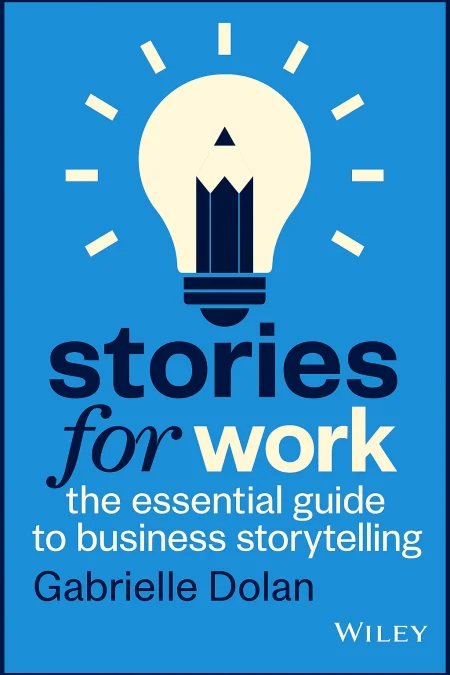
Stories for Work
The Essential Guide to Business Storytelling
Book Edition Details
Summary
In the bustling corridors of corporate life, where data reigns supreme and facts often fall flat, Gabrielle Dolan unveils an ancient yet revolutionary tool—storytelling. "Stories for Work" isn't just a guide; it's your passport to transforming mundane meetings into memorable moments. With insights drawn from a decade of coaching business titans, Dolan reveals the magnetic power of a well-crafted tale to sway decisions, win over clients, and inspire teams. This book shows you how to weave narratives that resonate with authenticity and purpose, creating a tapestry of personal stories tailored to pivotal business encounters. Discover how real-world leaders have harnessed this timeless art to redefine leadership and drive change. Whether you're navigating a career crossroads, courting a critical client, or guiding a team through transition, let your stories do the heavy lifting. Embrace the narrative edge—because in business, the best story wins.
Introduction
Merrin Butler found herself on a familiar Sunday night flight from Dublin to Glasgow, settled into her seat with a newspaper, completely ignoring the safety demonstration she had witnessed countless times before. The crew's routine gestures with oxygen masks and emergency exits had become white noise to this seasoned traveler. But that particular evening, turbulent weather forced the pilot to abort two landing attempts. Before the third and final attempt, an announcement crackled through the cabin: "We'll try one more time, but first, the crew will demonstrate our safety procedures again." Suddenly, every passenger sat bolt upright, asking detailed questions about life jackets and counting rows to exits. The same information that seemed irrelevant moments before had become precious knowledge when circumstances shifted. This transformation illustrates the profound difference between hearing information and truly absorbing it through emotional engagement. In our data-saturated business world, leaders struggle daily with the challenge Merrin's crew faced: how do we make critical messages resonate when audiences have heard it all before? The answer lies not in shouting louder or adding more facts, but in understanding the fundamental way human minds process and retain information. Stories possess an almost magical ability to bypass our mental filters and speak directly to both our rational and emotional centers. They create the conditions where learning becomes inevitable, where abstract concepts transform into lived understanding, and where audiences move from passive listening to active engagement. This book reveals the scientific foundations of storytelling's power while providing practical frameworks for business professionals who recognize that authentic connection has become the ultimate competitive advantage.
The Science Behind Stories: Why They Work
When neuroscientist Uri Hasson placed research participants in brain scanners and played them stories, something remarkable happened. As the narrative unfolded, the listeners' brain activity began to mirror that of the storyteller's brain, creating what Hasson termed "neural coupling." Areas responsible for processing language, emotion, and sensory experience lit up simultaneously across different individuals, regardless of whether they were hearing the story in English or Russian. Even months later, when participants retold the story to others, their brains recreated the same patterns of activation they had experienced as listeners. This phenomenon reveals why traditional business presentations often fail to create lasting impact. While bullet points and data charts engage only our analytical processing centers, stories activate multiple brain regions simultaneously. The auditory cortex processes the sounds and rhythm of speech, while language areas decode meaning. Meanwhile, sensory regions fire as if we were experiencing the events ourselves. When a speaker describes walking on a beach, our motor cortex activates as though we were taking those steps. When they mention a sharp sound, our auditory centers respond as if hearing it directly. Perhaps most significantly, stories trigger the release of powerful neurochemicals that influence both attention and connection. Moments of tension or conflict in narratives prompt our brains to produce cortisol, sharpening our focus and ensuring we remain engaged. Simultaneously, compelling characters and emotional resonance stimulate oxytocin production, often called the "trust hormone." This chemical cascade creates the neurological foundation for rapport and credibility between speaker and listener. The implications extend far beyond neuroscience laboratories into boardrooms and conference halls worldwide. Research by neuroeconomist Paul Zak demonstrated that character-driven stories with emotional arcs not only improve message comprehension but enhance recall weeks later. In his studies, participants who heard information embedded within stories showed significantly better retention compared to those who received the same facts through traditional presentation methods. The stories literally rewired their brains for remembering, creating neural pathways that pure information could never establish.
Finding and Crafting Your Business Stories
Sarah Mitchell, a senior operations manager, initially insisted she had no stories worth sharing in professional settings. Her life felt ordinary, filled with routine challenges that hardly seemed worthy of boardroom attention. However, during a storytelling workshop exercise, she reluctantly shared an incident about her daughter's forgotten school lunch. Racing through traffic to deliver the meal before the cafeteria closed, Sarah discovered her daughter had already solved the problem by trading her art supplies for half a sandwich with a classmate. That moment of resourcefulness and collaboration, initially dismissed as mundane parenting chaos, became a powerful metaphor for adaptive leadership and creative problem-solving within her team. This transformation illustrates how our most impactful business stories often hide in plain sight, camouflaged as everyday experiences. The key lies not in dramatic life events but in recognizing the universal patterns within personal moments that connect to professional truths. Effective business storytelling requires developing what might be called "story radar" - the ability to detect narrative potential in situations others might overlook. The most compelling professional stories typically fall into four archetypal categories, each serving distinct communication purposes. Triumph stories showcase moments of achievement or growth, whether personal victories or collaborative successes. These narratives build credibility and inspire action by demonstrating what becomes possible through persistence or innovation. Tragedy stories, counterintuitively, often create deeper connections by revealing vulnerability and learning from failure. They show audiences that setbacks are universal experiences that can lead to wisdom and resilience. Tension stories capture moments of internal conflict or difficult choices, revealing values in action rather than mere words. These narratives resonate powerfully because they acknowledge the complexity of real decision-making, where right and wrong rarely present themselves clearly. Finally, transition stories chronicle significant life changes, from career pivots to personal transformations, helping audiences navigate their own periods of uncertainty by seeing how others have successfully adapted to new circumstances. The art of story selection involves matching narrative type to communication objective while ensuring authentic personal connection to the events described. A leader seeking to motivate a team through challenging changes might draw from their transition stories, while someone building credibility in a new role might emphasize relevant triumphs. The magic happens when personal authenticity meets professional purpose, creating messages that inform minds while moving hearts toward action.
Stories in Action: Real Examples Across Industries
Marcus Chen, chief technology officer at a growing software company, faced a skeptical board questioning his proposed shift to cloud infrastructure. Rather than launching into technical specifications and cost projections, Marcus began with a different kind of story. He described his grandmother's restaurant in San Francisco's Chinatown, where she had insisted on keeping paper receipts and handwritten inventory logs long after computerized systems became standard. When a kitchen fire damaged her physical records, decades of customer information and supplier relationships vanished overnight. His grandmother's restaurant survived, but the recovery process took months of painstaking reconstruction. Marcus connected this personal tragedy to the company's current infrastructure risks, explaining how traditional on-premise servers created similar vulnerabilities to unexpected disasters. The cloud migration he proposed would distribute their data across multiple secure locations, ensuring business continuity regardless of local disruptions. Board members who had initially focused on upfront costs began asking questions about risk mitigation and long-term stability. The technical details that followed gained weight and urgency because the human story had created an emotional framework for understanding abstract concepts. This example demonstrates how stories function as bridges between complex technical realities and human understanding. In healthcare settings, Dr. Jennifer Park uses patient stories to help medical teams understand treatment protocols not just as clinical procedures but as interventions that transform lives. When training staff on new cardiac rehabilitation guidelines, she shares the journey of a 52-year-old teacher who returned to coaching soccer after following their program, emphasizing how attention to seemingly minor details in recovery protocols enabled major life victories. Sales professionals have discovered that product demonstrations become exponentially more powerful when embedded within customer success stories. Rather than listing software features, top performers describe specific challenges their clients faced and walk prospects through the problem-solving journey. They paint vivid pictures of late-night troubleshooting sessions, breakthrough moments when solutions clicked into place, and the relief of teams who could finally focus on strategic work instead of technical frustrations. The pattern emerges across industries and contexts: information becomes persuasive when wrapped in human experience, and abstract concepts gain clarity when illustrated through specific situations. Stories don't replace data and analysis but rather create the emotional and intellectual conditions where logical arguments can take root and flourish in listeners' minds and hearts.
Building a Storytelling Culture in Organizations
The transformation at Spark New Zealand began when CEO Simon Moutter realized that the company's cultural change initiative was producing employee surveys and strategy documents instead of genuine behavioral shifts. Despite months of communication campaigns about new values like "We listen" and "We're straight up," middle managers reported that these concepts remained abstract ideas rather than practical guidance for daily decisions. Moutter decided to experiment with a different approach: asking leaders at every level to share personal stories that illustrated what these values meant in their own lives. Amanda Jarvie, a manager in market development, volunteered to address "We listen" by sharing her experience with parenting teenagers. She described hearing rugby legend John Kirwan discuss his research on preventing teenage depression, where he learned that parents often demanded conversation on their own schedules while remaining unavailable when young people actually wanted to talk. Amanda connected this insight to customer service, suggesting that truly listening meant making themselves available when customers needed support, not just when it was convenient for business operations. The response surprised everyone involved. Employees began approaching Amanda weeks later, referencing her story and asking how they could apply similar listening principles in their own roles. Teams started sharing their own examples of values in action, creating an organic network of meaning that spread far beyond formal training sessions. Within months, "We listen" had evolved from a corporate slogan into a practical philosophy with dozens of real-world applications throughout the organization. This cultural shift illustrates how stories function as meaning-making tools that help abstract values become concrete behaviors. When leaders share personal examples of values in action, they provide templates that others can adapt to their own circumstances. The stories become seeds that grow into new stories, creating what organizational psychologists call a "narrative ecosystem" where shared meaning emerges through collective storytelling rather than top-down communication. Building such cultures requires intentional investment in developing storytelling capabilities across leadership ranks. Organizations that successfully embed narrative approaches typically provide training in story identification, construction, and delivery while creating multiple channels for story sharing. They recognize that authentic organizational storytelling cannot be scripted from corporate communications but must emerge from the genuine experiences of people throughout the enterprise, supported by skills and systems that help those stories reach the audiences who need to hear them.
Summary
The evidence is clear and compelling: in an age of information overload and shortened attention spans, stories have emerged as the most effective tool for creating understanding, building trust, and inspiring action in professional contexts. From neuroscience laboratories to corporate boardrooms, research consistently demonstrates that narrative communication engages multiple brain systems simultaneously, creating neural conditions where learning becomes inevitable and retention extends far beyond traditional presentation methods. Yet the true power of business storytelling lies not in its scientific validation but in its deeply human appeal to our fundamental need for connection and meaning. When leaders share authentic stories that link personal experience to professional insights, they create bridges between individual hearts and collective purposes. They transform abstract concepts into lived understanding and turn routine information into memorable wisdom that guides decision-making long after meetings end. The path forward requires courage to move beyond the safety of bullet points and data charts toward the vulnerability of personal narrative. It demands investment in developing storytelling skills while remaining grounded in authentic experience rather than manufactured messaging. Most importantly, it calls for recognition that in our hyperconnected yet increasingly impersonal business world, the leaders who will thrive are those who remember that behind every spreadsheet and strategy document are human beings seeking not just information but inspiration, not just direction but connection to something larger than themselves. Through stories, we don't just communicate more effectively; we create the conditions where transformation becomes possible and where businesses become communities united by shared understanding and common purpose.
Related Books
Download PDF & EPUB
To save this Black List summary for later, download the free PDF and EPUB. You can print it out, or read offline at your convenience.
By Gabrielle Dolan
