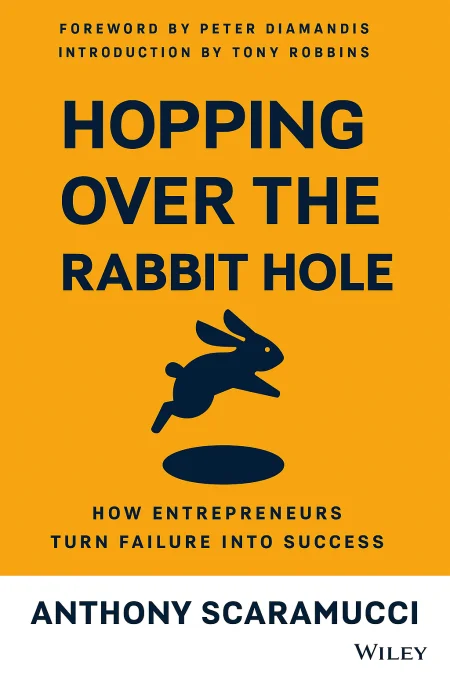
Hopping over the Rabbit Hole
How Entrepreneurs Turn Failure into Success
byAnthony Scaramucci, Peter Diamandis, Tony Robbins
Book Edition Details
Summary
Strap in for a wild ride through the ever-turbulent seas of entrepreneurship with Anthony Scaramucci's bold manifesto, "Hopping over the Rabbit Hole." This isn't just another tale of triumph; it's a raw, unvarnished journey through the chaos of building a business, where the only constant is uncertainty. Forget the glossy facade of overnight success stories—Scaramucci delivers the gritty truth about failure, resilience, and the relentless pursuit of excellence. Armed with lessons hard-won from his own meteoric rise, fall, and rebirth, he equips you with the mindset to transform setbacks into stepping stones. Discover how to pivot with precision, plan for the unpredictable, and harness adversity as your most potent tool. Whether you're an aspiring mogul or a seasoned veteran, this book is your indispensable guide to thriving amidst the whirlwind of modern business.
Introduction
Picture this: you're standing at the edge of what feels like a bottomless pit, watching everything you've built crumble before your eyes. Your business is failing, clients are fleeing, and everyone around you seems to be whispering about your imminent demise. This is the moment when most entrepreneurs give up, retreat, and accept defeat. But what if, instead of falling into that rabbit hole, you could hop over it entirely? The financial crisis of 2008 became the ultimate test for countless business leaders, separating those who would succumb to circumstances from those who would rise above them. In that crucible of economic chaos, some discovered that their greatest failures could become the foundation for their most spectacular successes. This isn't a story about avoiding mistakes or playing it safe. It's about embracing the inevitable setbacks, learning to dance with uncertainty, and developing the resilience to transform crisis into opportunity. Through this journey, you'll discover how to reframe failure as feedback, turn rejection into redirection, and build the kind of authentic relationships that sustain both personal fulfillment and business success. You'll learn why the most successful entrepreneurs don't fear the rabbit hole but instead develop the skills to leap over it, again and again, with growing confidence and wisdom.
The SALT Conference: Betting Big During Crisis
The ballroom at the Encore Hotel buzzed with nervous energy as Steve Wynn took the stage in May 2009. The financial world was still reeling from the collapse of Lehman Brothers, and Las Vegas itself had become a symbol of economic devastation. Yet here stood Wynn, introducing a hedge fund conference that, by all conventional wisdom, should never have existed. "I want to thank my good friend Andy for putting this conference together," Wynn announced to the packed room, mistaking Anthony Scaramucci's name in front of 500 industry leaders. The name mix-up was embarrassing, but it paled in comparison to the audacity of what was actually happening. Just two months earlier, SkyBridge Capital was on the verge of collapse. Redemptions were flooding in, the markets had hit rock bottom, and the firm was perhaps two phone calls away from shutting down entirely. It was then that Victor Oviedo approached his business partner with what seemed like an insane proposition: throw a hedge fund conference in Las Vegas during the worst financial crisis in seventy years. The idea was so contrarian, so seemingly reckless, that even SkyBridge's own partners voted against it five to two. But sometimes the most desperate moments demand the most audacious responses. Against all odds and conventional wisdom, they pressed forward. The inaugural SALT Conference became a beacon of hope in an industry shrouded in despair. By bringing together thought leaders, investors, and visionaries when everyone else was hiding, SkyBridge sent a powerful message: they weren't just surviving the crisis, they were betting on recovery. The conference succeeded not despite the terrible timing, but because of it. In a world full of fear and uncertainty, people craved optimism and connection more than ever. The lesson here cuts to the heart of entrepreneurial thinking: when everyone else is retreating, that's precisely when bold action can yield the greatest rewards. The most successful business leaders don't wait for perfect conditions. They create their own opportunities, often in the most unlikely circumstances. By choosing offense over defense, hope over fear, SkyBridge transformed what could have been their final chapter into the opening scene of their greatest success story.
From Goldman Sachs to Entrepreneur: Learning from Setbacks
The words hit like a physical blow: "We're letting go of about thirty-five people, and you are one of them." Mike Fascitelli delivered the news with characteristic directness, sitting in his West Village apartment while a Chicago Bulls game played in the background. It was 1991, and Anthony Scaramucci's first stint at Goldman Sachs was about to end abruptly. The real estate market was struggling, the economy was in recession, and as Fascitelli explained with brutal honesty, "I don't think you are particularly good at what you do." The conversation that followed became a masterclass in how to receive devastating feedback. Fascitelli introduced the concept of SARAH - Shock, Anger, Rejection, Acceptance, Help - explaining that this was the natural progression people experience when facing traumatic news. Rather than lashing out or making excuses, Scaramucci listened, processed, and ultimately accepted the hard truth: he lacked the technical skills for investment banking and wasn't the right fit for the role. What happened next illustrates the profound difference between those who recover from setbacks and those who don't. Instead of harboring resentment or playing the victim, Scaramucci handled his termination with grace and dignity. He showed up to work the next day to transition his responsibilities, maintained professionalism with colleagues who avoided eye contact, and resisted the temptation to burn bridges on his way out. This mature response didn't go unnoticed by Goldman's leadership. Years later, that same grace under pressure became his ticket back to the firm in a different role - one that better matched his natural talents for relationship building and sales. The experience taught him that setbacks aren't verdicts on your worth as a person, but rather information about fit and timing. The most successful entrepreneurs learn to separate their identity from their current circumstances, treating failure as feedback rather than a final judgment. They understand that today's rejection might be tomorrow's redirection toward something even better.
Building Teams and Partnerships: The Power of Trust
When Victor Oviedo walked into that job interview, he had no idea he was about to receive the most unconventional job description of his career. Anthony Scaramucci picked up a pen and drew what he called SkyBridge's version of the J-curve - but instead of the traditional private equity model showing initial losses followed by gains, this version included a stick figure at the bottom of a funnel. "You see, the 'J' is here, and this guy is right below it," Scaramucci explained, drawing the unfortunate figure. "All the garbage flows to the bottom of this 'J' into this little funnel, right into this guy's mouth. This guy literally swallows all this crap, and when he's not eating garbage, he's chomping on broken glass." The message was clear: startup life meant taking on every unglamorous task imaginable. Victor would be the low person on the totem pole, handling whatever needed to be done without complaint. Most candidates would have run screaming from such brutal honesty. But Victor's response was immediate and enthusiastic: "I can do that. When do I start?" His willingness to embrace the reality of startup life, combined with his previous entrepreneurial failure, made him exactly the kind of partner Scaramucci was seeking. This story illustrates a fundamental truth about building successful partnerships: transparency beats polish every time. Rather than sugar-coating the challenges ahead, Scaramucci laid out the harsh realities upfront. This approach accomplished two critical things: it set proper expectations and it attracted the right kind of person - someone who valued opportunity over comfort and was motivated by the chance to build something meaningful rather than collect a steady paycheck. The strongest business partnerships aren't built on shared success alone, but on mutual trust forged through difficult times. Victor eventually became a full partner at SkyBridge, not because the path was easy, but because both partners understood from day one what they were signing up for. True partnership requires people who are willing to subordinate their egos for the greater good, who can handle uncertainty, and who find energy in shared challenges rather than individual recognition. When you find such people, treasure them - they're the difference between a job and a calling.
Authentic Leadership: Marketing Without Selling Your Soul
The conversation at Del Frisco's seemed casual enough - a chance encounter at the bar with two Smith Barney executives while waiting for dinner guests. But when Anthony Scaramucci mentioned his interest in acquiring Citigroup's hedge fund business, that impromptu chat set in motion one of the most audacious deals in financial services history. Within days, he found himself in a conference room overlooking Madison Square Garden, facing executives who delivered shocking news: they wouldn't sell just the seeding business he wanted. It was all or nothing - the entire alternative investments unit. The magnitude of what they were offering was staggering. SkyBridge was a small seeding firm managing just over a billion dollars, and here was an opportunity to acquire Citigroup's $4.2 billion alternative investments business. It was, in Scaramucci's words, "a canary eating an elephant." By any rational measure, they shouldn't have been able to pull it off. But they had one crucial advantage: authenticity. While competitors took a hammer-and-chisel approach, trying to extract maximum value and dictate terms, SkyBridge focused on creating a genuine partnership. The key to winning the deal wasn't financial engineering or aggressive negotiation tactics. Instead, it was understanding what Citigroup truly needed: someone who would take care of their clients, preserve jobs for their employees, maintain performance continuity, and honor existing relationships. SkyBridge's willingness to structure the deal as a partnership rather than an acquisition, and their commitment to treating Citi's team as equity partners rather than employees, demonstrated something rare in business: authentic concern for all stakeholders. This approach reflects a deeper philosophy about sustainable success. The most enduring business relationships aren't built on zero-sum thinking but on creating value for everyone involved. When you lead with authenticity rather than artifice, when you prioritize long-term relationships over short-term gains, you attract partners who share those values. The result isn't just better deals - it's a business built on trust, loyalty, and mutual respect that can weather any storm.
Summary
The ultimate lesson of entrepreneurial resilience can be captured in one powerful truth: your greatest failures contain the seeds of your most extraordinary successes, but only if you're brave enough to plant them in new soil rather than mourn what might have been. Take immediate action by reframing your current challenges as opportunities for reinvention rather than obstacles to endure. When facing setbacks, ask yourself not "Why is this happening to me?" but "What is this teaching me about where I need to pivot?" Build relationships based on radical transparency and mutual value creation, remembering that authentic connections forged during difficult times become your strongest assets during good times. Finally, resist the temptation to play it safe when circumstances demand boldness - the moments when conventional wisdom says to retreat are often precisely when contrarian action yields the greatest rewards. Remember that every successful entrepreneur has stood at the edge of their own rabbit hole, convinced that the fall would be fatal. The difference between those who thrive and those who merely survive isn't the absence of failure, but the presence of resilience, authenticity, and the wisdom to see crisis as the birthplace of opportunity.
Related Books
Download PDF & EPUB
To save this Black List summary for later, download the free PDF and EPUB. You can print it out, or read offline at your convenience.
By Anthony Scaramucci
