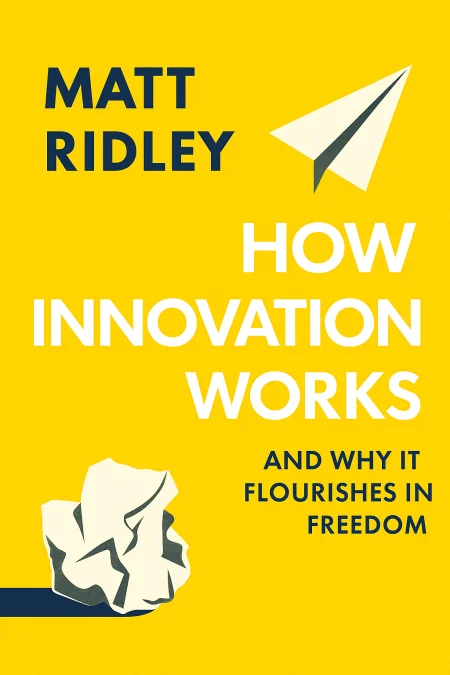
How Innovation Works
And Why It Flourishes in Freedom
Book Edition Details
Summary
In "How Innovation Works," Matt Ridley unravels the enigmatic tapestry of human progress, painting a vivid picture of innovation as a serendipitous, grassroots phenomenon. Unlike the traditional narratives of top-down genius, Ridley reveals a world where breakthroughs emerge from the fertile ground of human exchange and collaboration. This is not a tale of solitary inventors but of collective triumphs and missteps that define our era. From the steam engine to social media, each story unfolds like a chapter in a grand saga, showing how these innovations have shaped, and continue to shape, our lives. Ridley warns of an impending innovation drought, urging us to understand this dynamic process better, lest we stifle the very creativity that propels us forward. A must-read for anyone intrigued by the alchemy of ideas transforming into reality.
Introduction
Picture a moment twelve thousand years ago when a woman in the fertile crescent first noticed that scattered grain seeds had sprouted near her camp, leading her to experiment with deliberate planting. Fast forward to 1712, when Thomas Newcomen's steam engine began pumping water from English coal mines, unknowingly launching the Industrial Revolution. Jump to 1969, when two computers first connected across a network that would become the internet. These seemingly disconnected moments reveal a profound truth about human progress: innovation follows surprisingly predictable patterns, even as its specific outcomes remain wonderfully unpredictable. This exploration traces the hidden mechanics of how breakthrough ideas actually emerge, spread, and transform civilizations. You'll discover why the agricultural revolution happened simultaneously across multiple continents, how the telegraph created our first global information network, and why Silicon Valley became innovation's epicenter. The story challenges popular myths about lone geniuses having eureka moments, revealing instead that transformative change emerges through gradual, collaborative processes of trial, error, and unexpected connections. Whether you're curious about historical mysteries, seeking to understand how technological change really works, or looking for insights into fostering creativity and progress, these stories illuminate the surprisingly consistent forces that drive human advancement. From ancient fire-making to artificial intelligence, the same fundamental patterns repeat across millennia, offering both fascinating historical insights and practical wisdom for navigating our rapidly changing world.
Ancient Foundations: Fire, Agriculture, and Early Networks (12000 BC - 1700 AD)
The earliest innovations emerged not from desperation but from abundance, challenging our assumptions about necessity driving invention. As the last ice age ended around 12,000 years ago, rising temperatures and carbon dioxide levels created unprecedented opportunities for human experimentation. In the fertile valleys of Mesopotamia, the highlands of New Guinea, and the river systems of China, people independently discovered how to cultivate wild grasses and domesticate animals, launching the agricultural revolution that would define civilization. This transformation wasn't a sudden breakthrough but a gradual process unfolding over millennia. Archaeological evidence reveals that the most innovative early societies shared crucial characteristics: access to diverse resources, stable climates, and extensive trade networks that allowed ideas to flow freely between communities. The same pattern that would later drive Renaissance innovation in Italian city-states was already at work, prosperity and exchange creating conditions where experimentation could flourish. These ancient innovations demonstrate how technological change reshapes human biology and society in unexpected ways. The adoption of dairy farming led to genetic mutations allowing lactose tolerance in adults. The control of fire enabled smaller digestive systems and larger brains. The development of written language transformed how knowledge could be preserved and transmitted across generations. Innovation doesn't just change our tools; it changes us, creating feedback loops that accelerate further technological and social transformation. The rise of early civilizations in Mesopotamia, Egypt, and the Indus Valley reveals innovation's dependence on networks and specialization. As agricultural surpluses freed some people from food production, societies could support craftsmen, traders, and thinkers who pushed the boundaries of human knowledge. The invention of the wheel, the development of metallurgy, and the creation of mathematical systems all emerged from these early innovation ecosystems, establishing patterns that would repeat throughout history as each wave of technological change created new possibilities for human organization and achievement.
Industrial Revolution: Steam Power and Mass Production Transform Society (1700-1900)
The transformation that began in eighteenth-century Britain marked humanity's first systematic conversion of heat into work, unleashing forces that would reshape every aspect of human existence. Thomas Newcomen's steam engine of 1712 exemplifies how innovation actually works, building on earlier experiments by Denis Papin and Thomas Savery through patient problem-solving rather than brilliant insight. His breakthrough came from the fortunate accident of a leaking cylinder that revealed the power of rapid steam condensation, demonstrating innovation's dependence on trial, error, and unexpected discoveries. Within decades, James Watt's improvements made steam engines efficient enough to power factories, while George Stephenson's locomotives conquered distance itself. These developments shared crucial characteristics that would define successful innovation throughout history: they emerged from networks of competing inventors and entrepreneurs, thrived in regions with good transportation and communication links, and succeeded by making previously expensive capabilities affordable for ordinary people. The pattern established in Britain's coal-rich valleys would repeat across continents as industrialization spread. The electrical revolution followed similar patterns of gradual development and cross-pollination of ideas. Thomas Edison's famous light bulb was actually invented by at least twenty-one different people, but Edison succeeded by treating innovation as a systematic business process. His Menlo Park laboratory employed teams of craftsmen and scientists in what he called "the invention business," emphasizing organized experimentation over individual genius. This approach revealed that innovation required not just clever ideas but the organizational capacity to test, refine, and scale those ideas for mass adoption. By 1900, steam power and electricity had created the first truly industrial civilization, with factories, railroads, and telegraph networks connecting previously isolated communities into integrated economic systems. This transformation established the template for all subsequent technological revolutions: gradual accumulation of improvements reaching a tipping point, fierce competition between alternative approaches, initial resistance from established interests, and ultimately widespread adoption that made the previous way of life seem primitive and quaint.
Electric Age: Telegraph, Radio, and Communication Revolution (1840-1950)
The 1840s marked humanity's first conquest of distance through electronic communication, beginning with Samuel Morse's electromagnetic telegraph system. After years of struggling with bankruptcy and ridicule, Morse finally transmitted his famous message "What hath God wrought?" from Baltimore to Washington in May 1844, launching the information age. Within a decade, 42,000 miles of wire crisscrossed America, while submarine cables began linking continents, creating the first truly global information network that could transmit news from London to New York in minutes rather than weeks. The telegraph's impact revealed patterns that would repeat throughout communication technology history. Initial utopian hopes promised that instant communication would end wars and unite humanity, just as similar claims would later be made about the internet. The technology faced fierce resistance from established interests, required massive infrastructure investment, and sparked bitter patent disputes that consumed inventors' lives and fortunes. Yet once the network effects took hold, adoption became explosive, making life without telegraphic communication unimaginable within a generation. Guglielmo Marconi's wireless experiments in the 1890s built upon the telegraph's foundation while eliminating the need for physical wires. Unlike most inventors of his era, Marconi combined scientific knowledge with business acumen and social connections, quickly recognizing that wireless communication could revolutionize maritime safety and global commerce. His first successful transmission across the Atlantic in 1901 demonstrated that innovation often succeeds through strategic partnerships and practical applications rather than pure technical superiority. Radio's development into mass media by the 1920s revealed both the promise and peril of broadcast technology. The medium could educate and entertain through programming like the BBC's educational broadcasts, but also manipulate and polarize through propaganda like Nazi Germany's systematic use of radio for political control. These lessons proved prophetic as later innovations from television to social media grappled with similar challenges of balancing free expression with social responsibility, showing that each new communication technology forces society to confront fundamental questions about truth, power, and human nature.
Digital Era: Computing Networks Reshape Human Connection (1940-Present)
The computer revolution emerged through the convergence of wartime necessity, mathematical theory, and engineering ingenuity rather than any single breakthrough moment. The massive ENIAC, weighing thirty tons and filling an entire room, became operational in 1945 through collaboration between John Mauchly, Presper Eckert, and Herman Goldstine. Yet this machine represented merely one milestone in a gradual evolution stretching from Charles Babbage's mechanical calculators to Alan Turing's theoretical work on universal computation, demonstrating innovation's fundamentally collaborative nature. Gordon Moore's 1965 observation that computing power doubled roughly every two years while costs halved became both prediction and prescription, driving five decades of relentless semiconductor improvement. This created unique conditions where innovation became routine and expected, with each generation of technology automatically cheaper and more powerful than the last. The result was an explosion of applications nobody had foreseen: personal computers democratizing information processing, the internet connecting isolated machines into a global network, and mobile phones putting supercomputer power into billions of pockets. Silicon Valley emerged as innovation's epicenter through a unique ecosystem of universities, venture capital, and entrepreneurial culture rather than government planning. The region's success stemmed from its tolerance for failure, rapid information sharing, and willingness to cannibalize existing products for better ones. Companies like Intel, Apple, and Microsoft didn't just create new technologies; they created new ways of thinking about innovation itself, establishing the template for digital disruption through exponential improvement, network effects, and constant creative destruction. The rise of search engines and social media in the 2000s revealed innovation's unpredictable nature and unintended consequences. Google began as an academic project to catalog web links, not to create the world's most valuable advertising platform. Facebook started as a college networking site, not as a global communication system influencing elections and social movements. These platforms succeeded by solving immediate practical problems, only later revealing their transformative potential for commerce, politics, and human relationships, while also creating new challenges around privacy, misinformation, and social polarization that society continues to grapple with today.
Summary
The history of innovation reveals a fundamental paradox that transcends specific technologies and time periods: the most transformative changes in human civilization follow surprisingly consistent patterns, yet their timing and consequences remain largely unpredictable. From the gradual adoption of agriculture to the explosive growth of digital networks, successful innovations share common characteristics including emergence through collaborative processes rather than individual genius, dependence on favorable conditions of prosperity and open exchange, and success through solving practical human problems rather than pursuing technological sophistication for its own sake. Innovation thrives in environments that combine intellectual freedom, competitive markets, tolerance for failure, and rapid information sharing, whether in ancient Mesopotamian trading centers, Renaissance Italian city-states, or modern Silicon Valley. It struggles under excessive regulation, monopolistic control, risk aversion, and the precautionary principle applied too broadly. The central challenge for any society seeking to foster beneficial innovation is maintaining the delicate balance between enabling experimentation and managing the disruptive effects of technological change on existing institutions and social structures. Looking forward, the countries and regions that best balance innovation's risks with its rewards will likely dominate the next phase of human progress. This means preserving the conditions that allow experimentation to flourish: protecting intellectual property without stifling competition, supporting useful failure alongside spectacular success, and maintaining openness to ideas from unexpected sources. Most importantly, we must remember that innovation is ultimately about human flourishing rather than technological advancement for its own sake, ensuring that the innovations we pursue and adopt genuinely improve people's lives while creating the foundation for continued progress across generations.
Related Books
Download PDF & EPUB
To save this Black List summary for later, download the free PDF and EPUB. You can print it out, or read offline at your convenience.
By Matt Ridley
