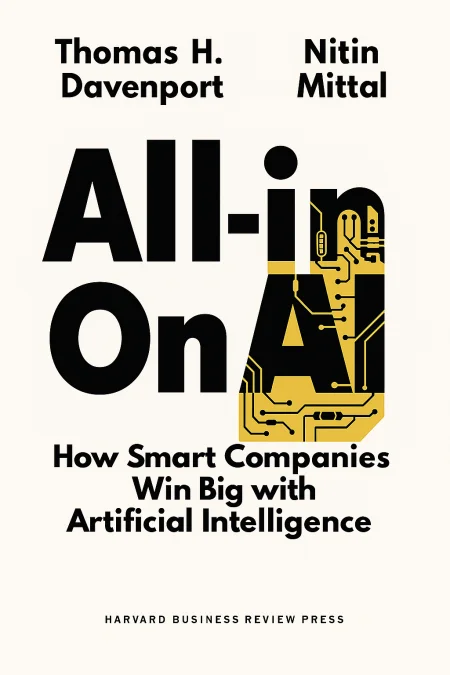
All-in On AI
How Smart Companies Win Big with Artificial Intelligence
byThomas H. Davenport, Nitin Mittal
Book Edition Details
Summary
In a world where the pace of technological innovation can feel overwhelming, "All-In on AI" reveals a select group of trailblazing companies that have mastered the art of integrating artificial intelligence into the very fabric of their operations. Authored by business thought leaders Tom Davenport and Nitin Mittal, this compelling narrative ventures beyond mere speculation, offering an insider's glimpse into firms like Anthem and Capital One that have harnessed AI to achieve remarkable success. Here, you'll uncover the strategic blueprints that separate the frontrunners from the pack—those who have quadrupled their stock market performance. With vivid case studies and actionable insights, this book is an indispensable guide for leaders eager to transform their organizations into AI-driven powerhouses. Whether you're a seasoned executive or a curious innovator, "All-In on AI" delivers the keys to revolutionizing your business landscape through the lens of artificial intelligence.
Introduction
In the quiet corridors of a Singapore bank once mockingly called "Damn Bloody Slow," CEO Piyush Gupta faced a daunting reality. His institution ranked dead last in customer service among local banks. Traditional approaches weren't working, and digital natives were reshaping entire industries overnight. Yet within five years, this same bank would earn recognition as the World's Best Digital Bank, processing millions of transactions with unprecedented efficiency while delivering personalized experiences that delighted customers across Asia. This transformation wasn't magic—it was the methodical application of artificial intelligence at every level of the organization. While many companies dabble with AI pilots that never see production, a select few have made the bold decision to become truly AI-fueled. They don't just use AI; they reimagine their entire business around the partnership between human intelligence and machine capability. These organizations represent less than one percent of large companies today, yet they're quietly redefining what's possible in their industries. From mortgage originators processing loans in minutes instead of weeks, to insurance companies preventing accidents before they happen, to manufacturers predicting equipment failures months in advance—these pioneers are writing the playbook for the AI-powered future. The journey isn't without challenges, but the rewards are transformational. Companies that successfully integrate AI throughout their operations don't just improve efficiency—they unlock entirely new ways of creating value, serving customers, and competing in an increasingly complex world.
Building AI-Powered Organizations: Leadership and Culture
At DBS Bank, the transformation began with an uncomfortable truth. Despite Singapore's reputation for efficiency, the bank's early AI experiments in 2013 failed spectacularly. CEO Piyush Gupta had signed up for an AI lab partnership, assembled teams of data scientists, and launched six promising projects. Not one succeeded. Yet rather than retreating, Gupta saw these failures as essential learning experiences—"signaling tools" that would teach his organization how to think differently about technology and change. Gupta made an unusual decision for a banking CEO: he personally led the bank's data transformation. Drawing on his background at Citigroup, where he'd helped create some of the industry's first data centers, he guided DBS through a massive overhaul of its data architecture. The bank moved from traditional data warehouses to more flexible data lakes, cleaned up eighty million incomplete records, and established new governance protocols. More importantly, Gupta opened his budget to experimentation, giving business units freedom to hire their own data scientists and explore AI applications. The HR team, despite having no technical background, developed an AI system to predict employee attrition and automate recruitment for high-volume roles. To demystify AI for his workforce, Gupta introduced creative learning initiatives. When an employee suggested using Amazon's DeepRacer League—an autonomous race car simulation game—to teach machine learning, Gupta embraced it enthusiastically. Soon three thousand employees were participating, with Gupta himself competing and proudly finishing in the top hundred. This wasn't just about technical skills; it was about changing the culture from one that feared AI to one that embraced it as a collaborative partner. The transformation at DBS reveals a fundamental truth: becoming AI-powered isn't primarily a technology challenge—it's a human one. Success requires leaders who understand that AI amplifies human capability rather than replacing it, who invest in cultural change as much as technical infrastructure, and who create environments where experimentation and learning from failure become organizational strengths. When leadership commitment combines with cultural readiness, AI becomes not just a tool but a new way of thinking and working together.
Strategic Transformation: From Operations to Ecosystems
When Peter Ma Mingzhe founded Ping An as a small insurance company in 1988, few could have imagined it would become a $200 billion ecosystem spanning financial services, healthcare, automotive services, and smart cities. The transformation didn't happen by accident—it was the deliberate result of using AI to create entirely new business models that transcended traditional industry boundaries. Ping An's healthcare ecosystem illustrates this strategic evolution. Rather than simply paying medical claims after people got sick, the company used AI to connect patients, doctors, hospitals, pharmacies, and insurers in a unified platform. Their AI systems now assist physicians in diagnosing over two thousand diseases, reducing diagnosis time from fifteen minutes to fifteen seconds. The platform serves four hundred million users through 46,500 external doctors and partnerships with 189,000 pharmacies. But the real genius lies in how this generates a "deep ocean of data"—every consultation, prescription, and treatment creates insights that improve the AI models, which in turn attract more participants to the ecosystem. Similarly, Airbus transformed from an aircraft manufacturer into a platform orchestrator through its Skywise initiative. By 2021, over 140 airlines had connected more than 9,500 aircraft to share operational data in real-time. This collaboration enables predictive maintenance across entire fleets, helping airlines prevent equipment failures before they cause costly delays or safety issues. Airbus evolved from selling planes to selling intelligence about how to operate them more effectively. The strategic insight these companies discovered is profound: AI doesn't just make existing operations more efficient—it enables entirely new ways of creating and capturing value. When organizations use AI to connect multiple participants in shared value creation, they move beyond traditional competition to orchestrate ecosystems where everyone benefits. This represents a fundamental shift from optimizing individual transactions to designing collaborative platforms that become more valuable as they grow. The companies that master this transition don't just survive digital disruption—they lead it.
Technology Foundations and Ethical Implementation
At Shell, the challenge of implementing AI at scale seemed overwhelming. With hundreds of thousands of pieces of equipment requiring maintenance across global facilities, the energy giant needed more than a small team of data scientists. Their solution was revolutionary: train thousands of engineers who already understood the equipment to become citizen data scientists capable of building and maintaining their own predictive maintenance models. Dan Jeavons, Shell's head of digital innovation, partnered with Udacity to create custom AI training programs. Soon, over five thousand employees were learning machine learning techniques, with engineers developing models to predict when compressors, pumps, and control valves would need attention. The company built a massive data platform storing 1.9 trillion rows of operational data, accessible through automated machine learning tools that allowed engineers to create sophisticated predictive models without deep programming expertise. Today, Shell monitors over ten thousand pieces of equipment daily, with the number growing by hundreds each week. The technical architecture supporting this transformation was equally impressive. Shell partnered with Microsoft for cloud infrastructure, used Databricks for data storage, and implemented machine learning operations (MLOps) tools to automatically retrain models as conditions changed. Engineers could share code and algorithms across the organization, deploy solutions rapidly, and maintain model performance over time. This wasn't just about technology—it was about creating a new way of working where domain expertise combined seamlessly with AI capabilities. Yet with great power comes great responsibility. As companies like Shell push the boundaries of AI implementation, questions of ethics and accountability become paramount. The same technologies that optimize operations can also introduce bias, invade privacy, or make decisions that affect human lives. Organizations must build governance frameworks that ensure AI systems remain trustworthy, explainable, and aligned with human values. The future belongs to companies that can harness AI's transformative power while maintaining the trust and confidence of employees, customers, and society. This balance between innovation and responsibility will define the next chapter of the AI revolution.
Industry Applications and the Path Forward
Capital One began as a bold experiment in "information-based strategy" when it spun off from Signet Bank in 1994. Founders Rich Fairbank and Nigel Morris believed that data and analytics could revolutionize credit card lending, making it more precise, profitable, and customer-friendly. Nearly three decades later, their vision has evolved into something far more ambitious: transforming every aspect of banking through real-time AI-powered decision making. The bank's journey from analytics to AI illustrates how companies can build systematically on existing capabilities. Capital One didn't abandon its analytical foundations—it supercharged them with machine learning that could process streaming data from web transactions, mobile apps, ATMs, and card purchases in real-time. Today, the bank uses AI to predict whether customers will call the call center and what problems they'll want to solve, detect fraudulent transactions in milliseconds, create personalized rewards offers, and even help customers improve their financial lives through intelligent insights. The transformation required more than new algorithms. Capital One closed its last data center in 2020, moving entirely to Amazon Web Services to gain the scale and flexibility needed for AI at speed. The bank developed machine learning platforms that standardize how thousands of models are built, deployed, and maintained across the organization. Most importantly, it invested heavily in talent, hiring thousands of machine learning engineers and creating career paths that attract top AI experts from technology companies. Capital One's evolution from a data-driven bank to an AI-fueled financial services company represents a broader pattern emerging across industries. Whether it's retailers using AI to personalize every customer interaction, manufacturers predicting equipment failures before they occur, or healthcare systems identifying patients at risk of serious complications, the companies thriving in the digital age are those that view AI not as a project or pilot program, but as a fundamental capability that transforms how they create value. The path forward requires courage to reimagine core business processes, commitment to invest in both technology and talent, and the wisdom to maintain human judgment and values while unleashing the power of artificial intelligence.
Summary
The journey from traditional business operations to AI-fueled transformation is neither simple nor certain, yet the companies that embrace this path discover something remarkable: AI doesn't diminish human capability—it amplifies it. From DBS Bank's cultural revolution to Ping An's ecosystem innovation, from Shell's democratization of data science to Capital One's real-time intelligence, these organizations prove that the future belongs to those who view AI as a collaborative partner rather than a replacement for human judgment. The most profound insight from these transformations is that becoming AI-fueled requires simultaneous evolution across multiple dimensions: leadership that champions experimentation and learning from failure, cultures that embrace collaboration between humans and machines, strategies that transcend traditional industry boundaries, and technological foundations that enable continuous innovation while maintaining ethical standards. Success isn't measured merely by efficiency gains or cost reductions, but by the ability to create entirely new forms of value that serve customers, employees, and society. For organizations standing at this crossroads, the path forward begins with a simple recognition: the question isn't whether AI will transform your industry, but whether you'll lead that transformation or be transformed by it. The companies profiled here started their journeys with different strengths and challenges, yet they all shared one crucial element—the courage to reimagine what's possible when human intelligence and artificial intelligence work together toward a common purpose.
Related Books
Download PDF & EPUB
To save this Black List summary for later, download the free PDF and EPUB. You can print it out, or read offline at your convenience.

By Thomas H. Davenport
