
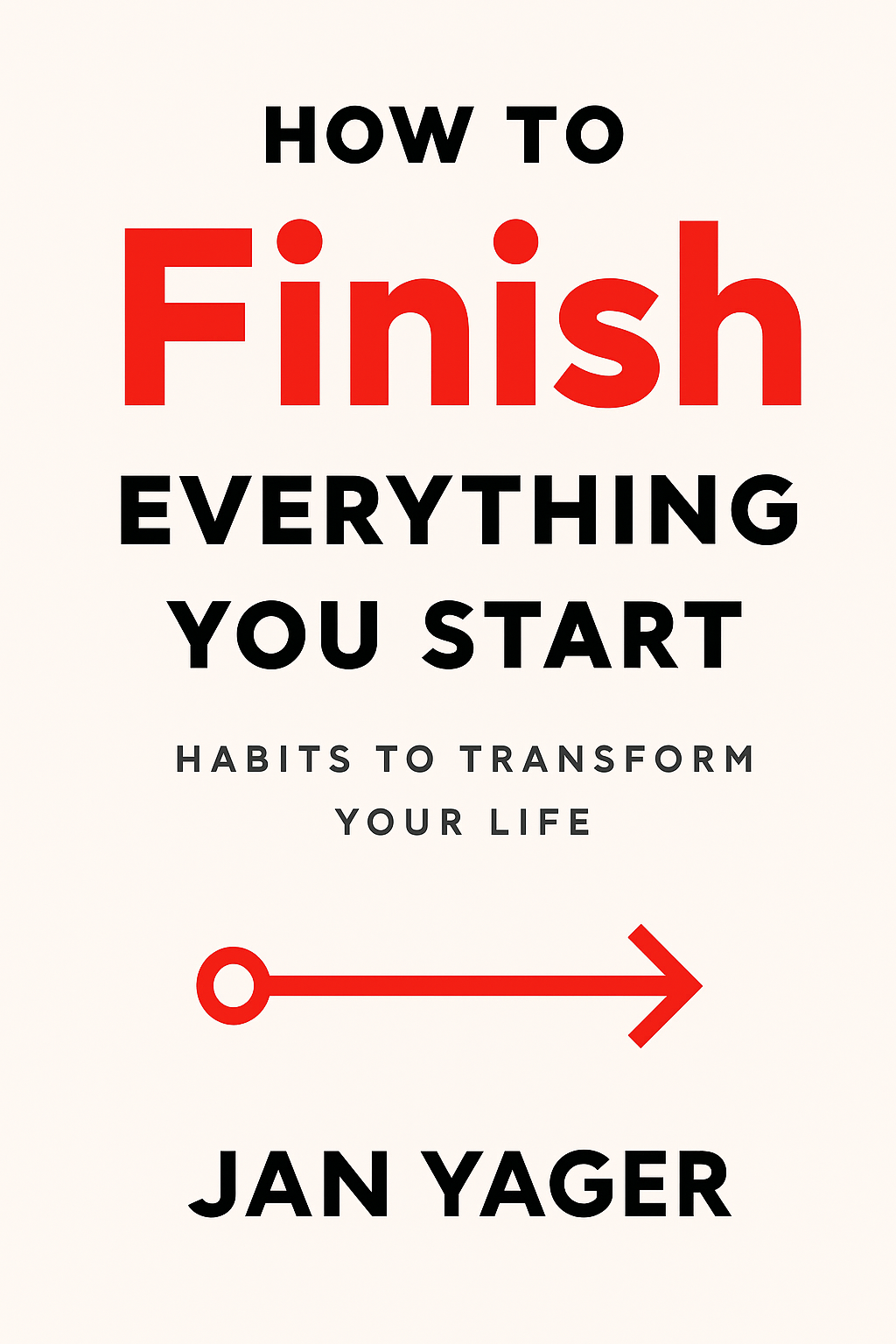
How to Finish Everything You Start
Habits to Transform Your Life
Book Edition Details
Summary
In a world where unfinished projects pile up like forgotten dreams, Jan Yager’s "How to Finish Everything You Start" emerges as a beacon of clarity and productivity. This insightful guide tackles the pervasive issue of incomplete tasks head-on, offering a fresh perspective on why we struggle and how to conquer our own inertia. Yager, a prolific author and sociologist, introduces her groundbreaking FINISH system—an arsenal of strategies designed to dismantle procrastination and perfectionism alike. With her expertise, readers gain the power to prioritize with purpose and make peace with the projects that deserve to be set aside. Transform your approach to productivity with this indispensable resource, and reclaim the satisfaction of seeing your endeavors through to the end.
Introduction
Picture this: you're surrounded by half-completed projects, your desk cluttered with reminders of good intentions that never quite made it to the finish line. That novel you started last year sits abandoned at chapter three. The online course you enrolled in with such enthusiasm remains perpetually at sixty percent completion. The home renovation project has turned into a monument to procrastination. If this sounds familiar, you're not alone in facing what has become a modern epidemic of unfinished endeavors. The ability to see things through to completion has become one of the most valuable skills in our distraction-filled world. Whether it's a work presentation, a personal fitness goal, or a creative project close to your heart, the satisfaction and success that come from crossing the finish line can transform not just your productivity, but your entire sense of self-worth and accomplishment. The journey from starter to finisher is filled with learnable strategies, mindset shifts, and practical tools that can turn your pattern of abandonment into a legacy of achievement.
Understanding Why We Don't Finish
The root of our finishing struggles lies not in external circumstances, but in the complex web of psychological barriers we've unconsciously constructed. At its core, the inability to complete tasks stems from a fascinating paradox: we often fear both failure and success equally. This internal conflict creates a safe middle ground where projects remain perpetually "in progress," shielding us from the vulnerability that comes with putting our work into the world for judgment. Consider the case of Marcus, a talented software developer who consistently left coding projects ninety percent complete. Through careful self-reflection, he discovered that finishing meant facing potential criticism from peers he deeply respected. His fear of their judgment kept him trapped in an endless cycle of tweaking and perfecting, never quite ready to ship. This pattern had cost him three promising job opportunities and countless hours of frustrated effort. The breakthrough came when Marcus realized that his unfinished projects were actually protecting him from something he wanted more than safety: genuine recognition for his abilities. He began to reframe completion not as exposure to criticism, but as an opportunity to receive the feedback that would help him grow. By shifting his perspective from "What if they don't like it?" to "What can I learn from their response?", he found the courage to start finishing what he started. The most effective approach to overcoming these internal barriers involves first identifying your specific completion triggers. Write down the last three projects you abandoned and honestly examine what emotions arose as you approached the finish line. Were you worried about perfectionism? Afraid of what comes next? Overwhelmed by the scope of remaining work? Once you recognize your personal pattern, you can develop targeted strategies to push through these predictable moments of resistance. Remember that awareness alone creates transformation. Simply recognizing that your hesitation is a normal part of the creative and productive process, rather than evidence of your inadequacy, can provide the psychological permission you need to keep moving forward. The goal isn't to eliminate these feelings, but to acknowledge them and continue working despite their presence.
Proven Strategies to Complete Any Task
The most powerful completion strategy revolves around breaking overwhelming projects into what psychologists call "minimum viable progress" units. This approach transforms daunting goals into a series of small, manageable actions that create momentum rather than paralysis. The key lies in making each step so small that your brain cannot manufacture a reasonable excuse to avoid it. Sarah, a marketing consultant, applied this principle to her stalled business plan. Instead of facing the intimidating task of "writing a comprehensive business plan," she committed to spending just fifteen minutes each morning on one specific section. On Monday, she outlined her target market. Tuesday brought a brief competitive analysis. Wednesday focused on pricing strategy. What seemed impossible as a monolithic project became surprisingly achievable when approached incrementally. Within six weeks, Sarah had not only completed her business plan but had gained enough clarity and confidence to secure her first major client. The momentum from these small daily actions created a positive feedback loop that carried her through the traditionally difficult middle phases of the project. She discovered that consistency, not intensity, was the secret ingredient that had been missing from her previous attempts. The implementation framework follows a simple three-step process: First, identify the specific next physical action required to move your project forward. Second, schedule exactly when and where you'll take that action, treating the appointment with yourself as seriously as you would a meeting with your most important client. Third, immediately after completing each small step, acknowledge your progress and identify the next action for the following day. This approach works because it leverages the psychological principle of task completion satisfaction while building the habit of forward movement. Each small victory strengthens your identity as someone who follows through, making subsequent actions feel more natural and inevitable. The compound effect of consistent small steps often leads to results that exceed what you thought possible through sporadic bursts of intense effort.
Building Your Finishing Mindset
The transformation from chronic starter to consistent finisher begins with a fundamental shift in how you view the completion process itself. Instead of seeing finishing as a distant, overwhelming destination, successful completers understand it as a series of decision points where they choose progress over perfection, action over analysis, and movement over stagnation. Dr. Patricia Williams, a research psychologist, struggled for years to complete her dissertation until she adopted what she called "the pilot mindset." Rather than viewing each chapter as a permanent statement of her expertise, she began treating her writing as a series of experiments designed to test and refine her ideas. This reframing eliminated the paralyzing pressure to get everything perfect on the first attempt and allowed her to focus on iteration and improvement. Her breakthrough moment came when she realized that her dissertation committee expected evolution, not perfection, in her drafts. By submitting work that was "good enough to get feedback," she entered into a collaborative refinement process that ultimately produced better results than her previous approach of isolated perfection-seeking. Within four months of this mindset shift, she successfully defended her dissertation and launched her academic career. The finishing mindset consists of three core beliefs that you can consciously adopt and reinforce. First, completion is a skill that improves with practice, not an innate talent that you either possess or lack. Second, finished projects that receive feedback and iteration are infinitely more valuable than perfect projects that never see the light of day. Third, the discomfort you feel as you approach completion is a signal that you're about to break through to a new level of capability and confidence. To cultivate this mindset, create a daily practice of acknowledging your completion victories, no matter how small. Keep a "finished" list alongside your to-do list, recording everything you complete each day from responded emails to completed workout sessions. This practice trains your brain to notice and celebrate the completion habit you're building, reinforcing the identity of someone who follows through on commitments.
Creating Lasting Change
The ultimate goal isn't just to finish individual projects, but to fundamentally rewire your relationship with completion so that following through becomes your natural default mode. This transformation requires creating systems and environments that make finishing easier than quitting, while simultaneously addressing the underlying beliefs that have historically derailed your efforts. James, a freelance graphic designer, discovered that his completion struggles weren't about motivation or time management, but about the lack of external accountability that came with working alone. He created an artificial accountability structure by scheduling weekly progress reviews with a mentor and committing to specific deliverables by predetermined dates. This external framework provided the structure his brain needed to push through the inevitable resistance points that had previously caused him to abandon projects. The systematic change that followed was remarkable. Within three months, James had completed four major client projects that had been languishing for months, launched his professional website, and developed a waiting list of potential clients. The accountability structure had not only improved his completion rate but had fundamentally changed how he approached new projects, building completion checkpoints into his process from the very beginning. The most effective approach to lasting change involves designing what behavioral scientists call "environmental architecture" that supports your finishing goals. This means removing barriers that make quitting easy while adding friction to the abandonment process. Create dedicated workspaces associated only with important projects, establish specific times for focused work, and develop rituals that signal the beginning and end of productive sessions. Equally important is building a personal completion philosophy that guides your decisions during challenging moments. Write down your personal manifesto about why finishing matters to you, what it represents about your character and values, and how completed projects contribute to your larger life goals. When you face the inevitable urge to quit, this written reminder of your deeper motivation can provide the emotional fuel needed to push through temporary discomfort toward lasting satisfaction.
Summary
The journey from chronic starter to consistent finisher represents one of the most transformative skills you can develop in our modern world of endless distractions and competing priorities. The strategies and mindset shifts outlined here aren't just about productivity; they're about reclaiming your sense of personal agency and building unshakeable confidence in your ability to see important things through to completion. As the research consistently shows, the satisfaction that comes from finishing what you start creates a positive feedback loop that makes subsequent completions easier and more natural. The most important insight to carry forward is that finishing is fundamentally about making a series of small, consistent choices rather than relying on bursts of motivation or perfect circumstances. Start today by identifying one meaningful project that has been waiting for your attention, break it down into the smallest possible next step, and schedule exactly when you'll take that action. Your future self will thank you for the gift of completion, and you'll discover that the finish line was never as far away as it seemed.
Related Books
Download PDF & EPUB
To save this Black List summary for later, download the free PDF and EPUB. You can print it out, or read offline at your convenience.
By Jan Yager
