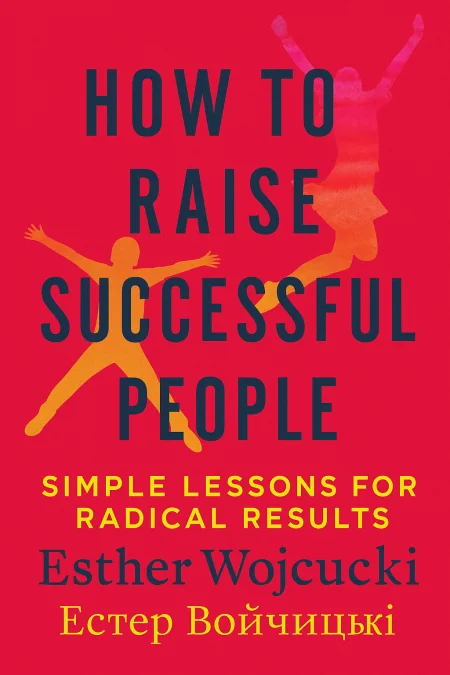
How to Raise Successful People
Simple Lessons for Radical Results
byEsther Wojcicki, Естер Войчицькі
Book Edition Details
Summary
Esther Wojcicki, an icon in both education and parenting, offers a transformative guide that turns conventional child-rearing wisdom on its head. Through the lens of her groundbreaking TRICK philosophy—Trust, Respect, Independence, Collaboration, and Kindness—Wojcicki shares the alchemy behind nurturing not just success, but genuine happiness and resilience in children. Renowned for inspiring Silicon Valley giants and raising three remarkably accomplished daughters, Wojcicki invites parents to embrace a fresh approach: empower children with autonomy, value their voices, and instill a sense of curiosity and kindness. As parental anxiety reaches a fever pitch, her insights promise relief and revolutionary results. How to Raise Successful People distills decades of experience into an essential manifesto for anyone who dreams of raising not just achievers, but leaders and innovators.
Introduction
In the hallways of Palo Alto High School, students know her simply as "Woj." For over three decades, Esther Wojcicki has been quietly revolutionizing how we think about education and parenting, creating a ripple effect that extends far beyond her Silicon Valley classroom. As a journalism teacher, she has watched thousands of students transform from timid teenagers into confident young adults with powerful voices. As a mother, she raised three daughters who would go on to become leaders in their fields: Susan as CEO of YouTube, Janet as a professor of pediatrics at UCSF, and Anne as co-founder of 23andMe. Yet perhaps most remarkably, she accomplished this not through the intense pressure and micromanagement that characterizes much of modern parenting, but through what she calls the "TRICK" method—a philosophy built on Trust, Respect, Independence, Collaboration, and Kindness. Her approach stands as a compelling alternative to the anxiety-driven, helicopter parenting that has left so many children struggling with depression, lacking grit, and unprepared for adult life. Through her story, readers will discover how authentic empowerment works in practice, why giving children real responsibility creates better outcomes than protecting them from all challenges, and how the same principles that work in her classroom can transform family dynamics and prepare the next generation to tackle the world's most pressing problems.
From Childhood Adversity to Educational Innovation
Esther Wojcicki's journey began in the most unlikely of circumstances. Born to Russian Jewish immigrants in a cramped one-bedroom apartment on New York's Lower East Side, she experienced firsthand the devastating consequences of powerlessness. Her father's rigid authoritarianism, shaped by Old World traditions that valued men above women, created a household where her voice was systematically silenced. The family's poverty was crushing, but it was the preventable death of her younger brother David—killed by an aspirin overdose when hospitals repeatedly turned him away for lack of payment—that crystallized her understanding of how the marginalized suffer when they cannot advocate for themselves. This early trauma became her North Star. In a household where she was told that "boys are more important," where she was expected to marry young rather than pursue education, Wojcicki developed what she calls a "fighter mentality." She learned to question authority after a near-fatal carbon monoxide poisoning that she survived only because she refused to follow her mother's instructions to stay in bed. These experiences taught her that blind obedience could be deadly, and that thinking independently wasn't just valuable—it was essential for survival. When she won a full scholarship to UC Berkeley, she was finally able to escape the limitations imposed by her upbringing. Meeting her future husband Stan, a physicist who had survived Nazi-occupied Poland, reinforced her belief that skepticism toward authority and faith in one's own judgment were not luxuries but necessities. Both had learned that traditional power structures could not be trusted, that individuals must develop their own moral compass and the courage to follow it. These formative experiences would later shape every aspect of her teaching philosophy. In her classroom, she saw too many students paralyzed by the fear of making mistakes, conditioned to seek permission rather than take initiative. Drawing from her own childhood of enforced silence, she made the radical decision to hand real power to her students, making them editors, decision-makers, and voices for change in their community rather than passive recipients of instruction.
Building TRICK: Trust, Respect, Independence, Collaboration, Kindness
The TRICK philosophy emerged not from academic theory but from decades of practical experience watching what actually works with young people. Trust, Wojcicki discovered, is the foundation upon which all other growth depends. When she began trusting sixteen-year-olds to produce a professional newspaper, investigating school board corruption and tackling controversial topics, they consistently rose to meet those expectations. Students who had been considered "difficult" in other classes flourished when given genuine responsibility and the belief that their voices mattered. Respect, in her framework, goes far deeper than basic politeness. It means honoring children's autonomy and individuality, recognizing that each young person has unique gifts that may not align with parental expectations. She watched too many talented students wither under parents' demands that they pursue medicine or law when their passions lay elsewhere. True respect meant supporting children as they discovered their own paths, even when those paths challenged conventional notions of success. This wasn't permissive parenting—she maintained high standards—but rather collaborative parenting that worked with children's natural inclinations rather than against them. Independence, perhaps the most misunderstood element of her philosophy, requires parents to step back and allow children to experience both success and failure on their own terms. She observed how helicopter parenting, despite coming from love, actually weakened children by depriving them of opportunities to develop resilience and problem-solving skills. Her approach involved giving age-appropriate challenges—from letting toddlers dress themselves to allowing teenagers to manage complex projects—always with support available but never doing for children what they could learn to do themselves. Collaboration and kindness complete the framework by ensuring that independence doesn't become selfishness. In her classroom, older students mentored younger ones, creating a community where everyone's success was interconnected. Students learned that real achievement comes not from individual competition but from lifting others up. This collaborative spirit, combined with genuine kindness toward those who make mistakes, created an environment where young people felt safe to take risks, learn from failures, and ultimately develop into confident, compassionate leaders.
Raising Three Pioneering Daughters Through TRICK Values
The true test of any parenting philosophy lies in its results, and Wojcicki's three daughters represent perhaps the most compelling case study for the TRICK approach. From infancy, she treated her children as capable individuals rather than fragile beings requiring constant protection. When they were toddlers, she taught them to swim not through gradual immersion but by trusting their natural abilities and giving clear instruction. When the family lived in Geneva, she sent five-year-old Susan and four-year-old Janet to the local store to buy bread on their own, understanding that real competence comes only through practice. Rather than dictating their interests and activities, she allowed each daughter to pursue her own passions. Susan gravitated toward technology and business, Janet toward science and medicine, Anne toward entrepreneurship and health innovation. When Anne turned down a prestigious job offer to continue babysitting, Wojcicki bit her tongue and waited, trusting that her daughter would find her own path to meaningful work. This patience paid off when Anne eventually took the position and launched her career on Wall Street, leading ultimately to her founding of 23andMe. The collaborative aspect of their family dynamic meant that major decisions were made together, with the children having real input into everything from vacation planning to household responsibilities. Each daughter learned to see herself as a valued contributor to the family rather than a passive recipient of parental directives. When conflicts arose—and they did—Wojcicki focused on understanding rather than punishment, using even disciplinary moments as opportunities for growth and learning. Perhaps most importantly, the emphasis on kindness and service meant that all three daughters understood their privilege came with responsibility. They saw their mother fighting for library access, building playgrounds, and advocating for the powerless. This modeling taught them that success without service is empty, that real achievement means using your platform to make life better for others. Today, each daughter leads in her respective field while maintaining a commitment to improving the world—Susan through democratizing access to information, Janet through combating childhood obesity and disease, and Anne through empowering individuals to take control of their own health.
Transforming Education and Empowering Global Communities
What began as one teacher's experiment in trusting teenagers has evolved into a global movement challenging fundamental assumptions about education and human development. Wojcicki's journalism program at Palo Alto High School has produced not just award-winning publications but graduates who carry the TRICK values into their professional lives, becoming leaders in technology, medicine, media, and public service. These former students consistently report that learning to think independently, collaborate effectively, and treat others with respect proved more valuable than any specific academic content they mastered. The ripple effects extend far beyond individual success stories. Companies like Google have adopted elements of her collaborative approach, recognizing that the rigid hierarchies and standardized processes of the industrial age are poorly suited to innovation-based economies. The business world increasingly values the exact skills that TRICK develops: critical thinking, emotional intelligence, adaptability, and the ability to work across differences toward common goals. On an even broader scale, Wojcicki's work points toward solutions for some of society's most pressing challenges. In an era of political polarization, her emphasis on respectful dialogue and collaborative problem-solving offers hope for democratic renewal. In a time of mental health crisis among young people, her approach of building genuine competence and connection provides an alternative to the anxiety-producing pressure of traditional achievement culture. Her methods have been successfully adapted in settings ranging from impoverished schools in Mexico to progressive educational initiatives worldwide. Perhaps most significantly, TRICK represents a fundamentally hopeful vision of human nature. Rather than seeing children as problems to be controlled or competitions to be won, it recognizes young people as inherently creative, caring, and capable individuals who need guidance rather than management. This shift in perspective—from adult-centered to child-centered, from compliance-focused to growth-oriented—has the potential to transform not just individual families but entire cultures, creating generations better equipped to address complex global challenges through collaboration rather than competition.
Summary
Esther Wojcicki's life and work demonstrate that the most profound changes often come not from grand theories but from the courage to trust in human potential and act on that belief consistently over time. Her TRICK philosophy offers a practical roadmap for raising children who are not only successful in conventional terms but also deeply engaged with making the world better. The evidence is overwhelming: when we trust young people with real responsibility, respect their individual paths, support their independence, foster collaboration, and model kindness, they develop into the kind of adults our troubled world desperately needs. For parents struggling with anxiety about their children's futures, educators seeking alternatives to test-driven instruction, and anyone hoping to nurture the next generation of thoughtful leaders, Wojcicki's approach provides both inspiration and concrete strategies for change. Her story reminds us that the choice to trust, respect, and empower young people isn't just good for them—it's essential for all of us.
Related Books
Download PDF & EPUB
To save this Black List summary for later, download the free PDF and EPUB. You can print it out, or read offline at your convenience.
By Esther Wojcicki
