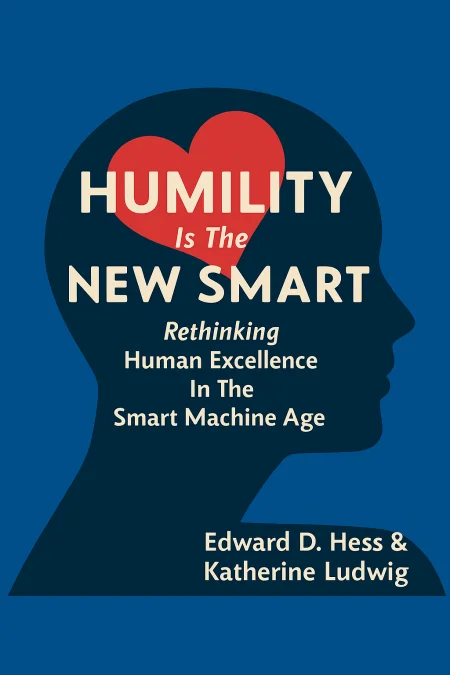
Humility Is The New Smart
Rethinking Human Excellence In the Smart Machine Age
byEdward D. Hess, Katherine Ludwig
Book Edition Details
Summary
In the brave new world of artificial intelligence, where the hum of machines grows louder and more omnipresent, "Humility Is the New Smart" offers a beacon of hope for the human spirit. As smart machines rise to take over countless jobs, Hess and Ludwig deliver a game-changing manifesto urging us to redefine intelligence in this digital age. They argue that the heart of staying indispensable lies not in trying to outdo these technological marvels, but in embracing the power of humility. By fostering critical and creative thinking, and nurturing genuine human connection, we tap into what machines cannot replicate. This groundbreaking guide arms us with NewSmart attitudes and behaviors, pushing us to embrace lifelong learning and open-mindedness. Here lies your path to not just surviving, but thriving in the machine age.
Introduction
As artificial intelligence and automation reshape our world at unprecedented speed, a profound question emerges: what happens to human relevance when machines can think, learn, and perform cognitive tasks better than we can? The traditional markers of intelligence—knowing more facts, processing information faster, making fewer mistakes—are rapidly becoming the domain of smart machines. This technological revolution demands not just new skills, but a fundamental reimagining of what it means to be smart and successful as a human being. The answer lies not in competing with machines on their terms, but in cultivating distinctly human capabilities that complement rather than compete with artificial intelligence. This requires embracing a counterintuitive mindset that values quality over quantity, collaboration over competition, and intellectual humility over ego-driven certainty. The core challenge becomes developing four essential human skills: critical thinking, innovative thinking, creativity, and high emotional engagement with others. Yet these very capabilities are often inhibited by our natural tendencies toward cognitive bias, emotional defensiveness, and self-protective behaviors. The path forward demands both a new definition of intelligence and a practical framework for developing the behaviors that enable human excellence in an age of smart machines.
The Smart Machine Age and NewSmart Mindset
The Smart Machine Age represents a fundamental shift in the relationship between human and artificial intelligence. Unlike previous technological revolutions that primarily automated manual labor, today's smart machines are conquering cognitive tasks once considered uniquely human. They can diagnose diseases more accurately than doctors, analyze legal documents faster than lawyers, and even compose music that moves audiences to tears. This transformation forces us to confront an uncomfortable truth: the traditional definition of being "smart" is becoming obsolete. For generations, intelligence has been measured quantitatively—by how much we know, how quickly we can recall information, and how few mistakes we make. This model served well during the Industrial Age, when educational systems needed to prepare workers for repetitive tasks that rewarded accuracy and efficiency. However, in a world where machines can access virtually unlimited information instantaneously and process it with perfect recall, this quantity-based approach to intelligence becomes not just inadequate but counterproductive. The NewSmart mindset redefines intelligence as a qualitative measure focused on how we think, learn, and emotionally engage with others rather than what we know. This shift emphasizes five core principles: defining ourselves by the quality of our thinking rather than the content of our knowledge; recognizing that our mental models are stories, not reality; decoupling our ego from our beliefs; treating our assumptions as hypotheses to be tested; and viewing mistakes as learning opportunities. This framework mirrors the scientific method, encouraging us to think more like researchers than know-it-alls. Consider how this plays out in practice. A traditional "smart" person might dominate meetings by showcasing their expertise and defending their positions. A NewSmart individual approaches the same situation with curiosity, asks probing questions, seeks disconfirming evidence, and remains open to changing their mind when presented with better information. The former approach may have worked in hierarchical organizations of the past, but the latter becomes essential in dynamic environments requiring continuous adaptation and innovation. NewSmart thinking transforms intellectual humility from perceived weakness into competitive advantage.
Humility as Gateway to Excellence
Humility, properly understood, serves as the foundational mindset that enables human excellence in the Smart Machine Age. This is not the self-deprecating modesty often associated with the term, but rather an accurate self-assessment combined with an outward focus that recognizes the value and contributions of others. True humility involves what psychologists call "forgetting the self"—moving beyond ego-driven concerns about appearance and status to engage authentically with reality and other people. The psychological components of humility create a powerful foundation for learning and growth. These include maintaining an accurate view of one's abilities and achievements, acknowledging mistakes and limitations, remaining open to new ideas and contradictory information, keeping accomplishments in perspective, and appreciating the diverse contributions others make to our understanding. This mindset directly counters the defensive mechanisms that typically inhibit high-level thinking and collaboration. Research consistently demonstrates that humble individuals and organizations outperform their more ego-driven counterparts in complex, uncertain environments. Google explicitly seeks humility as a hiring criterion, recognizing that only humble people can truly learn from failure and collaborate effectively. Pixar's creative culture depends on artists and storytellers who can separate their identity from their ideas, allowing for the brutal honesty necessary to refine creative work. Navy SEALs practice "extreme ownership" that requires checking egos and operating with humility to ensure mission success and team survival. The counterintuitive power of humility lies in its ability to unlock our full cognitive and emotional potential. When we stop defending our image and start exploring reality, we can think more clearly, listen more deeply, and connect more authentically with others. Humility transforms collaboration from a competitive arena into a cooperative search for truth and excellence. In the Smart Machine Age, this shift from "big me" to "big us" becomes not just morally admirable but strategically essential for human relevance and success.
The Four NewSmart Behaviors Framework
The transition from knowing about NewSmart principles to actually embodying them requires developing four interconnected behaviors that form the foundation of human excellence. These behaviors—Quieting Ego, Managing Self, Reflective Listening, and Otherness—work synergistically to overcome our natural tendencies toward defensive thinking and enable the high-level cognitive and emotional engagement needed in the Smart Machine Age. Quieting Ego begins with mindfulness practices that help us recognize and manage the self-protective inner dialogue that filters our perception of reality. Through techniques like meditation, breath awareness, and gratitude practices, we learn to create space between our thoughts and our identity. This allows us to observe our defensive reactions without being controlled by them, opening us to perspectives and information we might otherwise reject. The goal is not eliminating the ego but developing the ability to quiet its defensive chatter when high-quality thinking and relating are required. Managing Self encompasses both our thinking processes and emotional responses. On the cognitive side, this involves developing deliberate thinking practices, using tools like root cause analysis and "premortems" to improve decision-making, and actively seeking to stress-test our assumptions. Emotionally, it requires learning to recognize physical and mental signals of defensiveness or reactivity, then using techniques like deep breathing, reframing, and positive self-talk to maintain emotional equilibrium. The integration of cognitive and emotional self-management enables us to choose our responses rather than simply reacting. Reflective Listening transcends basic communication skills to become a practice of truly understanding others before seeking to be understood. This involves quieting our internal response-generation while others speak, asking genuine questions rather than leading inquiries, and taking time to "try on" different perspectives to understand how they might feel if we believed them. Such listening requires temporarily suspending our own agenda to fully engage with another person's reality, creating the foundation for meaningful collaboration and learning. Otherness, or emotionally connecting and relating to others, represents the culmination of the other three behaviors. It involves being genuinely present with others, communicating authentic care and positive regard, and building the trust necessary for effective teamwork. This behavior requires moving beyond transactional relationships to create the psychological safety that enables innovative thinking and creative problem-solving. Research shows that teams with high emotional connection consistently outperform those focused solely on individual achievement.
Building NewSmart Organizations
The individual practice of NewSmart behaviors, while personally transformative, reaches its full potential when embedded within organizational systems designed to enable human excellence. NewSmart organizations recognize that in the Smart Machine Age, their competitive advantage depends not on operational efficiency—which technology can provide—but on their ability to develop human capabilities and create value through innovation, adaptation, and meaningful relationships. These organizations build their cultures around three psychological foundations that create optimal conditions for human performance. Positivity involves creating emotionally supportive environments where people feel valued and energized rather than fearful and defensive. Self-Determination Theory guides the design of work experiences that meet fundamental human needs for autonomy, relatedness, and competence. Psychological Safety ensures that people feel secure enough to take risks, admit mistakes, challenge assumptions, and engage in the messy process of learning and innovation. Technology, paradoxically, will humanize successful organizations by eliminating routine tasks and forcing focus on distinctly human capabilities. Companies like Google and Pixar demonstrate how organizational systems can be aligned to promote NewSmart behaviors through careful hiring practices, feedback processes, decision-making structures, and leadership development. These organizations deemphasize hierarchy, encourage dissent, embrace failure as learning, and measure success not just by financial results but by the quality of thinking, collaboration, and human development they foster. The transformation required goes far beyond policy changes to encompass a fundamental reimagining of management philosophy. Leaders must evolve from command-and-control directors to enablers and developers of human potential. This requires managers who can model humility, create psychologically safe environments, and help individuals develop the cognitive and emotional skills necessary for adding value in a world of smart machines. The most successful organizations will be those that excel not just at their core business but at the business of human development itself.
Summary
The essence of thriving in the Smart Machine Age lies in this profound recognition: human excellence emerges not from competing with machines but from embracing the distinctly human capacities that machines cannot replicate—deep thinking, authentic relating, and continuous learning through humility. This transformation represents more than a career strategy; it offers a path toward more meaningful work, richer relationships, and fuller human potential. By redefining intelligence from quantity to quality, from knowing to being good at not knowing, we unlock capabilities that not only complement artificial intelligence but remind us what makes us irreplaceably human in an increasingly automated world.
Related Books
Download PDF & EPUB
To save this Black List summary for later, download the free PDF and EPUB. You can print it out, or read offline at your convenience.
By Edward D. Hess
