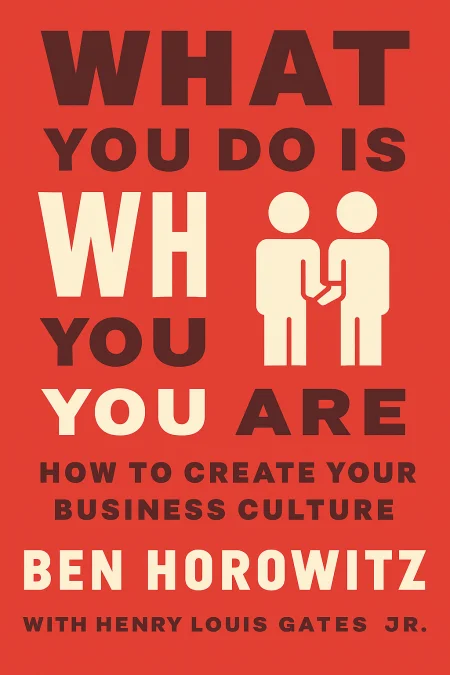
What You Do Is Who You Are
How to Create Your Business Culture
byBen Horowitz, Henry Louis Gates Jr.
Book Edition Details
Summary
Leadership isn't just about the corner office or grand speeches—it's about action and the culture you cultivate daily. Ben Horowitz, a luminary in venture capitalism and management, takes you on an exhilarating ride through history to uncover the essence of effective leadership in "What You Do Is Who You Are." Through the compelling stories of figures like Haiti's revolutionary leader Toussaint Louverture, Japan's disciplined Samurai, the legendary conqueror Genghis Khan, and the transformative prison leader Shaka Senghor, Horowitz explores how diverse leadership styles shape enduring cultures. Connecting these historical lessons to modern corporate landscapes, he challenges executives to define their company's identity not by words or beliefs, but through deliberate actions. This book is a powerful toolkit for anyone looking to build a robust, resilient organizational culture that speaks louder than any mission statement. Whether you're steering a startup or a global enterprise, Horowitz's insights provide the blueprint for a legacy of leadership that truly stands the test of time.
Introduction
Picture this: You walk into a tech company where employees bring their dogs to work, share meals together, and solve problems with remarkable innovation. Then you visit another company in the same industry where people wear suits, work in silence, and follow rigid hierarchies. Both companies are successful, but they feel like different worlds entirely. What creates these profound differences? The answer lies in something invisible yet powerful that shapes every interaction, decision, and outcome: culture. Most leaders recognize that culture matters, yet few understand how to deliberately craft one. They know culture isn't just ping-pong tables or mission statements on walls, but they struggle to identify what actually creates the behaviors they witness daily. This confusion leads to accidental cultures that often work against their goals rather than support them. Through studying history's most effective culture builders, from revolutionary leaders to warrior societies, from prison gangs to modern corporations, we can unlock the secrets of intentional culture creation. These stories reveal that culture isn't something that happens to you, it's something you create through specific, deliberate actions. The lessons from these unexpected teachers offer a practical roadmap for building cultures that not only survive but thrive, transforming ordinary groups into extraordinary organizations where people flourish and achieve remarkable things together.
The Slave Who Defeated Empires: Toussaint Louverture's Cultural Revolution
In 1791, a small, frail man named Toussaint Louverture faced an impossible challenge. Born into slavery on a sugar plantation in Haiti, he had witnessed unimaginable brutality. Slaves were routinely burned alive, had boiling sugar poured over their heads, and were worked to death in numbers so staggering that the population could only be maintained through constant importation of new captives. The odds against any successful slave rebellion were astronomical, as the culture of slavery systematically destroyed trust, education, and hope. Yet Louverture understood something profound: culture could be reprogrammed. He began with his inner circle of five hundred carefully chosen men, drilling them relentlessly while implementing shocking rules that redefined their identity. When he banned officers from taking concubines, his soldiers demanded to know why. His answer became cultural programming: "If we can't trust you to keep your word to your wife, we definitely can't trust you to keep your word to us." This single rule embedded loyalty, honesty, and integrity into their daily consciousness. Louverture transformed voodoo songs into encrypted battlefield communications and converted punishment into purpose. When his army could have massacred the plantation owners who had tortured them, Louverture made the counterintuitive decision to let them keep their land in exchange for paying workers. This demonstrated that their revolution was about creating a prosperous society, not seeking revenge. What Louverture accomplished through cultural transformation was unprecedented. His army of former slaves defeated the military forces of Spain, Britain, and France, inflicting more casualties on Napoleon than he would suffer at Waterloo. European newspapers began referring to this former slave with respect, and the U.S. Congress passed special legislation to trade with his nation. Through deliberate culture change, the impossible became inevitable, proving that when you transform how people see themselves and their purpose, you unlock extraordinary potential that was always there, waiting to be awakened.
From Outcast to Conqueror: Genghis Khan's Inclusive Meritocracy
As a frightened child, Temujin was so weak his family called him "Sickly Stick" and expected him to die. His tribe abandoned his widowed mother and seven children on the harsh Mongolian steppe, essentially condemning them to starvation. When his own tribe later enslaved him, Temujin experienced firsthand the arbitrary cruelty of social hierarchies based on birth rather than merit. Yet this outsider experience became his greatest strength, teaching him to see talent where others saw only threats. When Temujin rose to become Genghis Khan, he revolutionized Mongol culture by abolishing inherited aristocratic titles and creating history's most effective meritocracy. Shepherds could become generals. Defeated enemies were integrated into his army not as second-class soldiers, but as full equals who could rise to the highest ranks based on ability alone. He had his own mother adopt children from conquered tribes, symbolically making former enemies into family. This wasn't mere strategy; it was cultural engineering that transformed diversity from a source of division into a source of strength. His inclusive culture created military advantages his enemies couldn't match. While traditional armies moved slowly with their supply trains and rigid hierarchies, Genghis Khan's forces were entirely cavalry, self-sufficient, and organized in concentric circles that could outmaneuver and surround much larger forces. His engineers combined Chinese gunpowder with Islamic flamethrowers and European metalworking to create the world's first cannons. By seeing people for their talents rather than their origins, he assembled the most innovative and loyal fighting force in history. The Mongol Empire lasted for 150 years after Genghis Khan's death, spanning from Eastern Europe to the Pacific Ocean. This wasn't built through fear alone, but through a culture where everyone could contribute their best regardless of where they came from. His radical insight that character matters more than background offers timeless wisdom for any leader seeking to harness the full potential of diverse teams, proving that true strength comes not from uniformity, but from unity built upon mutual respect and shared purpose.
The Warrior's Code: Samurai Virtues and Modern Leadership
The samurai didn't just fight with swords; they lived by a code so precise it governed how they walked, talked, and even drank tea. This code, called bushido, enabled the warrior class to rule Japan for seven hundred years and continues to shape Japanese culture today. But what made their culture so enduring wasn't just its rules, it was how those rules were designed to work together as a complete system of behavior. At the heart of samurai culture was a startling practice: they began each day by meditating on their own death. This wasn't morbid pessimism but practical wisdom. By accepting the worst possible outcome, they freed themselves to act with complete integrity in every moment. A samurai would spend careful time grooming himself each morning, keeping his equipment spotless, because if he died that day, he wanted to be remembered as someone who took pride in his appearance and responsibilities. This daily confrontation with mortality created an almost supernatural attention to detail and craftsmanship. The samurai defined their culture around virtues rather than values, focusing on actions rather than beliefs. Politeness wasn't just good manners; it was the deepest expression of love and respect for others. Honor wasn't an abstract concept; it was demonstrated through specific behaviors in specific situations. They created detailed scenarios exploring every possible ethical dilemma, ensuring their code could guide decisions in any circumstance. Stories of legendary samurai became teaching tools, embedding cultural lessons so powerfully that people remembered them for generations. This systematic approach to culture creation offers profound insights for modern leaders. When you build culture around what people do rather than what they say they believe, when you make abstract values concrete through specific practices, and when you help people understand that their daily actions reflect who they truly are, you create something that endures. The samurai understood that culture isn't something you declare; it's something you live, moment by moment, choice by choice, until excellence becomes as natural as breathing.
Prison to Redemption: Shaka Senghor's Cultural Transformation
At nineteen, James White entered Michigan's prison system expecting to spend the rest of his life there. Within hours of leaving quarantine, he witnessed a casual, methodical stabbing that immediately communicated the prison's true culture: violence was currency, weakness was fatal, and survival required joining one of five powerful gangs. White chose the Melanics, a squad that preached education and black uplift but was led by charismatic manipulators who exploited members while enriching themselves. Using Socratic questioning at gang meetings, White challenged the leadership's hypocrisy: "If a leader does not follow his own instructions, is he a leader?" The younger members recognized the contradiction between their stated values and actual practices. Through careful psychological maneuvering rather than violence, White rose to lead the organization, implementing daily study groups, mandatory reading, and a code of genuine mutual protection. He transformed a gang of two hundred into the most feared and respected organization in the prison system. But White's greatest transformation was yet to come. After reading Malcolm X's autobiography, he realized he could change who he was by changing the culture around him. When gang members wanted to attack new prisoners for media-driven incidents, White forced them to examine their own crimes and how their own families might feel about vigilante justice. He instituted "Real Men, Real Talk" sessions that addressed trauma and emotional intelligence, eventually earning the trust of prison administrators who asked him to lead rehabilitation programs. By the time White was released after nineteen years, he had become Shaka Senghor, a bestselling author and leader in prison reform. His journey reveals culture's most powerful truth: the environment shapes the person, but individuals with courage and wisdom can reshape the environment. Senghor's story demonstrates that even in the most challenging circumstances, leaders who understand how culture works can create transformation that ripples far beyond their immediate sphere, proving that who you become is ultimately a choice about which culture you decide to build and live within.
Summary
These remarkable stories from history's greatest culture builders reveal a profound truth: culture isn't something that happens to you, it's something you create through deliberate, consistent actions. Whether leading a slave rebellion, building an empire, maintaining centuries of honor, or transforming lives in prison, each leader succeeded by understanding that culture is the invisible force that determines what people do when no one is watching. The most powerful insight from these diverse leaders is that culture change begins with clarity about who you want to become, then requires the courage to embody those values even when it's difficult or dangerous. Louverture could have chosen revenge but chose prosperity. Genghis Khan could have maintained traditional hierarchies but chose merit. The samurai could have focused on winning battles but chose honor. Senghor could have remained trapped by his environment but chose transformation. Each decision created ripple effects that shaped entire civilizations. Your opportunity lies in recognizing that every day, through countless small choices and actions, you're either building the culture you want or allowing an accidental culture to emerge. The leaders who changed the world understood that what you do is who you are, and who you are shapes everyone around you. Start where you are, with the people you influence today, making choices that reflect your highest aspirations. Culture isn't built through grand gestures alone but through daily practices that gradually become the foundation for extraordinary achievements that outlast any individual life.
Related Books
Download PDF & EPUB
To save this Black List summary for later, download the free PDF and EPUB. You can print it out, or read offline at your convenience.

By Ben Horowitz
