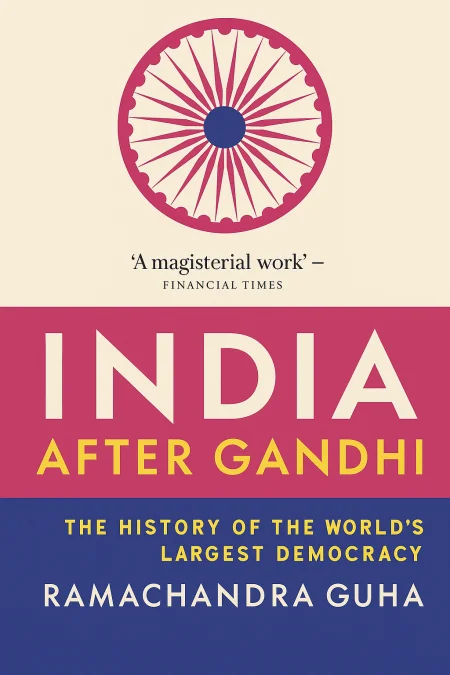
India After Gandhi
The History of the World’s Largest Democracy
Book Edition Details
Summary
The vibrant mosaic of post-colonial India unfolds in Ramachandra Guha's "India After Gandhi," a vivid tapestry of struggle and resilience. Amidst the cacophony of conflicts that threatened to unravel the world's largest democracy, Guha masterfully paints a portrait of a nation bound by its spirit and diversity. This scholarly opus, rich with intrigue and historical grandeur, invites readers to witness the intricate dance between chaos and cohesion that defines modern India. With every page, larger-than-life figures emerge, battling for the soul of a newly sovereign land, while unexpected alliances and enduring legacies hold the fragile fabric together. Prepare to be swept away by an epic narrative that captures the triumphs and trials of a nation constantly redefining itself against the backdrop of its tumultuous past.
Introduction
When the clock struck midnight on August 15, 1947, India awakened to freedom after centuries of colonial rule, yet this moment of triumph was shadowed by unprecedented challenges that would test the very survival of the world's newest democracy. How does a nation of 350 million people, divided by countless languages, religions, and castes, forge itself into a unified state while building democratic institutions from scratch? The answer to this question would reshape our understanding of what makes democracy possible. This extraordinary period reveals three profound historical insights that continue to resonate today. First, it challenges the assumption that democracy requires certain economic or social prerequisites, demonstrating instead that democratic institutions can take root through creative adaptation to local conditions. Second, it illuminates how diversity can become a source of strength rather than weakness when channeled through federal structures that give voice to different groups while maintaining national unity. Third, it shows how visionary leadership, grounded in pragmatic institution-building rather than mere charisma, can shape the destiny of nations during their most vulnerable moments. These lessons make this era essential reading for anyone seeking to understand not just India's remarkable journey, but the broader challenges facing emerging democracies everywhere. The story of how India navigated its birth pangs offers both inspiration and practical wisdom for contemporary struggles with pluralism, democratic consolidation, and nation-building in our interconnected world.
Partition's Trauma and Democratic Foundations (1947-1950)
The euphoria of independence quickly gave way to the harsh realities of partition, as millions of Hindus, Muslims, and Sikhs crossed newly drawn borders in what became the largest mass migration in human history. Ten million people abandoned their ancestral homes while communal violence claimed between 200,000 and one million lives. The scale was staggering, yet the human cost was measured not just in numbers but in the severing of cultural bonds that had developed over centuries. The refugee crisis tested India's nascent institutions to their breaking point. In Punjab alone, the government established nearly 200 camps, including the massive settlement at Kurukshetra that housed 300,000 displaced persons. The challenge was not merely humanitarian but existential, as the new nation had to prove it could protect and provide for its most vulnerable citizens. The remarkable efficiency of the resettlement operation, led by civil servants like Tarlok Singh, demonstrated the administrative capacity that would become crucial for India's survival. Perhaps most significantly, this period revealed both the fragility of communal harmony and the resilience of democratic ideals. The violence that accompanied partition was not inevitable but resulted from decades of divisive politics that had poisoned relations between communities. Gandhi's assassination in January 1948 by a Hindu extremist served as a stark reminder that the forces of hatred threatened the very foundations of the secular state Nehru envisioned. Yet from this trauma emerged a deeper commitment to democratic governance and secular values. The trauma of partition would shape Indian politics for generations, creating a deep suspicion of religious nationalism and reinforcing the determination to build a nation where citizenship, not faith, would determine belonging. This foundational experience established the precedent that in times of crisis, the Indian state would mobilize all available resources to protect its citizens, regardless of their background, setting the stage for the constitutional democracy that would soon emerge.
Constitutional Democracy and Linguistic Reorganization (1950-1956)
Between 1946 and 1949, representatives from across India gathered in New Delhi's Constitution Hall to draft what would become one of the world's longest and most comprehensive constitutions. This was democracy by design rather than evolution, as leaders like B.R. Ambedkar sought to create institutions that could accommodate India's bewildering diversity while promoting social justice. The constitution balanced federal and unitary features, guaranteed fundamental rights while allowing for affirmative action, and established an independent judiciary as the guardian of democratic values. The real test came with India's first general election in 1951-52, an exercise that foreign observers dismissed as the biggest gamble in history. How could 176 million voters, most of them illiterate, make informed choices in a meaningful democratic process? Chief Election Commissioner Sukumar Sen's innovative solutions, including pictorial symbols for parties and multiple ballot boxes, demonstrated that democracy could be adapted to local conditions without compromising its essential character. The success of this democratic experiment was soon challenged by demands for linguistic states, which posed perhaps the greatest threat to Indian unity after partition. When Telugu-speaking regions demanded a separate Andhra state, Nehru initially resisted, fearing that linguistic divisions would fragment the nation. The death of Potti Sriramulu after a 58-day fast in 1952 changed everything, sparking massive protests that forced the government to concede. What seemed like a recipe for disintegration actually strengthened Indian democracy. The States Reorganization Commission, established in 1953, faced the monumental task of balancing linguistic aspirations with national unity. By acknowledging linguistic identities within a federal framework, the reorganization channeled potentially separatist energies into constructive state-building. Regional languages flourished, distinctive cultural expressions emerged, and state governments became laboratories for policy innovation. The feared Balkanization never materialized because linguistic states remained firmly committed to the Indian union, offering valuable lessons about managing diversity in multi-ethnic societies.
Industrial Vision and Federal Consolidation (1956-1960)
Nehru's vision of a modern India centered on rapid industrialization through state-led planning, marking a decisive shift from the political challenges of the early years to the economic imperatives of development. The establishment of the Planning Commission in 1950 had begun an ambitious attempt to transform a predominantly agricultural economy into an industrial powerhouse. The Second Five-Year Plan, crafted by statistician P.C. Mahalanobis, emphasized heavy industries and import substitution, reflecting the era's faith in state-directed development. The construction of massive steel plants at Bhilai, Rourkela, and Durgapur became symbols of national pride and technological achievement. These projects, built with assistance from the Soviet Union, Germany, and Britain respectively, demonstrated India's ability to master complex industrial processes while maintaining non-aligned foreign policy. Similarly, large dams like Bhakra-Nangal were hailed as temples of modern India, promising to liberate agriculture from monsoon dependence while generating power for industry. The planning approach reflected deeper philosophical commitments about the role of the state in promoting social welfare and economic justice. Unlike purely market-driven development, Indian planning explicitly aimed to reduce inequality and ensure that the benefits of growth reached the poorest citizens. This model influenced development thinking across the newly independent world, from Egypt to Indonesia, establishing India as a leader among developing nations. However, this period also revealed the tensions between democratic governance and technocratic planning. The emphasis on heavy industry came at the cost of neglecting agriculture and consumer goods, creating imbalances that would later constrain growth. More importantly, the success of linguistic reorganization and industrial planning strengthened federal institutions and demonstrated that India could manage both unity and diversity, both democracy and development. By 1960, the foundations of modern India were firmly in place, setting the stage for the more complex challenges that would emerge in subsequent decades.
Summary
The period from 1947 to 1960 established the fundamental character of modern India through the successful navigation of three interconnected challenges: building democratic institutions, managing diversity, and pursuing economic development. The central tension throughout was between the imperative of national unity and the reality of extraordinary diversity, resolved through innovative institutional arrangements that accommodated difference within a shared democratic framework. The historical experience offers profound insights for contemporary nation-building efforts that remain strikingly relevant today. Democracy need not wait for ideal conditions but can be successfully established through creative adaptation to local circumstances, as demonstrated by India's electoral innovations and constitutional design. Diversity can be a source of strength rather than weakness when channeled through federal institutions that give voice to different groups while maintaining overarching unity. Visionary leadership matters enormously in shaping national trajectories, but it must be grounded in pragmatic institution-building rather than mere charisma or populist appeals. For today's world, these lessons suggest three actionable principles that transcend India's specific context. First, invest heavily in democratic institutions even when they seem fragile or inefficient, because they provide the only sustainable mechanism for managing social conflict peacefully. Second, embrace diversity as an asset rather than a threat to national unity, designing federal structures that allow different groups to flourish while contributing to a larger whole. Third, pursue development strategies that balance economic growth with social justice, recognizing that sustainable progress requires both material advancement and inclusive governance. India's foundational years remind us that the most daunting challenges of nation-building can be overcome through patient institution-building, inclusive governance, and unwavering commitment to democratic values.
Related Books
Download PDF & EPUB
To save this Black List summary for later, download the free PDF and EPUB. You can print it out, or read offline at your convenience.

By Ramachandra Guha
