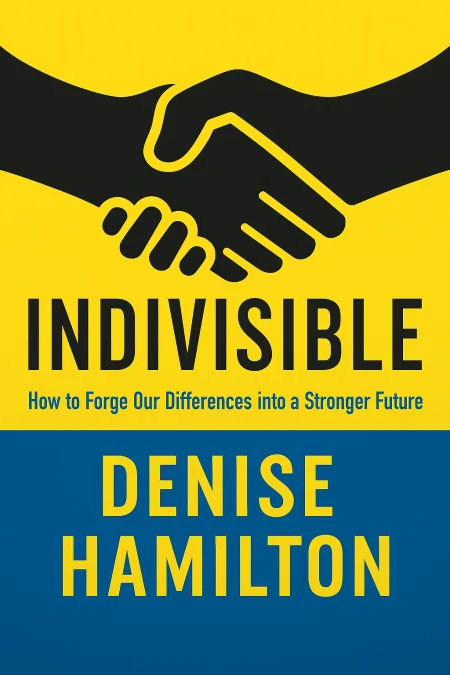
Indivisible
How to Forge Our Differences Into a Stronger Future
Book Edition Details
Summary
What if the world could transcend mere inclusivity to embrace a profound indivisibility? Denise Hamilton's transformative debut invites readers to challenge entrenched beliefs and dismantle societal hierarchies that bind us. Armed with personal narratives and thought-provoking prompts, Hamilton, a luminary in DEI, dares us to envision and create connections that are genuinely indivisible. This isn't just a call to action; it's a blueprint for redefining relationships in both our professional spheres and personal lives. With her insightful guidance, Hamilton crafts a compelling narrative that reaches beyond business, touching the very fabric of human connection and unity. "Indivisible" doesn't just ask us to think differently; it inspires us to act with purpose.
Introduction
Contemporary American society faces a profound challenge that transcends traditional political divisions: how to forge genuine unity from our differences rather than merely tolerating diversity. This exploration delves into the mechanisms that perpetuate division and proposes a transformative approach to building what can be termed "indivisible" communities. The central argument challenges the prevailing assumption that inclusion efforts and diversity initiatives are sufficient solutions to our societal fragmentation. The analysis reveals how our current frameworks for addressing difference often operate from flawed premises, creating superficial changes while leaving deeper structural inequities intact. Rather than settling for tolerance or even acceptance, the text advocates for a more demanding standard of interdependence that recognizes our collective strength depends on the flourishing of all members. Through examining historical patterns, institutional practices, and personal interactions, a comprehensive blueprint emerges for moving beyond performative gestures toward substantive transformation. Readers will encounter a systematic deconstruction of comfortable assumptions alongside practical methodologies for creating environments where differences become sources of collective power rather than division.
Confronting Uncomfortable Truths About Our Broken Stories
The foundation of genuine unity requires dismantling the mythologies that obscure historical realities and perpetuate harmful patterns. These narratives, often presented as patriotic or inspirational, frequently contain significant distortions that prevent communities from honestly assessing their current challenges. The examination reveals how seemingly innocent stories about national heroes, institutional practices, and cultural traditions often sanitize complex histories, creating blind spots that hinder progress. Historical revisionism takes multiple forms, from textbook omissions that present slavery as merely "agricultural labor" to the persistent circulation of debunked tales that serve ideological purposes. These distorted narratives create cognitive dissonance when confronted with evidence that challenges beloved beliefs. The resistance to factual correction often stems not from intellectual disagreement but from identity protection, as individuals and communities invest their sense of self in particular versions of history. The process of truth-telling requires distinguishing between productive discomfort that leads to growth and destructive shame that paralyzes action. Confronting difficult truths about past and present inequities creates the necessary foundation for building authentic relationships across difference. Without this honest reckoning, efforts at inclusion remain superficial, addressing symptoms while leaving root causes untouched. Moving beyond comfortable fiction toward uncomfortable truth demands both intellectual courage and emotional resilience. This transition involves grieving the loss of simpler stories while embracing the complexity of real human experience, ultimately creating space for more inclusive and accurate narratives that honor the full spectrum of American experiences.
Moving from Ownership to Active Change Leadership
Transformative change requires shifting from passive consumption of societal benefits to active stewardship of collective wellbeing. This transition involves recognizing the distinction between those who extract value from systems versus those who invest in long-term sustainability. The metaphor of ownership versus renting illuminates how different mindsets approach community challenges, with owners taking responsibility for maintenance and improvement while renters focus primarily on personal benefit. Genuine leadership in creating inclusive environments demands personal accountability that extends beyond individual success to encompass systemic health. This involves examining how current practices, policies, and cultural norms either facilitate or hinder the full participation of all community members. Leaders must develop the capacity to identify and address structural barriers, even when those barriers have historically benefited their own advancement. The concept of "placechanging" emerges as a critical leadership function, involving the deliberate expansion of opportunities and the removal of artificial constraints that limit human potential. This requires not only recognizing talent in unexpected places but also creating pathways for that talent to flourish. Historical examples demonstrate how exclusionary practices often waste tremendous human resources, depriving entire systems of valuable contributions. Effective change leadership also involves modeling vulnerability and continuous learning, acknowledging that expertise in one area does not automatically translate to competence in navigating complex human dynamics. The most impactful leaders combine strategic thinking with genuine humility, seeking input from affected communities rather than imposing solutions from positions of assumed authority. This collaborative approach generates more sustainable and effective outcomes than top-down mandates.
Bridging Differences Through Creative Middle-Ground Solutions
Complex social challenges require innovative approaches that transcend traditional either-or thinking. The tendency to frame issues in binary terms often obscures creative possibilities that could address multiple concerns simultaneously. Effective bridge-building involves identifying underlying values that different groups share, even when their surface-level positions appear incompatible. The process of finding middle ground begins with expanding beyond familiar perspectives and actively seeking to understand how different groups experience the same situations. This involves recognizing that identical policies or practices can have vastly different impacts depending on individual circumstances and historical contexts. What appears fair from one vantage point may create significant hardship from another, requiring nuanced solutions that account for diverse needs. Creative problem-solving often involves challenging assumptions about resource scarcity and zero-sum competition. Many conflicts arise from the false belief that improving conditions for one group necessarily diminishes opportunities for others. Historical examples demonstrate how expanding access and removing barriers frequently generates benefits that extend far beyond the initially targeted populations. The art of creative compromise also requires distinguishing between core principles that cannot be negotiated and tactical approaches that allow for flexibility. Successful bridge-building maintains focus on shared goals while remaining open to multiple pathways for achieving those objectives. This approach generates solutions that may initially seem unconventional but prove more durable and effective than traditional approaches that satisfy no one completely.
Listening for Echoes and Choosing Justice Over Peace
Sustainable change requires developing sensitivity to the persistent effects of historical inequities that continue to shape present-day experiences. These "echoes" appear as seemingly neutral policies or practices that inadvertently perpetuate past exclusions, creating ongoing disadvantages that may not be immediately visible to those in privileged positions. Identifying these patterns requires deliberate attention and willingness to examine familiar systems with fresh eyes. The choice between peace and justice often emerges when addressing these systemic echoes creates temporary discomfort or conflict. The preference for maintaining harmony can inadvertently preserve harmful status quo conditions, prioritizing the comfort of those in power over the wellbeing of those experiencing ongoing harm. Authentic peace can only emerge from establishing just conditions, not from suppressing legitimate grievances. Effective intervention requires developing both individual courage to speak truth in difficult moments and systemic changes that address root causes rather than merely symptoms. This involves creating accountability mechanisms that ensure harmful behaviors face appropriate consequences while also providing pathways for genuine redemption and growth. The goal extends beyond punishment to include restoration and prevention of future harm. The process of choosing justice over superficial peace demands sustained commitment that persists through periods of resistance and backlash. Change efforts often face their greatest challenges not at the beginning but during implementation, when initial enthusiasm wanes and entrenched interests mobilize opposition. Maintaining momentum requires clear vision, strategic thinking, and the ability to celebrate incremental progress while keeping sight of ultimate objectives.
Summary
The path to genuine unity requires abandoning comfortable illusions in favor of honest confrontation with both historical truths and present realities, followed by sustained commitment to systemic transformation rather than superficial accommodation. This approach demands personal courage, strategic thinking, and collaborative leadership that prioritizes collective flourishing over individual comfort. The framework presented offers a comprehensive methodology for building truly inclusive communities that harness the full potential of human diversity, creating strength through interdependence rather than mere tolerance. Readers seeking to move beyond performative gestures toward substantive change will find both the analytical tools and practical guidance necessary for this challenging but essential work.
Related Books
Download PDF & EPUB
To save this Black List summary for later, download the free PDF and EPUB. You can print it out, or read offline at your convenience.

By Denise Hamilton
