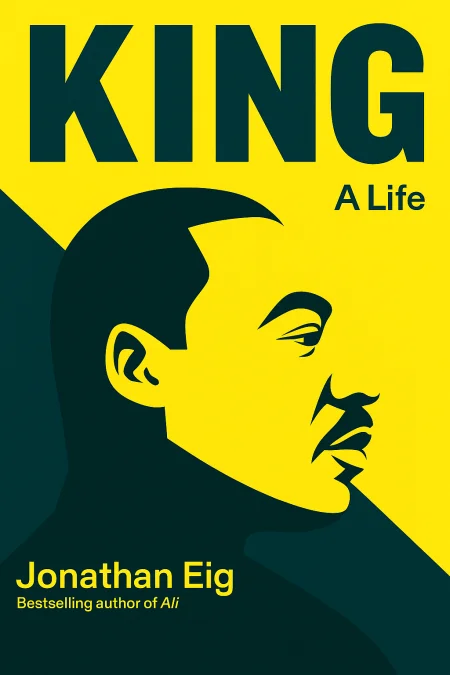
King
A Life
Book Edition Details
Summary
In the pages of Jonathan Eig’s masterful biography, the veil lifts on Martin Luther King Jr.—not as a distant icon, but as a man of flesh and bone, fraught with struggles and triumphs. Here, King’s saga unfolds, a tapestry woven with exhaustive new research and vivid storytelling. Peek into the soul of a minister who grappled with his own demons while galvanizing a nation towards justice. With fresh insights from declassified FBI files, Eig paints a portrait of King as a strategic thinker and radical visionary, navigating the tumultuous landscapes of Birmingham, Selma, and beyond. This isn’t just history; it’s the heartbeat of a legacy—a call to action that echoes with urgency today. Eight pages of rare photographs accompany this journey, offering a poignant glimpse into the life of America’s most cherished martyr, forever altering the course of civil rights.
Introduction
On a cold December evening in 1955, a twenty-six-year-old Baptist preacher stood before five thousand angry and frightened people in Montgomery, Alabama. Martin Luther King Jr. had been thrust into leadership of a bus boycott that would last 381 days and transform America forever. Yet this moment was just the beginning of a journey that would challenge the nation's deepest contradictions and force a reckoning with its founding promises. This remarkable story reveals how one man's spiritual awakening became America's moral awakening. It explores the profound question of how ordinary people find extraordinary courage in the face of seemingly insurmountable injustice. Through King's transformation from a privileged young minister to the nation's most powerful voice for justice, we witness the birth of a movement that would reshape American democracy itself. The narrative illuminates three critical phases of this awakening, each building upon the last, each demanding greater sacrifice and deeper faith. It's a story for anyone seeking to understand how social change actually happens, how moral leadership develops under pressure, and how the arc of history, though long, can indeed bend toward justice when people of conscience refuse to accept the unacceptable.
From Privileged Pastor to Montgomery Leader (1929-1957)
Martin Luther King Jr.'s journey began not in the cotton fields of the Deep South, but on Sweet Auburn Avenue in Atlanta, a thriving center of Black prosperity and pride. Born in 1929 to a family that had already tasted freedom's possibilities, young King grew up insulated from the worst brutalities of Jim Crow, yet acutely aware of its daily humiliations. His father, Martin Luther King Sr., had escaped the sharecropper's life through sheer determination, transforming himself from "Mike King" into "Martin Luther King" and building Ebenezer Baptist Church into a pillar of Atlanta's Black community. The formative experiences of King's youth reveal the complex psychology of a future leader. When his white childhood friend was forbidden to play with him because of race, King experienced his first searing encounter with segregation's arbitrary cruelty. Yet rather than crushing his spirit, these early wounds seemed to forge an inner strength. His mother's gentle wisdom that "you're as good as anyone" planted seeds of self-worth that would later bloom into a philosophy of universal human dignity. King's education at Morehouse College under Benjamin Mays exposed him to a broader vision of Christianity's social mission. Here he encountered the radical idea that the Gospel demanded not just personal salvation but social transformation. The intellectual foundations were being laid for what would become his life's work. As Mays taught his students, they were called to be "a creative minority" willing to challenge unjust systems. When Rosa Parks's arrest on December 1, 1955, provided the spark, it was King's voice that ignited the flame of sustained resistance. The 381-day boycott that followed became a masterclass in nonviolent resistance and community organizing. King's genius lay in his ability to frame the struggle in terms that resonated across racial and religious lines. This wasn't just about bus seats, he argued, but about the soul of America itself. The boycott's success reverberated far beyond Montgomery's city limits, establishing King as the movement's most compelling spokesperson and proving that organized resistance could topple seemingly immutable systems of oppression.
Birmingham to Washington: Becoming America's Moral Voice (1958-1963)
The formation of the Southern Christian Leadership Conference in 1957 marked King's evolution from local leader to national figure. With his appearance on the cover of Time magazine and his powerful speeches at national gatherings, King stepped onto the national stage as the primary spokesman for Black America's aspirations. His message was clear: the time for gradual change had passed, and America must choose between justice and continued moral decay. King's pilgrimage to India in 1959 deepened his understanding of nonviolent resistance and its potential for social transformation. Walking in Gandhi's footsteps, he came to see the American civil rights struggle as part of a global movement toward human dignity and freedom. The poverty he witnessed in India also opened his eyes to the connections between racial injustice and economic inequality, planting seeds for his later focus on economic justice. Birmingham became King's masterpiece of strategic confrontation in 1963. Unlike previous campaigns, Birmingham was deliberately chosen because its notorious Commissioner Bull Connor could be counted on to respond to peaceful protests with shocking brutality. King knew Connor's violent reactions would be broadcast into American living rooms, forcing the nation to confront the reality of segregation. The decision to use children as protesters was controversial but brilliant, as images of police dogs attacking young people and fire hoses knocking down teenagers created a moral crisis that demanded federal intervention. The campaign's success lay not just in its immediate goals of desegregating Birmingham's businesses, but in its broader impact on national consciousness. King's "Letter from Birmingham Jail" articulated the moral urgency of the civil rights cause with unprecedented eloquence, while the televised brutality against peaceful protesters shattered any remaining illusions about the benign nature of segregation. This period culminated in the March on Washington, where King's "I Have a Dream" speech transformed him from a regional leader into a global symbol of human rights, demonstrating the movement's ability to mobilize massive numbers while maintaining perfect discipline.
Vietnam War Opposition and Final Campaigns (1964-1968)
King's receipt of the Nobel Peace Prize in 1964 marked both the pinnacle of his international recognition and the beginning of his most challenging period. While the Civil Rights Act of 1964 and Voting Rights Act of 1965 represented legislative triumphs, King understood that legal victories meant little without addressing the deeper structures of American inequality. The riots in Watts and other northern cities revealed that the movement's southern strategy was insufficient for addressing the complex problems of urban poverty, housing discrimination, and economic inequality. King's opposition to the Vietnam War, announced definitively in his "Beyond Vietnam" speech at Riverside Church in 1967, alienated many former allies who saw it as a dangerous expansion of his mission. King argued that he could not condemn violence in the ghettos while remaining silent about his government's violence in Southeast Asia. He connected American militarism abroad to racism and poverty at home, articulating a radical critique that went far beyond civil rights to challenge the fundamental values of American society. The stance cost him support among moderate whites and even some Black leaders, while the FBI launched an all-out campaign to destroy his reputation. The Chicago campaign of 1966 exposed the limitations of King's southern strategy when applied to northern urban problems. Unlike the clear moral lines of southern segregation, Chicago's discrimination was subtle, complex, and deeply embedded in economic structures. King encountered hostility not just from white supremacists but from working-class whites who saw civil rights as a threat to their own precarious economic position. King's final campaign, the Poor People's Campaign, represented his most radical vision: a multiracial coalition demanding economic justice for all Americans. He argued that the civil rights movement had focused too narrowly on integration while ignoring the economic systems that perpetuated poverty. His assassination in Memphis on April 4, 1968, where he had gone to support striking sanitation workers, symbolically linked his death to his expanding vision of economic justice. The tragedy of his death at age thirty-nine was compounded by the immediate eruption of riots in over one hundred cities, yet his legacy proved more durable than his critics expected.
Summary
The story of Martin Luther King Jr. reveals the central tension that has defined American history from its founding: the gap between democratic ideals and democratic reality. King's genius lay in his ability to hold America accountable to its own stated values, using the language of the Constitution and the Bible to demand that the nation live up to its promises of equality and justice. His movement succeeded not by rejecting American ideals, but by insisting that they be applied universally. The historical lessons remain urgently relevant today. First, sustainable social change requires both moral vision and strategic brilliance. King's success came from combining prophetic rhetoric with careful planning and tactical flexibility. Second, progress is never inevitable; it requires constant vigilance and organized pressure from below. The civil rights gains of the 1960s were reversed in many areas when that pressure diminished. Finally, true democracy demands not just legal equality but economic justice. King's final campaigns recognized that political rights mean little without economic opportunity. For contemporary movements seeking social change, King's example offers both inspiration and practical guidance. Build coalitions that cross traditional boundaries. Use media strategically to expose injustice and build public support. Maintain nonviolent discipline even when provoked. Most importantly, understand that the arc of history bends toward justice only when enough people are willing to grab it and pull. King's legacy reminds us that ordinary citizens, when properly organized around moral principles, possess the power to transform society and redeem the democratic promise for all Americans.
Related Books
Download PDF & EPUB
To save this Black List summary for later, download the free PDF and EPUB. You can print it out, or read offline at your convenience.
By Jonathan Eig
