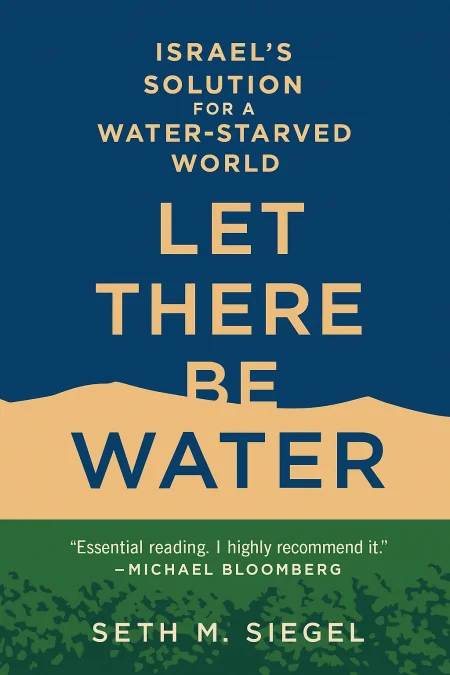
Let There Be Water
Israel’s Solution for a Water-Starved World
Book Edition Details
Summary
In a world parched by the relentless advance of water scarcity, one nation defies the odds. Israel, a desert-draped marvel, stands as a beacon of hydrological ingenuity. "Let There Be Water" unveils the riveting tale of how this small country transformed its barren landscape into a flourishing oasis through audacious innovation and unwavering resolve. Brimming with untold stories of quirky inventors and unexpected alliances, this book delves into the alchemy of turning scarcity into abundance. From fueling regional diplomacy to rekindling international relations, the narrative flows with insights that ripple far beyond borders. As looming water crises threaten global stability, the lessons from Israel's trailblazing triumphs hold the promise of hope and resilience for nations and readers alike. A masterclass in visionary leadership, this book beckons you to discover how one nation’s quest for water security could illuminate the path for the entire world.
Introduction
In the scorching desert of the Middle East, where ancient civilizations once flourished and collapsed under the weight of water scarcity, an extraordinary transformation has quietly unfolded over the past century. While neighboring regions grapple with mounting water crises that threaten their very survival, one small nation has achieved the seemingly impossible: converting absolute water poverty into unprecedented abundance and global leadership. This remarkable journey reveals how a country blessed with no natural water advantages—surrounded by hostile neighbors, covered sixty percent by desert, and cursed with declining rainfall—systematically transformed these crushing limitations into the foundation of national prosperity. The story encompasses three profound questions that extend far beyond the Middle East: How can societies overcome apparently insurmountable resource constraints through visionary planning and technological innovation? What happens when long-term thinking becomes the cornerstone of national survival strategy? And perhaps most urgently for our water-stressed world, how can other regions apply these hard-won lessons before crisis becomes catastrophe? This narrative offers invaluable insights for policy makers wrestling with infrastructure challenges, business leaders pursuing sustainable solutions, and citizens concerned about environmental security. It demonstrates that scarcity, rather than abundance, can become the most powerful catalyst for revolutionary breakthroughs that ultimately benefit not just one nation, but the entire world.
Foundation Era: Building Water Infrastructure Against All Odds (1920s-1960s)
The foundations of water mastery were forged in the crucible of existential necessity, long before independence became reality. When Zionist pioneers arrived in the 1920s and 1930s, they confronted a brutal truth that British colonial officials would later weaponize against Jewish immigration: the land simply could not sustain large populations due to catastrophic water shortages. The infamous 1939 White Paper declared that Palestine could support no more than two million people, effectively sentencing the entire Zionist enterprise to inevitable failure. This death sentence sparked a revolutionary response that would reshape the relationship between human civilization and natural constraints. Simcha Blass, a visionary Polish-born engineer who would become the architect of the national water system, began developing comprehensive plans that defied every conventional assumption about resource limitations. His audacious vision extended far beyond local wells and primitive irrigation to encompass an integrated national network capable of transporting water from the abundant north to the parched south, creating abundance where nature had provided only scarcity. The cultural transformation proved equally revolutionary. Unlike societies that treated water as private property to be hoarded and exploited, the emerging Jewish community embraced radical collective ownership and management. The groundbreaking Water Law of 1959 established that all water belonged to the people as a unified whole, creating a socialist approach to resource stewardship that would endure even as the country later embraced free-market capitalism in virtually every other sector. The era culminated triumphantly in 1964 with the completion of the National Water Carrier, a massive engineering marvel that transported precious water across the entire country. Far more than mere infrastructure, it represented a fundamental philosophical victory over natural limitations, proving that human ingenuity and collective determination could literally reshape the relationship between society and environment, establishing the foundation for even more dramatic innovations ahead.
Technological Breakthrough: Drip Irrigation and Desalination Revolution (1960s-2000s)
The decades following the National Water Carrier's completion witnessed an explosion of technological innovation that would revolutionize agriculture and water management across the globe. The breakthrough began with Simcha Blass's seemingly mundane observation of a single tree growing dramatically larger than its neighbors, thriving due to nothing more than a tiny leak in a nearby irrigation pipe. This simple insight evolved into drip irrigation technology that would save forty to seventy percent of agricultural water while simultaneously increasing crop yields to previously unimaginable levels. The innovation's impact transcended mere water conservation to enable fundamental transformations in agricultural possibility. Drip irrigation made farming viable in previously unusable desert regions, allowed precise delivery of fertilizers directly to plant roots, and remarkably made agriculture possible using brackish water that would normally destroy crops. Israeli scientists developed specialized seeds that actually thrived under these harsh conditions, producing vegetables and fruits that were sweeter and more nutritious than those grown through traditional methods with abundant water. Parallel developments in desalination and wastewater treatment created entirely new water sources that seemed almost magical in their transformation of waste into precious resource. The country began treating and reusing an astounding eighty-five percent of its sewage for agricultural purposes, creating a parallel water system that provided reliable supply regardless of rainfall patterns or natural water availability. Early experiments with desalination, though initially expensive and energy-intensive, established crucial groundwork for future breakthroughs that would eventually make manufactured water cost-competitive with natural sources. These technological advances created a powerful virtuous cycle where each breakthrough enabled new possibilities, which in turn drove demand for further innovation. The period firmly established the revolutionary principle that water challenges should be met not with rationing, restriction, and acceptance of limitation, but with creativity, technology, and the relentless pursuit of abundance through human ingenuity.
Water Abundance: From Scarcity to Global Leadership (2000s-Present)
The new millennium brought the spectacular culmination of decades of planning and innovation through large-scale seawater desalination plants that fundamentally transformed the national water equation forever. Five massive facilities along the Mediterranean coast began producing nearly 500 million gallons of pristine freshwater daily, making desalinated water the country's largest single water source and effectively ending the age of scarcity that had defined the region for millennia. This manufactured abundance enabled a complete reversal of traditional water paradigms that had governed human civilization since ancient times. Instead of desperately extracting every possible drop from increasingly stressed natural sources, the country could now allow rivers to flow freely, supporting environmental restoration and recreational use that had been unthinkable luxuries just decades earlier. The Sea of Galilee, once monitored with obsessive anxiety for dangerous water level drops, stabilized as a managed reservoir within a flexible, integrated system that balanced human needs with environmental health. The transformation extended far beyond domestic benefits to create unprecedented international influence and commercial opportunity. Water technology exports exploded from $700 million to over $2 billion annually, with hundreds of innovative companies developing cutting-edge solutions for desperate global markets. The country became a pilgrimage destination for water professionals worldwide, hosting thousands of visitors annually who came to study revolutionary techniques they could adapt to their own water-stressed regions. Perhaps most significantly, water abundance created entirely new possibilities for regional cooperation and diplomatic breakthrough. The country could now afford to share water with neighbors, provide technical assistance to former adversaries, and deploy water expertise as a powerful bridge-building tool in international relations. Ambitious projects like the Red Sea-Dead Sea initiative, involving Jordan and the Palestinian Authority, demonstrated how water cooperation could create frameworks for broader regional collaboration, suggesting that resource challenges might ultimately become vehicles for peace rather than perpetual sources of conflict.
Worldwide Impact: Lessons for Global Water Crisis Solutions
The extraordinary transformation from water scarcity to abundance offers profound lessons for addressing global water challenges that currently threaten billions of people worldwide. The experience demonstrates conclusively that water problems are fundamentally governance and vision problems, requiring long-term strategic thinking, sustained technological innovation, and the political courage to make difficult but absolutely necessary investments in infrastructure and institutional transformation. The most crucial insight involves the revolutionary power of treating water as a managed resource rather than an unchangeable natural constraint. By systematically developing multiple sources including natural, recycled, and manufactured water, then integrating them into a flexible, responsive system, it becomes possible to completely decouple economic growth and population expansion from natural water availability. This approach demands significant upfront investment and often painful cultural change, but ultimately provides far greater security and substantially lower costs than traditional approaches based on exploiting natural sources to their absolute limits. The regional cooperation model pioneered here points toward practical solutions for transboundary water challenges affecting multiple countries across continents. When parties can develop shared infrastructure and complementary capabilities, they create beneficial interdependencies that serve both immediate practical needs and long-term diplomatic purposes. The key lies in structuring arrangements so that all parties gain significant benefits while none can easily withdraw without seriously harming their own interests, creating stable foundations for sustained cooperation. For water-stressed regions worldwide, the path forward requires embracing both the technical and social dimensions of this transformation, recognizing that technology alone cannot solve problems rooted in inadequate governance, short-term thinking, and failure to invest in long-term solutions that transcend immediate political cycles.
Summary
The remarkable journey from water scarcity to abundance reveals a fundamental truth about human societies and their relationship with natural constraints: resource limitations need not determine destiny when confronted with visionary leadership, sustained innovation, and collective action guided by long-term thinking rather than short-term expedience. The central theme threading through this transformation demonstrates the extraordinary power of treating apparent limitations as opportunities for breakthrough thinking rather than accepting them as permanent barriers to human progress and prosperity. The experience offers three crucial insights for contemporary global challenges. First, long-term infrastructure investments guided by comprehensive planning can fundamentally alter a society's relationship with natural constraints, but only when supported by appropriate institutions, cultural values, and political commitment that transcends electoral cycles. Second, technological innovation thrives under pressure when combined with systematic research, entrepreneurial culture, and willingness to experiment with unproven solutions that conventional wisdom dismisses as impossible. For leaders facing water stress in their own regions, the path forward requires embracing both technical and social dimensions of transformation. This means investing systematically in diverse water sources, developing robust institutional frameworks for long-term planning, and fostering innovation ecosystems that can adapt global solutions to unique local conditions. Most importantly, it demands the courage to think beyond traditional approaches and the persistence to pursue solutions that may require decades to fully realize but possess the power to transform entire societies and regions in the process.
Related Books
Download PDF & EPUB
To save this Black List summary for later, download the free PDF and EPUB. You can print it out, or read offline at your convenience.
By Seth M. Siegel
