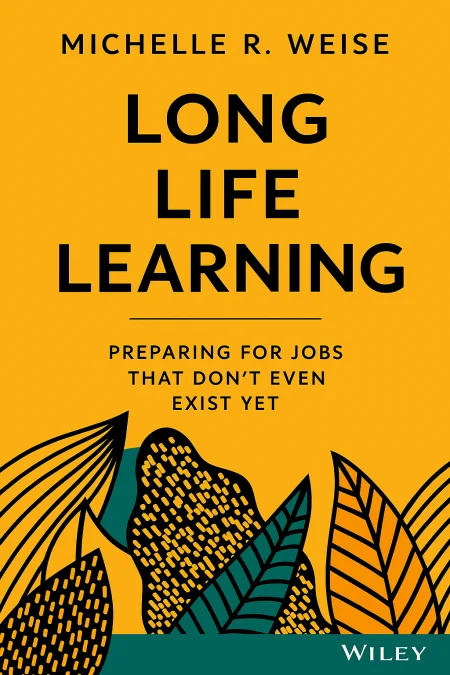
Long Life Learning
Preparing for Jobs that Don't Even Exist Yet
Book Edition Details
Summary
Futures are forged in classrooms without walls, and in "Long Life Learning: Preparing for Jobs That Don’t Even Exist Yet," the blueprint for tomorrow's educational landscape emerges. Imagine careers stretching across a century, where education isn't a stage but a lifelong companion. This book, penned by a leading mind in workforce innovation, challenges the static nature of traditional degrees and unveils a dynamic learning model poised to redefine how we work and learn. With careers no longer bound by a linear trajectory, the narrative dissects how extended lifespans demand perpetual learning, ushering in an era of adaptability and evolution. It's a must-read for those eager to navigate the seismic shifts in education and employment, revealing a future where the only constant is change.
Introduction
Sarah had worked at the same pharmacy for fifteen years, starting as a high school graduate with dreams of advancement. Her managers promised growth opportunities, but as store leadership churned and the retail landscape shifted, those promises never materialized. At forty-three, with a family to support and bills mounting, Sarah found herself trapped in a dead-end position, watching younger employees with college degrees leap past her into roles she could handle with her eyes closed. The cruel irony? She possessed years of customer service expertise, inventory management skills, and deep product knowledge, but none of it counted without "that piece of paper" employers demanded. Sarah's story echoes across millions of American lives today. In an era where technological change accelerates daily and career paths grow increasingly unpredictable, traditional education models are failing the workers who need them most. The promise of lifelong learning remains largely theoretical while real people struggle to navigate an economy that demands constant reskilling but offers few accessible pathways to acquire new capabilities. This exploration reveals how outdated systems create barriers for adult learners while showcasing innovative solutions emerging across the country. Through intimate portraits of workers reinventing themselves and organizations pioneering new approaches, we discover practical strategies for building an education ecosystem that truly serves the future of work. These stories illuminate both the urgent challenges facing working adults and the transformative possibilities when learning adapts to meet people where they are.
The End of Linear Careers: From Steve's Struggle to Systemic Change
Steve's body was telling him it was time for a change. After twenty years as an IT specialist, crawling under desks and hauling heavy equipment, the fifty-one-year-old sole breadwinner for his extended family knew he needed to transition to something less physically demanding. Teaching seemed like a natural fit given his love for children, but the path forward felt impossibly complex. How could he afford to go back to school while supporting his wife, two sons, and grandson? Where would he find the time between work and family obligations? Most frustratingly, he had no idea whether teaching was truly the best career move or simply the most familiar option within reach. Steve's predicament reflects a fundamental shift in how we think about careers and learning. The traditional model of front-loading education in our twenties, followed by a linear career trajectory, is crumbling under the weight of technological change and increased longevity. Today's workers can expect to live and work decades longer than previous generations, with some experts predicting work lives spanning 60 to 100 years. In this extended timeline, the dozen or more job transitions that have become the new normal will likely multiply exponentially. This transformation demands a complete rethinking of how education and work intersect throughout our extended lives. The old paradigm of "learn, earn, rest" must evolve into continuous cycles of "learn, earn, learn, earn" as workers navigate 20 to 30 career transitions. Yet our current systems remain stubbornly designed for a world that no longer exists, leaving millions of workers like Steve to navigate these transitions without adequate support, guidance, or accessible pathways for renewal.
Five Pillars of Tomorrow's Learning Ecosystem
Consider what Steve's journey could look like in a reimagined system. Instead of facing his transition alone, he would begin with a comprehensive skills assessment that revealed not just his current capabilities but also illuminated unexpected career pathways beyond teaching. Using real-time labor market data, he would discover that his IT background, combined with his natural teaching ability, positioned him perfectly for emerging roles in corporate training or educational technology that he never knew existed. With this clearer picture of possibilities, Steve would access wraparound support services connecting him with trusted advisors who understood both his financial constraints and family obligations. Rather than choosing between work and education, he would find flexible learning pathways that integrated with his current responsibilities, perhaps through evening cohorts with other career changers or competency-based programs that recognized his existing expertise while building new skills efficiently. The funding wouldn't require choosing between family stability and personal growth. Income share agreements would allow him to pay for training only after securing better employment, while his current employer might contribute to targeted upskilling that benefited both Steve's future and the company's immediate needs. Throughout this process, transparent information about outcomes and employer partnerships would give him confidence that his investment in learning would translate into meaningful career advancement. This vision represents five essential pillars of an effective learning ecosystem: navigation support to identify optimal pathways, wraparound services addressing whole-person needs, targeted education tailored to individual goals and market demands, integrated approaches that blend learning with earning, and transparent processes that connect education directly to employment outcomes. When these elements work together, career transitions become manageable journeys rather than overwhelming leaps of faith.
Building Bridges: Innovation Seeds Taking Root
Across the country, innovative organizations are already planting the seeds of this transformed ecosystem. In Providence, Rhode Island, College Unbound serves working adults whose average age is thirty-eight, most juggling full-time jobs while supporting families on modest incomes. Rather than forcing these students into traditional college structures, the school provides dinner and childcare during evening classes, creates peer support networks among students facing similar challenges, and celebrates the life experiences that traditional institutions often view as obstacles. Meanwhile, programs like i.c.stars in Chicago are demonstrating how experiential learning can accelerate skill development while building community. Their intensive technology training doesn't just teach coding; it creates cohorts where low-income young adults work together on real business challenges, developing both technical capabilities and leadership skills through authentic problem-solving experiences that mirror the collaborative nature of modern work. In San Francisco, organizations like Climb Hire are pioneering new funding models that align school success with student success. Participants pay nothing upfront but contribute to supporting future cohorts once they secure well-paying positions, creating sustainable cycles of mutual aid and advancement. These programs also emphasize network building, recognizing that social capital often matters as much as technical skills in launching successful careers. These innovations share common characteristics: they meet learners where they are rather than where institutions think they should be, they integrate multiple forms of support rather than treating education as separate from life circumstances, and they maintain strong connections to employer needs while honoring learner goals. Most importantly, they demonstrate that when we design learning ecosystems around human realities rather than institutional convenience, remarkable transformations become possible for individuals and communities alike.
The Future We Can Write Together
The choice before us is clear, though not simple. We can continue with systems that leave millions of workers stranded between obsolete careers and inaccessible retraining, or we can build the infrastructure needed to support continuous learning and adaptation throughout extended work lives. The technology exists, innovative models are proving their worth, and the economic imperative grows stronger daily as automation and globalization reshape entire industries. Yet systemic change requires more than scattered innovations; it demands coordinated effort among employers, educators, policymakers, and communities to create seamless pathways between learning and earning. Employers must move beyond viewing training as a nice-to-have benefit and recognize talent development as a strategic necessity. Educational institutions need to embrace flexibility and relevance while maintaining quality and rigor. Policymakers must update funding mechanisms and regulatory frameworks designed for a world of stable careers and front-loaded education. Most crucially, we must center these efforts on the lived experiences of working adults rather than the administrative convenience of existing institutions. This means acknowledging that effective learning ecosystems must address childcare, transportation, financial stability, and emotional support alongside skill development. It means recognizing that the wisdom gained through work and life experience represents valuable human capital that should be built upon, not dismissed. The transformation won't happen overnight, but every community can begin by mapping existing resources, identifying gaps, and fostering collaboration among stakeholders who traditionally operate in silos. When we start with empathy for those facing the greatest barriers, the solutions we create benefit everyone who will need to navigate career transitions in an uncertain future.
Summary
The stories throughout this exploration reveal a fundamental truth about our economic moment: the future of work is not something happening to other people in some distant tomorrow, but a present reality affecting all of us who will need to adapt and grow throughout dramatically extended careers. From Steve's midlife transition dilemma to Sarah's retail dead-end, from innovative programs creating new pathways to the technological forces reshaping entire industries, we see that the old promise of lifelong learning can only be fulfilled through radical reimagining of how education and work connect. The five pillars of effective learning ecosystems offer a roadmap for this transformation: navigation support that illuminates unexpected possibilities, wraparound services that address whole-person needs, targeted education tailored to individual and market demands, integrated approaches that blend learning with earning, and transparent processes that connect effort to opportunity. When these elements align, they create something more powerful than any single program or policy: they create hope backed by practical pathways to better futures. Perhaps most importantly, these stories remind us that building better systems is not just an economic necessity but a moral imperative. Every person deserves the opportunity to grow, contribute, and find meaning through work that sustains both their families and their sense of purpose. By centering our efforts on those facing the greatest barriers today, we create infrastructure that will serve all of us as we navigate the transitions yet to come. The future we need is the future we can build, one learner, one program, one community at a time.
Related Books
Download PDF & EPUB
To save this Black List summary for later, download the free PDF and EPUB. You can print it out, or read offline at your convenience.
By Michelle R. Weise
