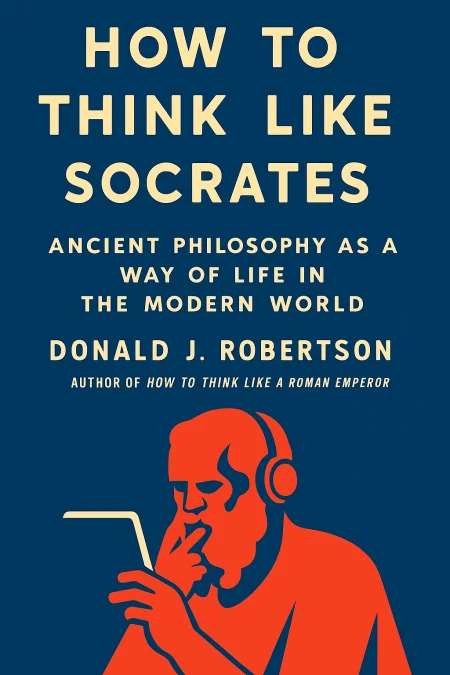
How to Think Like Socrates
Ancient Philosophy as a Way of Life in the Modern World
Book Edition Details
Summary
When the ancient streets of Athens echo with the steps of an inquisitive mind, the whispers of Socrates still resonate, urging modern souls to question, ponder, and redefine their truths. "How to Think Like Socrates" by Donald J. Robertson is not merely a journey through time; it's an invitation to engage with a philosophy as vital today as it was in the age of togas and temples. Robertson, a maestro of cognitive-behavioral therapy, masterfully bridges the chasm between the past and the present, illustrating how the Socratic Method can cut through the noise of contemporary life. With each page, discover how the art of questioning transforms ordinary decisions into reflections of profound wisdom. Embrace the challenge of living more examined lives through the timeless lens of a philosopher who dared to defy conventions and paid the ultimate price for his convictions. This is not just a book; it's a call to arms for thinkers everywhere.
Introduction
In the spring of 399 BCE, as morning light filtered through the columns of an Athenian courthouse, an extraordinary trial was about to begin. An elderly philosopher stood before five hundred citizen-jurors, charged with corrupting the youth and impiety toward the gods. Yet this was far more than the prosecution of one man—it was democracy itself on trial, forced to confront the uncomfortable questions that had haunted it for decades. The story that unfolds reveals how Athens, the brilliant city that gave birth to both democracy and philosophy, could ultimately turn against its own greatest principles. Through this dramatic confrontation between individual conscience and collective authority, we witness the eternal tension between the pursuit of truth and the demands of social conformity. The trial becomes a window into understanding how fear, ambition, and the intoxicating power of rhetoric can corrupt even the most enlightened institutions. This ancient drama speaks directly to anyone grappling with the challenges of living authentically in a world that often rewards conformity over courage. It offers profound insights for those navigating the complexities of moral leadership, civic responsibility, and the delicate balance between intellectual freedom and social stability. The questions raised in that Athenian courtroom echo through the centuries, as relevant today as they were twenty-five centuries ago.
The Oracle's Challenge: Philosophy Confronts Athenian Power (434-431 BCE)
The seeds of Athens's eventual crisis were planted not in moments of defeat, but during the very height of its golden age. As the 430s dawned, the city commanded an empire stretching across the Aegean Sea, its treasury overflowing with tribute, its magnificent Parthenon rising like a marble crown above the Acropolis. Yet beneath this glittering surface, fundamental questions about wisdom, justice, and the nature of good governance remained unexamined, accepted through tradition rather than reason. It was during this period of unprecedented prosperity that an unlikely figure emerged to challenge the city's complacency. Socrates, the son of a stonemason, had received a puzzling pronouncement from the Oracle at Delphi: no man was wiser than he. Rather than accepting this as flattery, the philosopher embarked on a systematic investigation of Athens's most respected citizens, from politicians to poets to craftsmen, seeking to understand what wisdom truly meant. What Socrates discovered proved profoundly unsettling. Those who claimed the greatest knowledge often possessed the least, while their confidence in their own understanding blinded them to their ignorance. The city's leaders, so certain of their wisdom and virtue, crumbled under his gentle but relentless questioning. This revelation—that genuine wisdom began with acknowledging one's ignorance—would become the foundation of his philosophical method and the source of his growing list of powerful enemies. The collision between Socrates's mission and Athens's mounting hubris proved prophetic. As tensions with Sparta escalated and war clouds gathered, the philosopher's insistence on examining all beliefs through reason rather than accepting them through tradition began to seem not just annoying but potentially dangerous. The stage was set for a conflict that would test not only Athens's military might but the very intellectual and moral foundations upon which its civilization rested.
War and Demagogues: Democracy's Moral Decay (431-415 BCE)
The outbreak of the Peloponnesian War in 431 BCE marked the beginning of Athens's long descent from enlightened democracy toward something far darker and more desperate. As the conflict with Sparta dragged on year after year, the noble ideals that Pericles had articulated—Athens as the "school of Hellas"—gave way to a politics of fear, anger, and revenge that would have horrified the city's founders. The death of Pericles from plague in 429 BCE removed the one leader capable of maintaining the delicate balance between democratic participation and wise governance. Into this vacuum stepped demagogues like Cleon, who discovered that appealing to the crowd's basest instincts could win more votes than appeals to justice or reason. The transformation of political discourse from a search for the best policy into a contest of who could sound toughest marked a fundamental corruption of democratic ideals. Meanwhile, professional rhetoricians known as Sophists began teaching the art of persuasion without regard for truth, promising to make the weaker argument appear stronger. These teachers of eloquence turned language into a weapon rather than a tool for understanding, valuing clever wordplay over genuine wisdom. Socrates found himself increasingly at odds with this trend, insisting that knowledge and virtue mattered more than popular approval or rhetorical skill. The war's mounting casualties and military disasters created an environment where questioning traditional beliefs or challenging popular decisions seemed almost treasonous. The infamous debate over Mytilene, where Athens nearly massacred an entire city's population before reversing course the next day, demonstrated how democratic deliberation could become mob rule when guided by emotion rather than reason. As Athens struggled to maintain its empire through increasingly brutal methods, Socrates's voice calling for self-examination and moral reflection became an unwelcome reminder of principles the city was abandoning.
From Sicily to Tyranny: The Collapse of Reason (415-403 BCE)
The disastrous Sicilian Expedition of 415 BCE represented the moment when Athenian ambition finally exceeded Athenian wisdom, with consequences that would reverberate through the remainder of the war. What began as a modest intervention was transformed, through the persuasive rhetoric of Alcibiades and the Assembly's susceptibility to grandiose visions, into the largest military undertaking in Greek history. The expedition's catastrophic failure, resulting in the death or enslavement of thousands of Athenian citizens, marked the end of the city's imperial dreams and the beginning of a desperate struggle for survival. The mutilation of the sacred Herms on the eve of the fleet's departure revealed the depth of social divisions that now plagued Athenian society. The subsequent investigation, marked by denunciations and the torture of slaves, demonstrated how quickly democratic institutions could be weaponized by those seeking to destroy their political enemies. Alcibiades's defection to Sparta after being recalled on charges of impiety illustrated how the pursuit of personal glory, unchecked by moral restraint, could transform democracy's greatest assets into its most dangerous liabilities. Athens's final defeat in 404 BCE brought not just military collapse but the complete breakdown of democratic institutions. The victorious Spartans installed a puppet regime known as the Thirty Tyrants, led by men who had once been Socrates's students. This bitter irony forced the philosopher to confront the ultimate test of his principles when Critias, his former pupil, ordered him to participate in the regime's crimes by arresting an innocent man. Socrates simply walked away—an act of civil disobedience that demonstrated his commitment to justice regardless of personal cost. The eight months of tyrannical rule that followed were marked by executions, confiscations, and the exile of thousands of citizens. When democracy was finally restored in 403 BCE, the traumatized city sought scapegoats for its suffering. Socrates, with his association with former students who had become tyrants and his decades of criticism directed at democratic decision-making, became a convenient target for a society desperate to blame someone for its troubles.
The Final Reckoning: Truth on Trial (403-399 BCE)
The restoration of democracy in 403 BCE should have vindicated Socrates's lifelong commitment to questioning and truth-seeking. Instead, it set the stage for his final confrontation with Athenian society. The new democratic government, haunted by the memory of tyranny and desperate to rebuild social cohesion, had little patience for the kind of fundamental questioning that Socrates represented. His relentless examination of popular beliefs and powerful interests, once tolerated as an amusing eccentricity, now seemed dangerous to a city seeking stability above all else. The formal charges brought against Socrates in 399 BCE—corrupting the youth and impiety toward the gods—masked deeper anxieties about the role of intellectual inquiry in a democratic society. His accusers understood that his real crime was not religious heresy but something far more threatening: the persistent demonstration that most people, including themselves, did not truly understand the principles they claimed to live by. His method of questioning had exposed the hollow pretensions of politicians, the contradictions in popular beliefs, and the uncomfortable truth that wisdom was far rarer than anyone wanted to admit. During his trial, Socrates refused to abandon the principles that had guided his life, even when doing so might have saved him. Rather than begging for mercy or promising to cease his philosophical activities, he defended his mission as a service to the city, comparing himself to a gadfly that stings a lazy horse into action. His defiant speech, while admirable in its integrity, sealed his fate with jurors who wanted contrition, not continued challenges to their authority. The execution of Socrates by hemlock poisoning marked a tragic turning point in the relationship between philosophy and politics. Athens, the city that had once prided itself on intellectual freedom and rational discourse, had chosen the comfort of unexamined certainties over the difficult path of philosophical inquiry. The democracy that had nurtured the greatest flowering of human thought in history revealed that even the most enlightened society could become tyrannical when it felt threatened by uncomfortable truths.
Summary
The tragedy of Socrates illuminates a fundamental tension that haunts every democratic society: the conflict between collective will and individual conscience, between social stability and the relentless pursuit of truth. Athens's journey from confident empire to a city willing to execute its greatest philosopher reveals how fear and desperation can corrupt even the most enlightened institutions, transforming intellectual curiosity from a celebrated virtue into a perceived threat. The core lesson transcends ancient history, speaking directly to our contemporary struggles with authority, truth, and civic responsibility. Socrates's fate demonstrates that democracies face their greatest danger not from external enemies but from internal corruption—the gradual abandonment of the very principles that justify their existence. His execution was not merely the silencing of one voice but a symptom of a society that had lost the ability to distinguish between genuine wisdom and popular opinion, between constructive criticism and dangerous dissent. For citizens of any era, Socrates's example offers both warning and inspiration. We must cultivate the courage to ask difficult questions, especially when those questions challenge comfortable assumptions or powerful interests. We must resist the temptation to silence uncomfortable voices, recognizing that a democracy's strength lies not in unanimity but in its capacity for honest self-examination. Most importantly, we must remember that the price of freedom includes the ongoing commitment to seek truth wherever it leads, even when that search requires us to acknowledge our own ignorance and confront our deepest prejudices. Only by embracing the examined life can we hope to preserve the precious inheritance of democratic freedom for future generations.
Related Books
Download PDF & EPUB
To save this Black List summary for later, download the free PDF and EPUB. You can print it out, or read offline at your convenience.
By Donald J. Robertson
