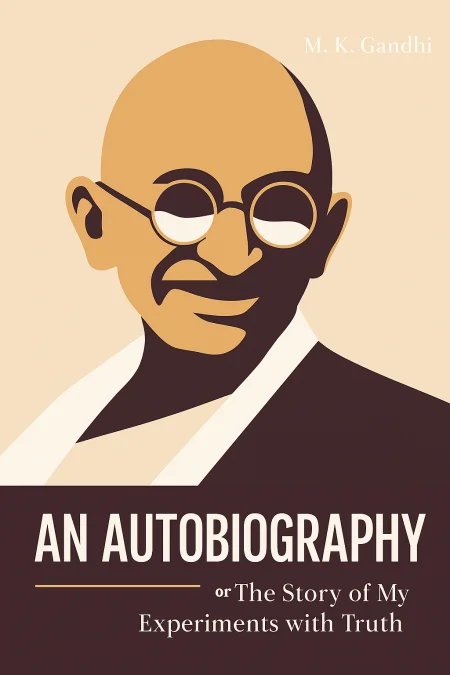
An Autobiography
The Story of My Experiments with Truth
Book Edition Details
Summary
In the tapestry of history, where rebellion meets revelation, stands "The Story of My Experiments with Truth"—the intimate portrait of Mohandas K. Gandhi's relentless pursuit of authenticity. Beyond the political titan, delve into the boy who dared to question, the young lawyer who clashed with injustice in South Africa, and the spiritual seeker who redefined resistance in India's quest for independence. This autobiography unfolds in vivid strokes, capturing Gandhi's evolving philosophy and unwavering commitment to nonviolence, as he navigates the turbulent waters of societal change and personal growth. Recognized as one of the spiritual cornerstones of the 20th century, Gandhi's narrative invites readers into the mind of a man who transformed truth into a living experiment, offering an introspective journey into the heart of humanity's struggle for freedom and integrity.
Introduction
In the dusty courthouse of Maritzburg, South Africa, a young Indian barrister sat shivering through a winter night, his overcoat locked away with luggage he dared not retrieve. Thrown off a first-class train despite holding a valid ticket, Mohandas Gandhi faced a moment that would reshape not only his own destiny but the course of history itself. This was no ordinary lawyer's tale of professional setbacks, but the beginning of a profound transformation that would see a shy, struggling advocate evolve into one of the most influential figures of the twentieth century. Gandhi's journey from privileged childhood in British India to his formative years in London and early struggles in South Africa reveals the making of a revolutionary spirit. His autobiography chronicles not just external events, but an inner quest for truth that would ultimately challenge empires and inspire millions. Through his candid reflections, readers witness the gradual awakening of a man who would pioneer non-violent resistance and demonstrate how individual transformation can become a force for global change. This intimate account offers insights into the personal struggles behind public greatness, the power of moral conviction, and the extraordinary potential that lies within ordinary human experience when guided by unwavering principles.
Formative Years: From Privileged Child to Struggling Barrister
Gandhi's childhood in the princely state of Porbandar was marked by the profound influence of his devout mother, Putlibai, whose religious observances and moral strength left an indelible impression on the young boy. Born into a family of administrators, Gandhi inherited both privilege and responsibility, yet his early years were characterized more by timidity than leadership potential. His marriage at thirteen to Kasturbai introduced him to the complexities of human relationships and the struggles between duty and desire that would later inform his philosophy of self-restraint. The decision to study law in London represented a dramatic departure from tradition, requiring him to break caste taboos and face social ostracism. His mother's insistence on vows of abstinence from meat, wine, and women became his moral anchor in a foreign land. In London, Gandhi's initial attempts to become an English gentleman through dancing lessons and formal dress gradually gave way to a deeper exploration of vegetarianism and comparative religion. These years of intellectual searching introduced him to the Bhagavad Gita, the Bible, and the Quran, laying the foundation for his later synthesis of universal spiritual truths. The young law student's encounters with Christian missionaries and theosophists challenged his inherited beliefs while strengthening his appreciation for Hinduism's philosophical depth. His involvement with the London Vegetarian Society provided his first taste of public advocacy and organizational work. Though he struggled with shyness and self-doubt, these formative experiences in England began to shape his understanding of truth as the supreme principle governing human conduct. Upon returning to India as a qualified barrister, Gandhi faced the harsh reality that legal credentials could not overcome his fundamental insecurities. His disastrous attempts at legal practice in Bombay, marked by an inability to speak in court and general professional inadequacy, revealed a young man still far from his destiny. These early failures, though painful, began teaching him humility and giving him an understanding of human frailty that would later inform his compassionate approach to leadership and social reform.
South African Crucible: Birth of Satyagraha and Moral Leadership
Gandhi's arrival in Durban in 1893 as a representative of an Indian trading company thrust him into a world of systematic racial discrimination that would forge his identity as a reformer. The famous incident on the train to Pretoria, where he was ejected from a first-class compartment despite holding a valid ticket, crystallized his understanding of injustice and sparked his lifelong commitment to fighting prejudice through legal and moral means. This personal humiliation became the catalyst for a broader awakening to the plight of Indians in South Africa. His legal work brought him into contact with indentured laborers, wealthy merchants, and colonial administrators, revealing the complex web of laws designed to restrict Indian rights and opportunities. The proposed three-pound annual tax on Indian laborers and the challenge to Indian voting rights galvanized Gandhi into organizing the Natal Indian Congress, his first major political initiative. Through pamphlets, petitions, and public meetings, he learned to mobilize public opinion and build coalitions across religious and class divisions within the Indian community. The twenty-one years Gandhi spent in South Africa transformed him from a struggling barrister into a seasoned activist and strategist. His experiments with communal living at Phoenix Settlement and Tolstoy Farm reflected his growing belief that personal transformation must accompany political action. The development of satyagraha, or truth-force, emerged from his conviction that means and ends were inseparable, and that lasting change could only come through methods that embodied the values one sought to achieve. The synthesis of Eastern and Western thought that characterized Gandhi's mature philosophy emerged through his encounters with Ruskin's social criticism, Tolstoy's Christian anarchism, and Thoreau's civil disobedience. His correspondence with Tolstoy and his study of religious texts from multiple traditions convinced him that truth was universal and that genuine spirituality required active engagement with the world's suffering. This integration of contemplation and action, of personal purification and social reform, became the distinctive mark of Gandhi's approach to both individual development and political change.
Return to India: Leading a Nation Through Truth and Non-Violence
Gandhi's return to India in 1915 marked his transformation from colonial activist to national leader. Following his mentor Gokhale's advice to spend a year observing his homeland, he established the Satyagraha Ashram at Sabarmati as his base for developing a uniquely Indian approach to independence. His decision to admit an untouchable family to the ashram immediately signaled his intention to challenge not just British rule but India's internal social divisions, demonstrating how personal conviction could drive social reform. The Champaran satyagraha in 1917 marked Gandhi's first major application of his South African methods to Indian conditions. The indigo farmers' plight against exploitative British planters provided the perfect opportunity to demonstrate how non-violent resistance could achieve concrete results while building mass support. Gandhi's meticulous investigation, his willingness to face arrest, and his success in securing justice for the farmers established his credibility as a leader who could deliver practical victories through moral means. The launch of the non-cooperation movement in 1920 represented the culmination of Gandhi's evolution into national leadership. His ability to unite Hindus and Muslims around the Khilafat issue while simultaneously pursuing Indian independence demonstrated his sophisticated understanding of coalition politics and moral authority. The adoption of khadi, or hand-spun cloth, as both symbol and practical program showed his genius for creating concrete activities that embodied abstract principles while providing economic benefits to India's masses. Gandhi's approach to mass mobilization revealed his understanding that lasting political change required cultural and spiritual transformation. His emphasis on swadeshi, or self-reliance, challenged Indians to reject not just British political control but the psychological dependence that sustained colonial rule. Through campaigns that combined immediate practical goals with long-term spiritual and political transformation, he demonstrated how individual conscience could become a force for national liberation.
Experiments with Truth: Personal Transformation as Social Revolution
Throughout his life, Gandhi viewed politics as inseparable from personal spiritual development, treating his public campaigns as extensions of his private experiments with truth. His commitment to brahmacharya, dietary restrictions, and voluntary poverty reflected his belief that effective leadership required complete alignment between personal conduct and public principles. These practices were not mere personal preferences but deliberate attempts to purify himself of the ego, desire, and fear that he saw as obstacles to both individual liberation and social transformation. Gandhi's approach to fasting exemplified his integration of personal discipline with political action. His fasts served multiple purposes: self-purification, penance for others' violence, and moral pressure on opponents. While critics questioned the coercive aspects of his fasting, Gandhi saw it as the ultimate expression of satyagraha, where the activist takes suffering upon himself rather than inflicting it on others. His willingness to risk death for his principles demonstrated a level of commitment that gave him unique moral authority. The development of his ashram communities provided laboratories for testing his theories about ideal society. From Phoenix Settlement in South Africa to Sabarmati Ashram in India, these experiments in communal living explored how people from different backgrounds could live together based on principles of truth, non-violence, and service. The daily routines of prayer, manual labor, and simple living were designed to break down barriers of caste, class, and religion while developing the character necessary for effective social action. Gandhi's educational philosophy reflected his belief that true learning involved the integration of intellectual, physical, and spiritual development. His emphasis on craft work, instruction in local languages, and character development over academic achievement challenged conventional approaches to education. He saw the transformation of India's educational system as essential to creating citizens capable of self-governance and resistant to the materialism and competitiveness he associated with Western civilization.
Summary
Gandhi's greatest legacy lies in his demonstration that individual transformation and social change are inseparably linked, that the means we employ inevitably shape the ends we achieve. His life proved that moral authority, carefully cultivated through personal discipline and unwavering commitment to truth, could challenge even the mightiest political and economic powers. The shy lawyer who could barely speak in court became a voice that resonated across continents because he learned to align his actions completely with his deepest convictions, accepting the personal cost of such integrity. For contemporary readers, Gandhi's experiments offer profound lessons about the relationship between personal authenticity and effective leadership, the power of principled persistence in the face of seemingly impossible odds, and the transformative potential of taking complete responsibility for one's own moral development. His approach suggests that lasting social change begins with individuals willing to embark on the difficult journey of self-purification, understanding that the quality of our inner life inevitably shapes the quality of our outer contributions to the world.
Related Books
Download PDF & EPUB
To save this Black List summary for later, download the free PDF and EPUB. You can print it out, or read offline at your convenience.
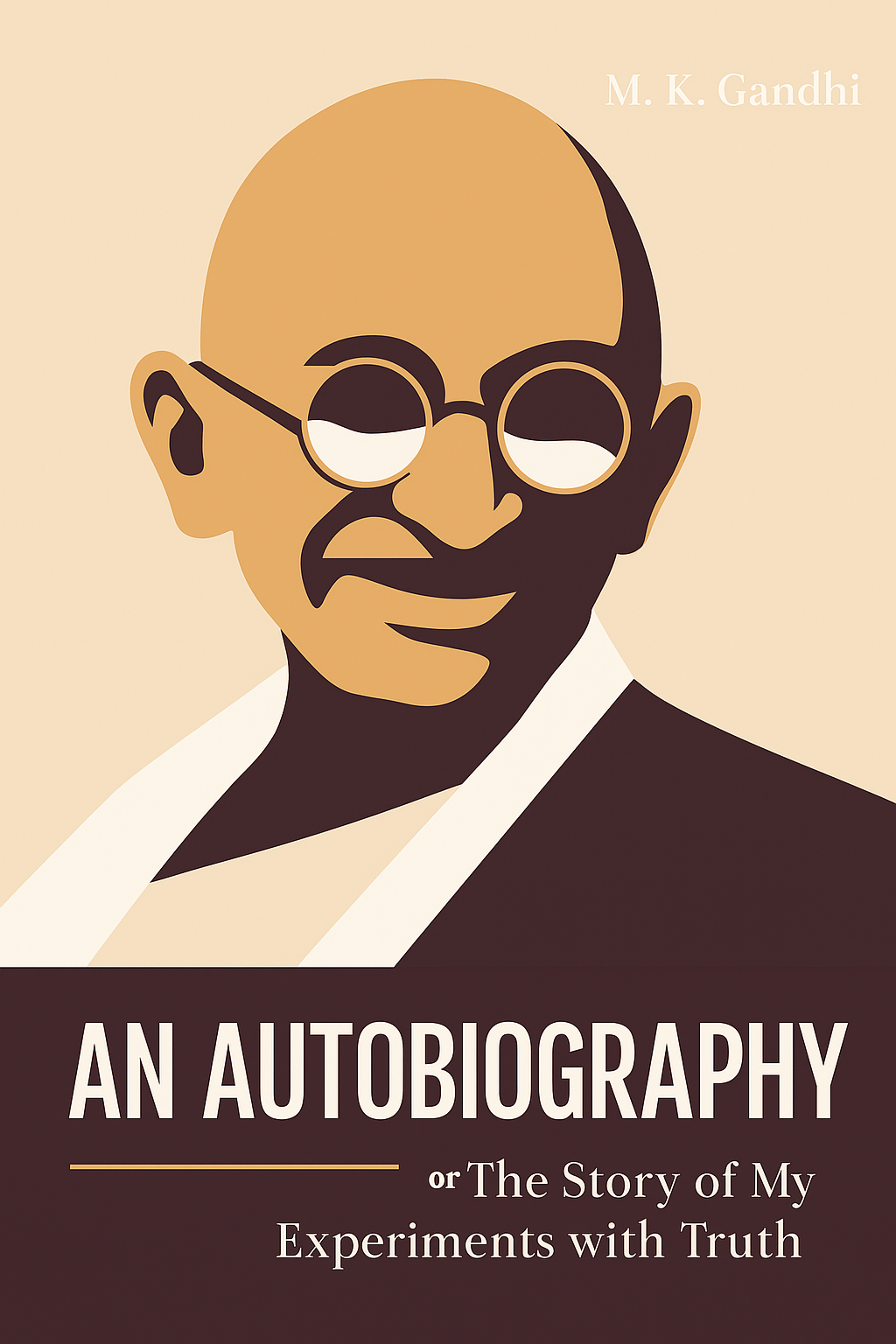
By M.K. Gandhi
