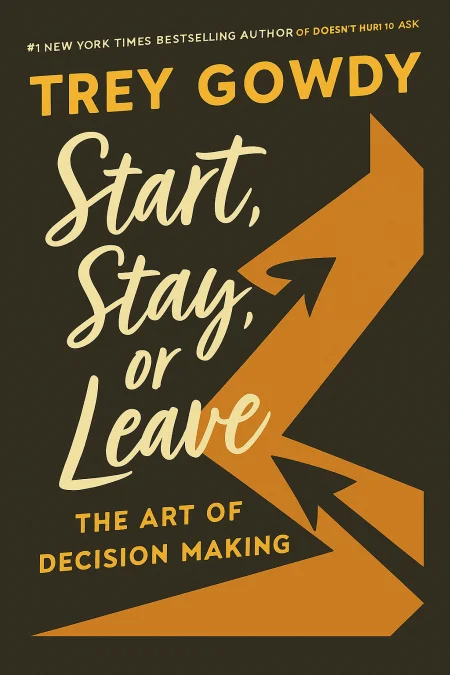
Start, Stay, or Leave
The Art of Decision Making
Book Edition Details
Summary
In the labyrinth of life's pivotal choices, Trey Gowdy stands as a seasoned navigator, guiding you through the crossroads with his transformative decision-making method. "Start, Stay, or Leave" unravels the art of making life-altering decisions—rooted in the simplicity of three options. From the courtroom's intensity to personal milestones, Gowdy's insights illuminate the path to clarity and confidence. This isn't just a guide; it's a confidant in book form, blending humor, heartache, and hard-won wisdom. Whether you're pondering a career move, a relationship shift, or a fresh start, Gowdy's framework empowers you to define success on your terms, balance head and heart, and chart your life's course with conviction. Dive into stories that resonate and advice that sticks, ensuring that whatever you decide, it's the right choice for you.
Introduction
Standing in his front yard in June 2009, Trey Gowdy made one of the most consequential announcements of his career—he was leaving his dream job as a prosecutor to run for Congress. It was a moment that embodied the central tension of human experience: when to pursue new paths and when to remain committed to the journey already begun. From a small-town South Carolina courthouse to the halls of the U.S. Capitol, Gowdy's life became a masterclass in navigating the fundamental choices that shape us all. Born into modest circumstances, Gowdy rose from delivering newspapers on a motorized bicycle to becoming one of America's most recognizable congressional figures. Yet his story is not one of relentless ambition, but rather of careful deliberation about life's crossroads. His journey reveals a man who learned to distinguish between external expectations and internal purpose, between the pyramid of traditional success and the mirror of self-reflection. Through his experiences as a federal prosecutor, state solicitor, congressman, and ultimately a teacher and television host, readers will discover the art of decision-making itself—how to know when to start something new, when to stay and build upon existing foundations, and when to leave with grace and purpose. This is the chronicle of a man who discovered that true success lies not in climbing ladders or building pyramids, but in crafting a life that reflects one's deepest values and desired legacy.
From Prosecutor to Public Servant: The Journey of Purpose
Gowdy's transformation from prosecutor to politician began with a profound sense of calling. As a federal prosecutor in South Carolina, he found his rhythm in the courtroom, standing before judges and juries with the weight of justice on his shoulders. The work satisfied something deep within him—the opportunity to speak for those who could no longer speak for themselves, to pursue truth in its purest form, and to serve as what the Supreme Court called "a minister of justice." His prosecutorial career was marked by complex cases that tested both his legal acumen and moral compass. The murder of federal witness Ricky Samuel became a defining moment, teaching him to start with the end in mind—literally writing his closing arguments first, then building the evidence to support them. This backward approach to building cases would later inform his entire philosophy of life decisions. He learned that knowing your destination makes every step along the journey more purposeful. The transition from federal to state prosecutor represented Gowdy's first major career pivot, driven by a desire for more meaningful work. While federal cases often involved drug trafficking and firearms violations, state court offered the opportunity to prosecute the crimes that truly shocked the conscience—murders, sexual assaults, and violence against the most vulnerable. This move required him to leave the security and prestige of the federal system, run against a popular incumbent, and risk public failure in his hometown. The decision to enter politics came not from ambition, but from necessity. After a decade of prosecuting violent crimes, Gowdy found himself spiritually and emotionally depleted. The constant exposure to humanity's darkest impulses had exacted a toll he could no longer ignore. His family noticed the changes, and he realized that some dreams, no matter how noble, come with expiration dates. Congress offered what seemed like an honorable exit—a way to continue serving justice in a different arena while preserving his well-being and family relationships.
Congressional Years: Navigating Politics and Principle
Washington, D.C. proved to be a vastly different arena than any courtroom Gowdy had known. The rules of engagement were murky, the media landscape was hostile, and the very concept of objective truth seemed to dissolve in the harsh light of partisan politics. Sleeping on a pullout couch in his office, sharing his space with mice he nicknamed "Leonidas," Gowdy discovered that the nation's capital could be both the pinnacle of public service and a profoundly lonely place. His committee assignments—Judiciary, Oversight and Reform, and Education and the Workforce—reflected his background and interests rather than the fundraising potential that motivated many of his colleagues. This choice between meaningful work and political advantage would define his entire congressional tenure. He sought challenges that resembled his prosecutorial background, investigations that required the careful assembly of evidence and the methodical pursuit of truth. The Benghazi investigation became both Gowdy's highest-profile assignment and his greatest source of frustration. Appointed to chair the House Select Committee, he approached the task as he would any homicide investigation—seeking to answer the fundamental questions of what happened, when, why, and how it could have been prevented. However, he quickly discovered that congressional investigations operate under entirely different rules than criminal prosecutions. Political considerations contaminated every aspect of the process, from document production to witness testimony. The experience crystallized Gowdy's growing disillusionment with the political environment. Unlike the courtroom, where rules of evidence and procedure created a framework for pursuing truth, Congress operated in a realm where partisan advantage often trumped factual accuracy. The media, which he had expected to serve as neutral arbiters, proved to be active participants in the political theater. Republican colleagues undermined the investigation by conducting parallel inquiries, while Democratic members seemed more interested in protecting political figures than uncovering facts. This environment stood in stark contrast to the collaborative pursuit of justice he had known as a prosecutor.
The Courage to Leave: Choosing Legacy Over Position
By his third term, Gowdy had reached a crossroads that would test every principle he had developed about decision-making. The opportunity to run for Speaker of the House presented itself—a position that would have represented the pinnacle of his political career and validated every sacrifice he had made. Yet when he applied his own framework of starting with the end in mind, he realized that the title held no appeal. The daily responsibilities of herding congressional factions and managing political egos bore no resemblance to the work that had originally drawn him to public service. The constant manufactured crises within his own party had become exhausting. Republican members seemed more interested in gaining media attention by criticizing their own leadership than in advancing conservative principles. The Freedom Caucus's repeated challenges to Speaker Boehner created an atmosphere of perpetual conflict that sapped Gowdy's enthusiasm for the work. He found himself longing for the civility he had experienced even in death penalty cases, where adversaries could disagree professionally without personal animosity. His decision to leave was accelerated by personal considerations that had always been paramount in his value system. His wife Terri and their children had sacrificed much during his years in Washington, and he increasingly questioned whether the cost was justified by the results. The work environment had become toxic, with colleagues betraying confidences and using their positions primarily for personal advancement rather than public service. The media's consistent misrepresentation of his motivations and actions added another layer of frustration to an already challenging role. The final straw came during the Russia investigation, when Gowdy found himself appointed to yet another high-profile, politically charged committee assignment. Despite Speaker Paul Ryan's intention to give him a less controversial role on the Intelligence Committee, fate seemed determined to place him at the center of Washington's partisan battles. This pattern convinced him that no committee assignment or leadership position would insulate him from the political theater that had consumed Congress.
Wisdom from Experience: Lessons in Life and Leadership
Gowdy's post-congressional reflection reveals a man who had successfully navigated the transition from external validation to internal purpose. His decision to decline a federal judgeship—something that would have represented the culmination of his legal career—demonstrated his evolution from the pyramid model of success to the mirror model of self-awareness. The position would have provided lifetime security and professional prestige, but it no longer aligned with his deeper priorities. The conversation with the stranger in the grocery store parking lot became a crystallizing moment. Here was someone who knew him only as the local prosecutor, who remembered him as fair—the very quality he hoped would define his legacy. This encounter reinforced his decision to return to his roots in South Carolina, teaching college students and practicing law on his own terms. The woman's assumption that he would continue seeking higher office reflected the external expectations he had learned to shed. His relationship with Tim Scott exemplified the kind of friendship that sustains leaders through difficult transitions. Their mutual support during the 2016 election cycle, when Scott asked Gowdy to run for one more term, demonstrated how personal loyalty could override individual preferences when serving a greater good. This decision to stay when he wanted to leave, made purely to support a friend, illustrated the importance of considering relationships alongside career ambitions. The advice Gowdy offers to his younger self centers on redefining success and failure. Instead of viewing failure as public embarrassment or losing an election, he learned to see it as the refusal to venture or try. His mother's disappointed face when he declined to run for high school student council remained a more powerful memory than any electoral defeat. This shift in perspective—from fearing failure to embracing the attempt—became central to his philosophy of decision-making and life itself.
Summary
Trey Gowdy's life demonstrates that true success lies not in accumulating titles or meeting external expectations, but in making decisions that align with one's deepest values and desired legacy. His journey from prosecutor to congressman to private citizen illustrates the courage required to leave prestigious positions when they no longer serve one's authentic purpose. The most profound lesson from his experience is the importance of starting with the end in mind—envisioning the final argument of one's life and making daily decisions that support that vision. For anyone facing their own crossroads, Gowdy's story offers a blueprint for navigating major transitions with integrity, emphasizing that the quality of one's character matters more than the height of one's achievements. His ultimate choice to prioritize relationships over recognition, purpose over prestige, and peace over power provides a compelling model for those seeking to craft their own meaningful existence in an increasingly complex world.
Related Books
Download PDF & EPUB
To save this Black List summary for later, download the free PDF and EPUB. You can print it out, or read offline at your convenience.
By Trey Gowdy
