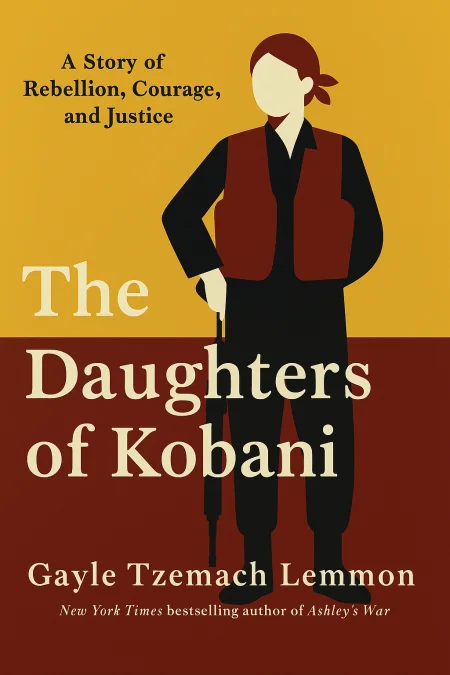
The Daughters of Kobani
A Story of Rebellion, Courage, and Justice
Book Edition Details
Summary
Against the backdrop of war-torn Syria, a group of fearless women from Kobani defied the odds and shattered conventions, wielding their determination as fiercely as their weapons. "The Daughters of Kobani" unfolds the gripping saga of these Kurdish women who rose against the Islamic State's reign of terror. More than a battle for territory, their struggle embodied a fight for gender equality in a region steeped in tradition. Gayle Tzemach Lemmon paints a vivid portrait of resilience, chronicling the women’s transformative journey from oppression to the frontline of hope. This is a testament to human courage, as these heroines not only confronted a ruthless enemy but also kindled a global conversation about women's rights in the ashes of war. Prepare to be moved by a story where bravery knows no bounds and the pursuit of justice becomes a revolution.
Introduction
In the dusty streets of a Syrian border town, a revolution quietly unfolded that would challenge both ISIS's brutal vision and centuries of tradition. When the Islamic State launched its assault on Kobani in 2014, few could have predicted that the town's defense would rest in the hands of young Kurdish women who had traded marriage prospects for sniper rifles. This extraordinary story reveals how war can become an unexpected catalyst for social transformation, as female fighters not only battled one of history's most ruthless terrorist organizations but simultaneously waged a deeper campaign for women's liberation across the Middle East. Their struggle illuminates a fundamental tension between competing visions of society—one that seeks to enslave women and another that places their emancipation at the very center of human freedom. For readers interested in understanding how ordinary people can reshape history through extraordinary courage, this narrative offers profound insights into the intersection of warfare, ideology, and social change in our contemporary world.
From Oppression to Resistance: Kurdish Women Rise (2004-2013)
The seeds of revolution were planted on a soccer field in Qamishli, where a March 2004 match between Kurdish and Arab fans erupted into Syria's largest civil uprising in decades. When Syrian security forces opened fire on unarmed Kurdish protesters, killing more than two dozen, young women like Azeema and Rojda witnessed firsthand the price of resistance. Yet this brutal crackdown also revealed a crucial weakness—the Kurdish community's lack of organization and weapons to defend itself. The massacre became a catalyst, teaching a generation of Kurdish youth that survival required more than peaceful protest. The uprising exposed deep generational divides within Kurdish society. While older leaders favored quiet diplomacy with the Assad regime, young Kurds grew impatient with decades of systematic oppression that denied them citizenship, education in their native language, and basic cultural rights. Into this frustration stepped the Democratic Union Party, spreading the radical philosophy of imprisoned Kurdish leader Abdullah Ocalan, who taught that women's liberation was inseparable from Kurdish freedom. For young women trapped in patriarchal families where fathers chose their husbands and uncles could end their education, Ocalan's message resonated with revolutionary power. The 2011 Syrian uprising created an unexpected opening. As Assad's forces became consumed with crushing Arab rebels, they withdrew from Kurdish areas, leaving a power vacuum. Kurdish women who had spent years organizing in secret through groups like Congress Star suddenly found themselves with space to act. They formed the People's Protection Units, initially as self-defense forces, but their mission expanded as Islamist extremists began targeting Kurdish communities. The formation of the all-female Women's Protection Units in 2013 marked a decisive break with tradition—these women would not merely support male fighters but command their own units and shape their own destiny. This period established the ideological foundation for everything that followed. By linking Kurdish nationalism to women's liberation, these young fighters created a vision that was simultaneously local and universal, grounded in their specific struggle yet applicable to oppressed peoples everywhere. Their decision to take up arms represented more than military necessity—it was a declaration that they would no longer accept a world where their voices were silenced and their choices made by others.
The Kobani Siege: Defining Battle Against ISIS (2014-2015)
When ISIS launched its assault on Kobani in September 2014, the world witnessed an unlikely David-and-Goliath battle that would define the fight against the Islamic State. The extremist group, flush with victories in Mosul and Raqqa, deployed thousands of fighters and heavy weaponry captured from Iraqi forces, confident that this Kurdish border town would fall within days. Instead, they encountered something unprecedented—female snipers like Azeema who not only refused to retreat but taunted their enemies over radio channels, telling ISIS commanders that women would be their downfall. The siege revealed the tactical brilliance born from desperation. Facing overwhelming odds, Kurdish commanders divided their forces into small units, used their intimate knowledge of urban terrain, and employed psychological warfare that exploited ISIS's own misogyny. The sight of women leading men into battle, planning complex operations, and dying heroically for their cause created a narrative that captured global attention while striking at the heart of ISIS's ideology of female subjugation. Social media amplified these images, turning the obscure border town into a symbol of resistance against extremism. The battle's turning point came not just from American airstrikes but from the extraordinary resilience of fighters who refused to abandon their positions even when surrounded. Young women like Arin Mirkan strapped grenades to their bodies and ran toward ISIS tanks, choosing death over capture and enslavement. Their sacrifice galvanized defenders and shocked their enemies, who had expected Kurdish forces to crumble under pressure. The graffiti left in a Kobani school basement captured their determination: "We will fight to the last person." Kobani's liberation in January 2015 delivered ISIS its first major defeat and proved that the seemingly invincible caliphate could be stopped. More importantly, it established the Kurdish women fighters as a force capable of leading complex military operations. The victory validated their belief that women's liberation and military success were inseparable—their willingness to die rather than submit had saved not only their town but provided a model for resistance that would inspire oppressed women across the region. The battle transformed local defenders into an international symbol of hope against tyranny.
Liberation Campaigns: From Manbij to Raqqa (2016-2017)
With Kobani's victory behind them, the Syrian Democratic Forces launched increasingly ambitious campaigns that would test the limits of their abilities and their partnership with American forces. The battle for Manbij in 2016 marked a new level of complexity, requiring a nighttime river crossing under enemy fire followed by months of brutal urban combat against ISIS's most experienced foreign fighters. Commanders like Nowruz and Znarin found themselves leading thousands of troops in operations that would have challenged professional armies. The Manbij campaign revealed both the evolution of these fighters and the deepening contradictions of their alliance with America. While U.S. officials praised their tactical skills and determination, Turkey increasingly viewed the Kurdish-led forces as an existential threat. The Americans found themselves walking a diplomatic tightrope, supporting the only effective ground force against ISIS while trying to maintain relations with a NATO ally that considered their partners terrorists. This tension would shadow every subsequent operation. Raqqa represented the ultimate test—liberating ISIS's capital from fighters who preferred death to surrender. The campaign lasted months, with Kurdish women commanders like Rojda leading house-to-house combat against an enemy that used human shields and turned every building into a potential bomb. The psychological toll was enormous, as fighters watched friends die from sniper fire and improvised explosives while civilians suffered under ISIS's final desperate measures. Yet they persevered, driven by memories of enslaved women they had rescued and the knowledge that failure would mean a return to the darkness ISIS represented. The October 2017 liberation of Raqqa marked more than military victory—it represented the triumph of one vision of society over another. Where ISIS had once sold women in slave markets, Kurdish female commanders now raised their flags over the city's central square. The transformation was both symbolic and practical, as women's councils began organizing to rebuild shattered communities along egalitarian principles. These victories established the Syrian Democratic Forces as the dominant power in northeastern Syria, but they also raised questions about what would happen once their usefulness to America ended.
Victory and Uncertainty: Territorial Defeat and New Challenges (2018-2019)
The final collapse of ISIS's territorial control in March 2019 at Baghouz marked the end of one war but the beginning of new struggles for the Kurdish-led forces who had sacrificed so much to achieve this victory. The ceremony celebrating ISIS's defeat featured both American and Kurdish flags flying together, symbolizing a partnership that had achieved the seemingly impossible—the complete territorial destruction of a caliphate that once controlled territory the size of Britain. Yet even as they celebrated, the shadow of abandonment loomed large. Turkey's threats to launch military operations against Kurdish areas intensified, while President Trump's December 2018 tweet announcing American withdrawal from Syria sent shockwaves through the region. The Syrian Kurds faced a cruel irony—their success against ISIS had made them more vulnerable, not more secure, as their usefulness to American policy appeared to be ending just as their need for protection was greatest. The post-ISIS period revealed the depth of transformation that had occurred in Kurdish society. Women who had once been denied education now commanded military units and governed cities. Former marriage prospects had become international symbols of resistance. Yet this progress remained fragile, dependent on continued international support and protection from enemies who viewed women's liberation as a threat to their own power structures. The constitutional framework establishing women's equality existed only within the territory the Kurdish forces could defend. By 2019, it became clear that military victory was only the beginning of a much larger challenge. Building sustainable institutions, educating a new generation, and maintaining social transformation while under constant military threat required different skills than those needed for battlefield success. The women who had learned urban warfare now faced the perhaps more difficult task of translating their wartime gains into lasting social change. Their greatest battles lay not in the past but in an uncertain future where their revolutionary experiment would face its ultimate test of survival.
Summary
The story of Kurdish women fighters represents far more than a military campaign—it illuminates how moments of extreme crisis can shatter seemingly immutable social structures and create space for revolutionary change. The central tension between ISIS's vision of female enslavement and the Kurdish model of women's liberation played out across battlefields and in the realm of ideas, with consequences that extend far beyond Syria's borders. These young women proved that resistance to oppression can emerge from the most unlikely circumstances and that ordinary people, when faced with existential threats, can achieve extraordinary transformations. Their struggle demonstrates that progress toward equality often requires not just changing laws but fundamentally challenging power structures through direct action and sacrifice. For those seeking to understand how social change happens, this narrative offers crucial insights: lasting transformation requires both individual courage and collective organization, progress often emerges from the intersection of different struggles for justice, and the most profound changes frequently occur when people have nothing left to lose. The Kurdish women's revolution reminds us that even in humanity's darkest moments, the desire for freedom and dignity can ignite movements that reshape history and inspire others to imagine new possibilities for their own societies.
Related Books
Download PDF & EPUB
To save this Black List summary for later, download the free PDF and EPUB. You can print it out, or read offline at your convenience.
By Gayle Tzemach Lemmon
