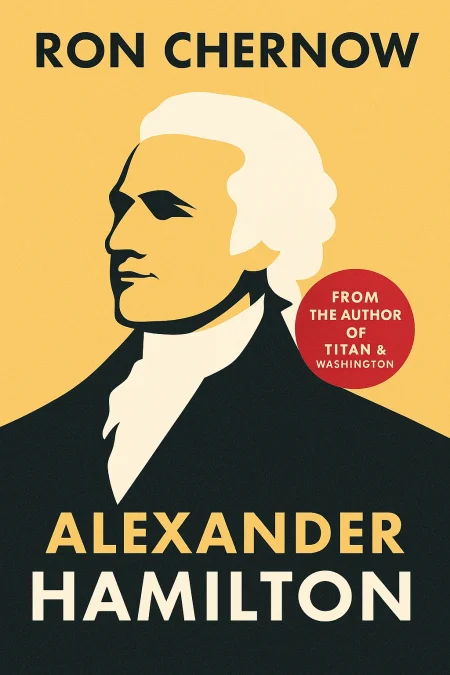
Alexander Hamilton
The bestselling inspiration for the hit Broadway musical
Book Edition Details
Summary
In the vibrant tapestry of early America, one figure stands as a paradox of brilliance and controversy—Alexander Hamilton. Through the masterful lens of Pulitzer Prize-winning author Ron Chernow, the pulse of this revolutionary era beats anew. This full-length portrait of Hamilton reveals the orphaned immigrant's audacious rise from Caribbean obscurity to the heights of American political life, where he crafted the economic backbone of a fledgling nation. His tale is woven with ambition, genius, and intrigue, challenging the conventional narrative that often casts him in shadow. Chernow paints Hamilton not merely as a statesman but as a fiery patriot whose vision laid the cornerstone of modern America. Here unfolds the compelling saga of a man driven by relentless spirit, whose legacy, marked by titanic feuds and unyielding passion, continues to shape the world. With eloquence and insight, this biography invites readers to rediscover the dynamic force behind America's birth, echoing the vibrant drumbeat of history.
Introduction
On July 11, 1804, as morning mist rose from the Hudson River, Alexander Hamilton lay dying on the dueling grounds of Weehawken, New Jersey, struck down by Aaron Burr's pistol. In that moment, America lost one of its most brilliant and transformative founding fathers—a man who had risen from illegitimate birth on a forgotten Caribbean island to become the architect of the nation's financial system. Hamilton's forty-nine years burned with an intensity that few lives have matched, driven by an immigrant's hunger for acceptance and a visionary's determination to build something lasting. This extraordinary figure embodied the promise of American opportunity while helping to create the very institutions that would extend that promise to future generations. Born into poverty and abandonment, Hamilton possessed nothing but raw intellect and relentless ambition, yet he would become George Washington's most trusted aide, the nation's first Treasury Secretary, and the prophet of America's capitalist future. His story reveals the fierce ideological battles that shaped the early republic, the personal costs of political warfare, and the complex character of a man who could be both brilliant and self-destructive. From Hamilton's remarkable journey, readers will discover how individual genius can transform national destiny, how economic vision becomes political reality, and how the tension between personal ambition and public service defines the American experience. His life offers profound insights into the nature of leadership, the power of institutions, and the enduring question of how a diverse nation of immigrants and strivers can achieve greatness through merit rather than birth.
From Illegitimate Orphan to Washington's Right Hand
Alexander Hamilton's early years were marked by abandonment and tragedy that would have crushed a lesser spirit. Born around 1755 on the small Caribbean island of Nevis, he was the illegitimate son of Rachel Faucette Lavien and James Hamilton, a failed Scottish merchant. His mother had fled an abusive first marriage to live with Hamilton's father in what colonial society deemed scandalous cohabitation. When Hamilton was around ten, his father abandoned the family, unable or unwilling to face the social stigma and financial pressures of his irregular situation. Tragedy struck again when Hamilton was thirteen. His mother died of yellow fever, leaving him and his older brother James completely orphaned and penniless. The local probate court awarded their meager possessions to Rachel's legitimate son from her first marriage, branding Alexander and James as illegitimate children with no legal rights to their mother's estate. Suddenly, the boys found themselves not only parentless but dependent on the charity of relatives and community members who viewed them as social outcasts. Rather than succumb to despair, Hamilton threw himself into work and learning with fierce determination. He found employment as a clerk in a trading house on St. Croix, where his exceptional intelligence and facility with numbers quickly impressed his employers. His letters revealed a sophisticated understanding of commerce and politics that astonished adults, while his vivid account of a devastating hurricane in 1772 so moved local benefactors that they raised funds to send the promising seventeen-year-old to North America for education. The young man who arrived in New York in 1773 was already transformed by hardship into someone far older than his years. At King's College, he devoured works on law, economics, and political philosophy while emerging as a powerful voice for American independence. When revolution came, Hamilton's organizational genius and personal courage caught the attention of General George Washington, who made him his aide-de-camp in 1777. This appointment placed Hamilton at the center of the revolutionary struggle, where he witnessed firsthand the weaknesses of the Continental Congress and developed his lifelong conviction that America needed strong federal institutions to survive and prosper.
Constitutional Architect and Financial System Builder
After the war, Hamilton channeled his continental vision into the movement for constitutional reform. He saw that the Articles of Confederation had created a government too weak to pay its debts, regulate commerce, or command respect abroad. As a delegate to the Constitutional Convention in 1787, Hamilton advocated for a strong executive and federal government, though his proposals for lifetime tenure for presidents and senators were deemed too radical by his fellow delegates. Hamilton's greatest contribution to the constitutional cause came through The Federalist Papers, the brilliant series of essays he conceived and largely wrote with James Madison and John Jay. Writing at breakneck speed to meet newspaper deadlines, Hamilton produced fifty-one of the eighty-five essays, crafting sophisticated arguments that explained how the proposed Constitution would provide energy and stability while protecting individual liberty. His essays on the executive and judicial branches remain masterpieces of political theory, demonstrating his unique ability to combine practical experience with philosophical insight. When George Washington became president and appointed Hamilton as the first Secretary of the Treasury, the young nation faced financial ruin. The federal government owed over fifty million dollars, states owed additional millions, and American credit was worthless in international markets. Hamilton saw opportunity where others saw only crisis. His plan to fund all debts at face value and assume state obligations was controversial but brilliant, creating a class of creditors with a vested interest in federal success while establishing America's creditworthiness abroad. The centerpiece of Hamilton's system was the Bank of the United States, modeled on the Bank of England but adapted to American conditions. This institution would serve as the government's fiscal agent, provide a stable national currency, and facilitate commercial development. Despite fierce opposition from Thomas Jefferson and others who viewed the bank as unconstitutional and dangerous to republican government, Hamilton's defense of implied constitutional powers became a cornerstone of American law. His comprehensive vision extended to manufacturing and infrastructure, outlined in his prescient Report on Manufactures, which anticipated America's industrial future by decades. Through these interconnected policies, Hamilton laid the foundation for the United States to become the world's largest economy, proving that a young republic could compete with established empires through the power of credit, commerce, and carefully designed institutions.
Political Warfare and the Price of Ambition
Hamilton's success as Treasury Secretary made him one of the most powerful men in America, but also the primary target of an increasingly vicious opposition led by Thomas Jefferson and James Madison. What began as policy disagreements over the proper role of federal government soon hardened into the nation's first political parties, with Hamilton leading the Federalists and Jefferson organizing the Democratic-Republicans. The philosophical divide was profound: Hamilton envisioned America as a modern commercial republic powered by industry and finance, while Jefferson championed an agrarian society of independent farmers suspicious of concentrated power. The political warfare of the 1790s was brutal and personal in ways that would shock modern Americans. Hamilton found himself accused of being a monarchist, a tool of British interests, and a corrupt speculator who enriched his friends at public expense. These attacks were particularly painful because they struck at his deepest vulnerabilities: his foreign birth, his humble origins, and his fierce pride in his integrity. Hamilton responded with characteristic combativeness, launching newspaper campaigns that were often brilliant but sometimes crossed into personal vindictiveness that damaged his own cause. The most devastating blow to Hamilton's reputation came from his affair with Maria Reynolds, which began in 1791 when the married woman approached him claiming to need financial assistance. What started as charity became a sexual relationship that lasted over a year, during which Maria's husband James blackmailed Hamilton for money. When Republican investigators discovered Hamilton's payments to Reynolds in 1797, they initially suspected financial corruption rather than personal misconduct. Hamilton's extraordinary decision to publish a detailed confession of adultery to clear himself of official wrongdoing demonstrated both his integrity in public matters and his catastrophic judgment in private ones. Despite these scandals, Hamilton continued to wield enormous influence behind the scenes, advising Federalist leaders and helping to navigate crises like the Quasi-War with France. However, his combative personality and inability to compromise gradually isolated him even within his own party. His bitter public attack on President John Adams in 1800 contributed to Jefferson's electoral victory and effectively ended Hamilton's hopes of returning to high office. The tragic death of his eldest son Philip in a duel in 1801 marked the beginning of Hamilton's final decline, transforming him from an energetic political combatant into a melancholy figure increasingly preoccupied with mortality and religion. His own fatal encounter with Aaron Burr in 1804 represented the culmination of a lifetime spent defending his honor against all challengers, even when the personal cost became unbearable.
Summary
Alexander Hamilton's extraordinary life demonstrates that in America, genius and determination can overcome even the most disadvantaged beginnings, while also revealing the complex relationship between personal ambition and public service that defines democratic leadership. From his origins as a Caribbean orphan to his role as architect of American financial power, Hamilton proved that individual vision, when coupled with institutional brilliance, can reshape the destiny of nations. His greatest achievement was not merely his own remarkable rise, but his creation of the economic and political framework that enabled the United States to emerge as a global power while remaining true to its democratic ideals. Hamilton's story offers enduring lessons about the transformative power of education, the importance of building strong institutions, and the courage required to champion unpopular but necessary reforms in the face of fierce opposition. For anyone seeking to understand how visionary leadership can serve the common good, or how economic policy becomes the foundation of national strength, Hamilton's life provides both inspiration and practical wisdom about the art of translating bold ideas into lasting reality.
Related Books
Download PDF & EPUB
To save this Black List summary for later, download the free PDF and EPUB. You can print it out, or read offline at your convenience.
By Ron Chernow
