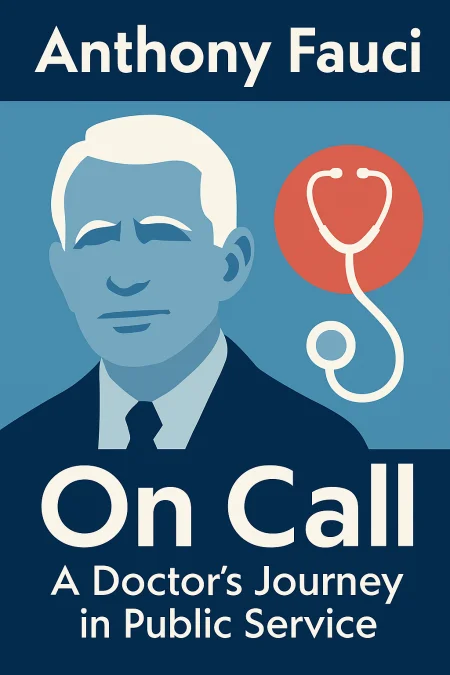
On Call
A Doctor's Journey in Public Service
Book Edition Details
Summary
In the corridors of power and the frontlines of healthcare, Dr. Anthony Fauci has been a guiding light through the darkest times. On Call is not just a memoir; it's a testament to a lifetime dedicated to combating global health crises with unwavering resolve and empathy. From a spirited boy in Brooklyn to a stalwart figure advising seven U.S. presidents, Fauci's journey offers an insider's view of the complex dance between science and politics. This narrative takes readers through the tumultuous waves of HIV, Ebola, and COVID-19, revealing the man behind the medical marvels. Rich with personal anecdotes and professional triumphs, this book is a clarion call for truth, integrity, and the relentless pursuit of public service. For anyone who has ever been inspired by courage in the face of adversity, Fauci's story is an essential read.
Introduction
On a crisp morning in March 2020, as the world grappled with an emerging pandemic, Dr. Anthony Fauci stood before the American people with the same steady demeanor he had maintained through four decades of public health crises. At nearly eighty years old, this Brooklyn-born son of Italian immigrants had become the nation's most trusted voice on infectious diseases, having guided the country through AIDS, anthrax, SARS, Ebola, and now COVID-19. His presence at the podium represented more than just medical expertise—it embodied the intersection of rigorous science and compassionate public service that had defined American health policy for generations. Fauci's remarkable journey from a neighborhood pharmacy in Bensonhurst to the corridors of power in Washington reveals the making of a physician-scientist who would reshape how America responds to health emergencies. His story spans nearly five decades of medical breakthroughs, political challenges, and unwavering dedication to scientific truth, offering profound insights into the delicate balance between evidence-based medicine and public policy. Through his experiences confronting humanity's most devastating diseases, readers will discover how one person's commitment to both scientific rigor and human compassion can influence the course of history. His life demonstrates the evolution of modern public health leadership, the importance of building trust between scientific institutions and diverse communities, and the courage required to speak truth to power when lives hang in the balance. From his early encounters with mysterious immune deficiencies to his role in developing life-saving treatments and vaccines, Fauci's career illuminates the profound responsibility that comes with serving as the nation's doctor during times of crisis and uncertainty.
From Brooklyn Roots to Medical Excellence
Anthony Stephen Fauci's journey began on Christmas Eve 1940 in the tight-knit Italian-American community of Bensonhurst, Brooklyn, where his parents Stephen and Eugenia Fauci instilled values of hard work, education, and service to others. His father owned the local pharmacy, Fauci Pharmacy, where the family lived in the apartment above the store, and young Anthony learned his first lessons about caring for others by watching his father extend credit to customers who couldn't afford their medications. The dinner table conversations in the Fauci household often centered on helping neighbors and the importance of putting community needs above personal profit, lessons that would profoundly shape his approach to public health decades later. The foundation of Fauci's character was built through the influence of his remarkable parents, particularly his mother Eugenia, whose deep empathy and moral clarity left an indelible mark on her son. When news of the atomic bombs dropped on Japan reached their Brooklyn home, she wept openly, telling young Anthony that the loss of innocent lives was "one of the worst things that could have happened in this world." This early exposure to his mother's compassion for human suffering, combined with his father's quiet generosity in serving their community, created a moral framework that would guide Fauci through the most challenging moments of his career. Education became Anthony's pathway to excellence, first at Our Lady of Guadalupe elementary school under the strict but nurturing Dominican nuns, then at the prestigious Regis High School in Manhattan. The Jesuits at Regis opened up a world of intellectual curiosity, emphasizing the motto "Men for Others" while providing a rigorous classical education that included Latin, Greek, philosophy, and advanced sciences. This dual foundation in humanities and sciences would prove crucial throughout his medical career, giving him both the analytical skills to tackle complex scientific problems and the communication abilities to translate medical concepts for diverse audiences. The transition from Brooklyn teenager to accomplished physician accelerated through his years at Holy Cross College and Cornell Medical School, where Fauci discovered his calling in the hands-on care of patients. At Cornell, he found exhilaration in the intellectual challenge of diagnosing complex cases and the profound responsibility of healing, while his natural clinical judgment and ability to remain calm under pressure marked him as exceptional among his peers. When personal tragedy struck with his mother's death from cancer during his final year of medical school, the young man who would graduate first in his class had already learned that medicine required both scientific precision and deep compassion for human suffering.
The AIDS Crisis: Science Meets Advocacy
The summer of 1981 brought a mysterious report that would reshape Fauci's career and the course of medical history when he read about five gay men in Los Angeles who had developed a rare pneumonia typically seen only in severely immunocompromised patients. As director of the Laboratory of Immunoregulation at the National Institute of Allergy and Infectious Diseases, Fauci felt an inexplicable chill reading the CDC's report, and when similar cases appeared weeks later, he knew he was witnessing something unprecedented. Against the advice of colleagues who warned it could derail his promising research career, Fauci made a decision that would define the next four decades of his life: he would abandon his successful work on inflammatory diseases to focus entirely on this mysterious new syndrome. The early years of AIDS research were marked by profound heartbreak and scientific frustration as Fauci and his colleagues cared for hundreds of young men who arrived at the NIH Clinical Center with a median survival of only nine to ten months. The ward became a place where hope seemed to die daily, where patients would go blind from opportunistic infections despite the medical team's best efforts, and where Fauci, trained as a healer, found himself powerless to cure anyone. The emotional toll was devastating, leading to moments when he would retreat to his office and weep privately after witnessing yet another young life cut short, while the broader medical community struggled to understand the underlying cause of this immune system collapse. The breakthrough came with the identification of HIV as the causative agent, followed by the development of the first antiretroviral drug, AZT, but even this initial success proved temporary as the virus developed resistance to single-drug therapy. Fauci realized that combination therapy would be necessary, a concept that required years of painstaking research and clinical trials conducted through the AIDS Clinical Trials Group he helped establish. His willingness to listen to AIDS activists, who initially disrupted his conferences and criticized the pace of research, transformed adversarial relationships into productive partnerships that revolutionized how clinical trials were conducted and how experimental treatments were made available to desperate patients. The transformation from despair to hope reached its crescendo in July 1996 at the International AIDS Conference in Vancouver, when data showed that triple combination therapy with protease inhibitors could suppress HIV to undetectable levels. Sitting in the packed convention hall as the audience erupted in sustained applause, Fauci witnessed what became known as the Lazarus effect—patients who had been preparing for death suddenly found themselves planning futures, returning to work, and resuming normal relationships. The disease that had claimed hundreds of thousands of lives was finally becoming manageable, transforming from a certain death sentence into a chronic condition that could be controlled with daily medication, validating decades of scientific persistence and collaborative research.
Global Health Leadership and Emergency Response
The morning of September 11, 2001, found Fauci in Manhattan for a foundation board meeting, watching in horror as the Twin Towers collapsed and immediately recognizing that the world had fundamentally changed. Within hours, HHS Secretary Tommy Thompson was calling upon him to lead the nation's biodefense efforts, understanding that future attacks might come in the form of biological weapons rather than hijacked airplanes. The anthrax letters that terrorized the nation weeks later, killing five people and exposing the vulnerability of America's public health infrastructure, thrust Fauci into an entirely new role as the government's primary spokesperson on bioterrorism while he worked to develop countermeasures against potential biological threats. The expansion into biodefense required NIAID to build capabilities for responding to weapons-grade pathogens including smallpox, anthrax, and other deadly agents, while Fauci navigated the complex politics of the Bush administration's homeland security priorities. Working closely with legendary smallpox expert D.A. Henderson and other specialists, he helped establish stockpiles of vaccines and treatments while building the specialized laboratory infrastructure needed to safely study dangerous pathogens. This massive undertaking, involving the creation of high-containment research facilities and the recruitment of top scientists to work on classified projects, represented a fundamental shift in how America prepared for biological threats and would prove invaluable when natural disease outbreaks emerged in subsequent years. Even as biodefense consumed much of his attention and resources, Fauci never lost sight of the ongoing global AIDS crisis, particularly in sub-Saharan Africa where the disease was devastating entire communities and economies. His transformative trip to Uganda in 2001 exposed him to the heartbreaking reality of HIV in resource-limited settings, where pregnant women faced infection rates of 20 to 40 percent and patients died for lack of access to drugs readily available in wealthy nations. The sight of a seventeen-year-old girl dying of AIDS-related complications that could have been easily treated in America moved him to tears and strengthened his resolve to address global health inequities through what would become PEPFAR, the President's Emergency Plan for AIDS Relief. The establishment of the Vaccine Research Center in 1999, following a pivotal conversation with President Clinton about the need for coordinated vaccine development, represented Fauci's recognition that complex health challenges required multidisciplinary approaches and sustained investment in basic research. Though the center's original mission to develop an HIV vaccine remained elusive, its scientists built expertise in vaccine platforms and immunology that would prove crucial when new threats emerged, from SARS to Ebola to Zika, and ultimately to COVID-19. Through each crisis, Fauci demonstrated an remarkable ability to adapt lessons learned from previous challenges while maintaining his fundamental commitment to scientific truth and evidence-based public health policy.
COVID-19: The Ultimate Test of Truth
The emergence of SARS-CoV-2 in early 2020 presented Fauci with perhaps the greatest challenge of his career, testing not only his scientific expertise and crisis management skills but also his ability to communicate effectively during an intensely polarized political moment. At nearly eighty years old, he found himself once again at the center of a global health crisis, this time serving as the primary scientific voice for an administration that often seemed skeptical of expertise and uncomfortable with the uncertainties inherent in confronting a novel pathogen. His daily presence at White House briefings made him a household name across America, but also transformed him into a lightning rod for those who disagreed with public health measures or sought to politicize the pandemic response for partisan advantage. Fauci's approach to COVID-19 reflected four decades of experience with emerging infectious diseases, emphasizing the critical importance of following scientific evidence even as understanding of the virus evolved rapidly. His willingness to acknowledge uncertainty and modify recommendations based on new data—whether regarding mask-wearing effectiveness, transmission patterns, or treatment protocols—demonstrated the scientific integrity that had defined his career but also provided ammunition for critics who preferred simple, unchanging messages over nuanced, evidence-based guidance. The challenge of communicating complex epidemiological concepts to a public hungry for certainty, while maintaining credibility with both political leaders and the international scientific community, required all of his accumulated skills in crisis communication and public education. The rapid development of COVID-19 vaccines represented the culmination of Fauci's career-long investment in vaccine research and basic immunology, as the mRNA platform technology that enabled unprecedented development speed built directly upon decades of fundamental research funded by NIAID. His role in coordinating Operation Warp Speed, while maintaining scientific standards for safety and efficacy, demonstrated how sustained investment in research infrastructure could pay enormous dividends during emergencies. His ability to explain the vaccine development process to skeptical publics, while addressing legitimate concerns about accelerated timelines and novel technologies, showcased his unique position as both researcher and public educator, helping to build confidence in scientific institutions during a time of widespread mistrust. The pandemic's later phases brought unprecedented personal challenges as Fauci became a polarizing figure in America's culture wars, facing death threats, conspiracy theories, and political attacks that tested his resilience and commitment to public service. His decision to continue serving despite these personal costs, while maintaining his focus on scientific truth and public health, reflected the same moral courage that had guided him through the AIDS crisis decades earlier. The experience highlighted both the vital importance of scientific expertise in policy-making and the dangerous consequences when public health becomes entangled in political tribalism, offering sobering lessons about the fragility of trust between institutions and citizens in democratic societies.
Summary
Anthony Fauci's extraordinary five-decade career embodies the principle that scientific integrity, when combined with moral courage and unwavering commitment to public service, can serve as a powerful force for human welfare and national resilience during times of crisis. His journey from a Brooklyn pharmacist's son to America's most trusted voice on infectious diseases demonstrates how sustained dedication to evidence-based decision-making, compassionate patient care, and transparent public communication can navigate even the most challenging health emergencies while maintaining both scientific credibility and public trust. Through his experiences with AIDS, bioterrorism, global health initiatives, and COVID-19, Fauci's story reveals the critical importance of building bridges between scientific communities and affected populations, as his transformative work with AIDS activists demonstrated, and the necessity of adapting traditional research methodologies to meet urgent human needs without compromising scientific rigor. From Fauci's remarkable career, we learn that effective crisis leadership requires not just technical expertise but also the ability to communicate complex information clearly to diverse audiences, the humility to acknowledge uncertainty and change course when new evidence emerges, and the courage to maintain focus on human welfare even when facing intense political pressure and personal attacks. His legacy offers invaluable insights for anyone interested in public service, scientific leadership, or the complex intersection of health policy and politics, demonstrating how individual dedication combined with institutional knowledge can serve the greater good across multiple decades and presidential administrations. For future leaders facing unprecedented challenges, Fauci's story reminds us that in times of crisis, society depends on those willing to speak truth to power, place public welfare above personal comfort, and maintain unwavering commitment to the scientific method as humanity's best tool for understanding and responding to existential threats.
Related Books
Download PDF & EPUB
To save this Black List summary for later, download the free PDF and EPUB. You can print it out, or read offline at your convenience.
By Anthony Fauci
