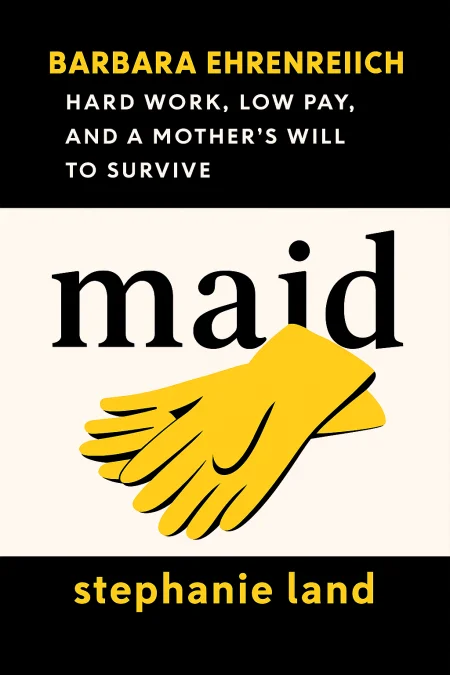
Maid
Hard Work, Low Pay, and a Mother's Will to Survive
byBarbara Ehrenreich, Stephanie Land
Book Edition Details
Summary
Amid the swirling chaos of a young life detoured by a sudden pregnancy, Stephanie Land emerges as a voice for the voiceless, revealing the unseen worlds of America’s upper-middle class through the lens of a maid. Her dreams of becoming a writer take root in the margins of cleaning schedules and online classes, nurturing hope amidst the dust and despair. Maid is not merely a memoir; it is a poignant reflection on resilience, poverty, and the quest for dignity. As Stephanie scrubs the floors of privilege, she uncovers not only the intimate secrets of her clients but also the raw, unfiltered truths of her own existence. This narrative is a clarion call, shedding light on the unseen struggle of those who toil in the shadows of the American Dream, capturing the hearts of anyone who has ever dared to dream against all odds.
Introduction
At twenty-eight, Stephanie Land thought she understood what poverty looked like from the outside. She had volunteered at food banks, participated in charity drives, and witnessed homelessness from a safe distance. But when domestic violence forced her to flee with her infant daughter Mia, she discovered that the reality of being poor in America was far more complex, exhausting, and dehumanizing than she had ever imagined. What began as a temporary setback stretched into years of scrubbing toilets for minimum wage while navigating a labyrinthine system of government assistance that seemed designed to keep people trapped rather than help them escape. Land's journey through the underworld of America's working poor reveals the invisible army of domestic workers who clean the homes of the wealthy while struggling to afford basic necessities for their own families. Her story exposes the crushing mathematics of poverty, where a single mother can work full-time yet still require food stamps, childcare assistance, and housing vouchers just to survive. Through her eyes, readers will understand how the cycle of poverty perpetuates itself, witness the extraordinary resilience required to break free from systemic disadvantages, and discover how the dream of education and self-determination can sustain hope even in the darkest circumstances. This is not just a story about cleaning houses; it is a testament to the unbreakable bond between mother and child and the transformative power of believing in a better future.
From Homelessness to Survival: The Early Struggle
When Stephanie Land's relationship with her abusive partner Jamie collapsed, she found herself in a position she never thought possible: homeless with a seven-month-old baby. The transition from middle-class expectations to literal homelessness happened with devastating speed. One day she was living in a trailer, planning a future with her daughter's father; the next, she was calling domestic violence hotlines and emergency shelters, learning a new vocabulary of survival that included terms like "transitional housing" and "ninety-day limits." The homeless shelter where Mia took her first steps became an unlikely classroom in resilience. Land discovered that proving poverty required almost as much work as escaping it. Her days were consumed with appointments with caseworkers, filling out forms in quadruplicate, and standing in long lines at government offices where the fluorescent lights seemed designed to drain hope from the human spirit. Each program had different requirements, different timelines, different ways of measuring worthiness. Food stamps required one set of documents; childcare assistance needed another; housing vouchers demanded still more proof that she deserved help. The shelter's rules reflected society's deep suspicions about poor people. Random drug tests, curfews, restrictions on visitors, and mandatory chores created an environment more reminiscent of probation than assistance. Land began to understand that being poor in America meant constantly proving your moral fitness to exist. The message was clear: if you needed help, you must have done something wrong, and society would monitor your every move to ensure you didn't make things worse. Yet within this dehumanizing system, Land found moments of profound love and connection with her daughter. Mia's first steps, taken across the worn linoleum of their temporary home, represented more than a developmental milestone. They symbolized forward movement in a situation that felt utterly static, hope in a place designed to contain rather than liberate. Even as Land navigated the bureaucracy of survival, she maintained her fierce commitment to being present for these precious moments of her daughter's childhood.
Invisible Labor: Life as a Professional Cleaner
The world of domestic cleaning revealed itself as a hidden caste system where middle-class homeowners purchased not just clean surfaces, but the luxury of invisibility from their own mess. Land entered this world through Classic Clean, a company that transformed her into a ghost who materialized just long enough to restore order before vanishing again. Her clients gave their houses nicknames in her mind: the Porn House, where she encountered evidence of a marriage's intimate failures; the Sad House, where a widower lived among the preserved memories of his deceased wife; the Cigarette Lady's House, where expensive anti-aging products lined the bathroom while cigarettes were hidden in a garage freezer. Each house told a story, and Land became an unwitting anthropologist of American domestic life. She discovered that wealth didn't necessarily correlate with happiness or fulfillment. The Chef's House contained prescription pain medications in nearly every room, suggesting that financial security hadn't prevented deeper forms of suffering. The Plant House owner battled constant mold and sinus infections despite having the resources to address these problems, revealing that some struggles transcended economic circumstances. Through these glimpses into private lives, Land began to understand that cleaning wasn't just about removing dirt—it was about bearing witness to the most intimate aspects of human existence. The physical demands of the work were brutal. Land's body bore the cost of her labor in chronic back pain, damaged nerves, and hands so cracked from cleaning chemicals that holding a dinner plate became difficult. She consumed dangerous amounts of ibuprofen just to function, knowing that missing work due to injury could mean losing everything. The company's minimal equipment—essentially vinegar, castile soap, and elbow grease—meant that every surface had to be scrubbed by hand, often while clients remained oblivious to the effort required to maintain their lifestyles. What struck Land most profoundly was her complete invisibility to most clients. She knew intimate details about their lives, their health problems, their relationships, their secrets, yet they often didn't know her name. This erasure was both a privilege and a wound. It allowed her to work without judgment, but it also reinforced her sense of existing outside normal human consideration. She was essential to their comfort yet utterly disposable—a paradox that captured the essence of America's relationship with its working poor.
Breaking Cycles: Education and the Dream of Escape
Education became Land's lifeline out of poverty, though pursuing it while working full-time and raising a child alone pushed her to the edges of human endurance. Community college classes taken online in the dark hours after Mia's bedtime represented more than academic credits—they were acts of faith in a future that seemed impossibly distant. Each assignment completed while fighting exhaustion was a declaration that this life of scrubbing toilets was temporary, that she was destined for something more meaningful than invisibility. The mathematics of escaping poverty through education proved as complex as any calculus course. Student loans provided breathing room but came with the weight of future debt. Work-study programs offered experience but paid barely enough to cover gas money. The Pell Grant felt like finding treasure, yet even with maximum financial aid, Land often had to choose between textbooks and groceries. The system seemed designed to test her commitment at every turn, as if society needed to ensure that only the most determined would succeed in changing their circumstances. The irony wasn't lost on Land that many of her clients possessed the college degrees she was working toward, yet seemed trapped in their own forms of misery. Education clearly wasn't a guarantee of fulfillment, but for someone starting from the bottom, it represented the only reliable ladder out of poverty. Her writing classes, in particular, began to offer something she hadn't expected: a sense of purpose that transcended economic necessity. Words became her refuge and eventually her weapon against the indignities of her circumstances. The decision to pursue education while maintaining her impossible schedule reflected a kind of generational courage. Land was determined to model for Mia that circumstances didn't define possibilities, that a person could rewrite their story through persistence and learning. Every late night spent hunched over homework while Mia slept was an investment not just in her own future, but in breaking cycles of limitation that might otherwise pass to the next generation. She was studying not just subjects, but the art of transformation itself.
Finding Home: The Journey to Independence and Hope
The road to Missoula, Montana, became both literal and metaphorical journey toward home—not just a place to live, but a community where Land and Mia could finally belong. For years, Missoula had existed in Land's imagination as a kind of promised land, influenced by the writing of authors who described it with almost mystical reverence. When she finally visited, the city lived up to its reputation, offering not just beautiful landscapes but a culture that embraced the kind of person she was becoming: educated, artistic, independent, and unashamed of her struggles. The move required extraordinary courage, not just because of the practical challenges of relocating across state lines, but because it meant confronting Jamie's attempts to maintain control through Mia. The legal process of relocating with a child forced Land to articulate her vision of a better life in court documents and testimony, making her dreams official and legally binding. She had to prove that Missoula offered opportunities that Washington couldn't provide, that education and community were worth the risk of starting over. In Missoula, Land discovered what she had been seeking without fully knowing it: a place where single mothers weren't anomalies, where artistic pursuits were valued, where diversity of experience was seen as strength rather than failure. The University of Montana provided not just educational opportunities but a community of learners who understood the transformative power of knowledge. For the first time, Land could envision a future where her struggles might become wisdom she could share with others, where her story might help illuminate paths for other women facing similar challenges. The mountain that loomed over Missoula became a perfect metaphor for Land's journey. When she and five-year-old Mia finally climbed to the summit of Sentinel Mountain, they were doing more than conquering a geographic challenge. They were proving to themselves that they had developed the strength and determination to reach any goal they set. From the mountaintop, looking down at their new home spread out in the valley below, they had literally and figuratively risen above their circumstances, ready to embrace whatever challenges and opportunities awaited them in their new life.
Summary
Stephanie Land's journey from domestic violence survivor to accomplished writer and educator demonstrates that poverty is not a moral failing but a systemic trap that requires both individual determination and community support to escape. Her experience reveals the hidden costs of America's service economy, where essential workers remain invisible and undervalued despite their crucial contributions to society's functioning. Most powerfully, her story shows how the love between a mother and child can provide the strength needed to endure unimaginable hardships while maintaining hope for transformation. Land's path offers two crucial lessons: first, that education remains one of the most reliable means of economic mobility, even when the pursuit seems impossibly difficult; and second, that finding community—a place where one's struggles are understood rather than judged—can be as essential as any material resource. Her ultimate success suggests that while individual effort is necessary for escaping poverty, it becomes possible only when combined with access to genuine opportunities and supportive communities. This story will resonate deeply with anyone who has ever felt trapped by circumstances, struggled to balance survival with dreams, or wondered whether persistence really can overcome systemic disadvantages.
Related Books
Download PDF & EPUB
To save this Black List summary for later, download the free PDF and EPUB. You can print it out, or read offline at your convenience.
By Barbara Ehrenreich
