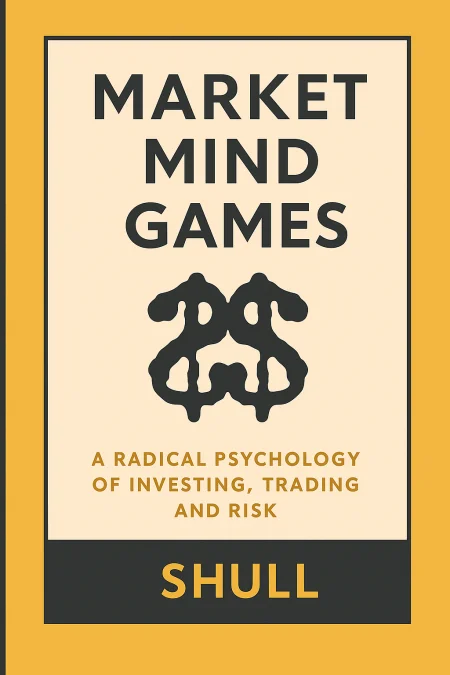
Market Mind Games
A Radical Psychology of Investing, Trading and Risk
byShull
Book Edition Details
Summary
In a world where decisions often hinge on logic and detachment, Denise Shull dares to flip the script with "Market Mind Games," a compelling narrative that boldly redefines our understanding of financial decision-making. Here, emotions are not the enemy; they are the key to unlocking sharper insights and smarter choices. Shull, a seasoned trader and biopsychology expert, reveals that sidelining feelings can amplify risk, challenging the age-old myth of the emotionless investor. Instead, she champions a strategy where emotions become vital data points, transforming uncertainty into opportunity. With the precision of a scientist and the intuition of a market veteran, Shull stitches together a tapestry of neuroscience and behavioral finance, guiding readers through a revolutionary approach that doesn't just work—it wins.
Introduction
Why do sophisticated investors repeatedly make the same costly mistakes, despite access to advanced analytical tools and market data? Why do billion-dollar hedge funds collapse seemingly overnight, and why do individual traders find themselves acting against their own carefully crafted strategies? The answer lies not in the numbers on our screens, but in the psychological processes that drive every market decision. This book presents a revolutionary framework that challenges the fundamental assumptions of traditional finance theory. Rather than viewing markets as mathematical puzzles to be solved through quantitative analysis, this approach reveals them as complex social and psychological systems where human perception, emotion, and unconscious patterns drive price movements. The theory synthesizes insights from neuroscience, behavioral psychology, and psychoanalytic thinking to create a comprehensive model for understanding how markets truly function. At its core, this framework argues that successful market participation requires mastering the psychological dimensions of decision-making under uncertainty, recognizing the social nature of price discovery, and developing what the author terms "psychological capital" alongside financial capital.
The Limits of Mathematical Models in Markets
The seductive precision of mathematical models in finance masks a fundamental flaw: they attempt to apply the certainty of arithmetic to the inherent uncertainty of human behavior. While two plus two will always equal four, market prices represent something far more complex—the collective perceptions and expectations of countless individuals making decisions about an unknowable future. Traditional quantitative approaches treat markets as if they operate according to discoverable natural laws, similar to physics or chemistry. However, this perspective fundamentally misunderstands what markets actually are: human social constructions that exist solely because people agree to participate in them. The limitations become apparent when we examine the track record of sophisticated mathematical models. The 2007-2008 financial crisis provides a stark example, where models that had worked for years suddenly failed catastrophically. Events that were statistically "impossible"—25-sigma deviations that should occur once in millions of years—happened repeatedly within months. This wasn't a failure of mathematics itself, but rather a failure to recognize that markets don't follow mathematical laws in the way that planetary motions follow gravitational laws. Consider the difference between rolling dice and playing poker. Dice have fixed, calculable probabilities—you can determine the exact odds of rolling any combination. Poker, while it involves cards with known quantities, becomes a game of uncertainty the moment human wagering begins. The mathematical probabilities of card combinations provide only a starting point; winning requires reading opponents, understanding psychological pressure, and making decisions based on incomplete information about others' intentions and emotional states. Markets operate far more like poker than like dice. Prices don't move according to mathematical formulas; they move because human beings decide to buy or sell based on their perceptions, emotions, and expectations about what other human beings might do. The numbers we see flashing on our screens are not mathematical truths waiting to be decoded, but rather a constantly evolving language that communicates the collective psychological state of market participants. This recognition doesn't invalidate quantitative analysis, but it places such analysis in its proper context as one tool among many, rather than as the ultimate arbiter of market truth.
Emotions as Data: The New Psychology of Risk
Traditional financial theory has long treated emotions as obstacles to rational decision-making, something to be controlled or eliminated through disciplined analysis. This view fundamentally misunderstands the role of emotions in human cognition and decision-making. Cutting-edge neuroscience reveals that emotions are not disruptive forces that interfere with rational thought, but rather essential components of the decision-making process itself. Without emotional input, humans literally cannot make decisions, even simple ones like choosing between two appointment times or selecting breakfast cereal. The key insight is reframing emotions from obstacles into data sources. Rather than trying to eliminate fear, anxiety, or excitement from trading decisions, successful market participants learn to recognize these emotions as valuable information about market conditions and their own psychological state. Fear, for instance, often signals important risks that purely analytical approaches might miss. The "gut feeling" that something isn't right in a market can reflect unconscious pattern recognition that processes information faster than deliberate analytical thinking. This emotional data operates on multiple levels simultaneously. At the most conscious level, traders can learn to identify where they fall on the spectrum between "fear of losing money" and "fear of missing out"—two primary emotional states that drive most market decisions. Fear of losing typically leads to premature exits and missed opportunities, while fear of missing out drives impulsive entries and position-sizing mistakes. Understanding which emotional state is dominant at any given moment provides crucial context for evaluating potential trades and managing risk. The deeper level involves what psychologists call "emotional context"—the background emotional state that colors all perception and decision-making. Just as physical fatigue affects athletic performance, emotional states like frustration, overconfidence, or anxiety systematically bias how we interpret market information. A trader who has just suffered a loss processes new information differently than one riding a winning streak. By tracking and acknowledging these emotional contexts, market participants can make adjustments that dramatically improve their decision-making quality. Rather than fighting against human psychology, this approach harnesses its power by treating emotions as sophisticated data-processing systems evolved over millions of years to help humans navigate uncertainty and make survival-critical decisions under pressure.
Fractal Patterns in Trading Psychology
The concept of fractal geometry—where similar patterns repeat at different scales throughout natural systems—provides a powerful framework for understanding how psychological patterns manifest in trading behavior. Just as the structure of a fern leaf mirrors the structure of the entire plant, the psychological patterns that govern individual trading decisions often mirror deeper patterns rooted in personal history and unconscious expectations. These fractal patterns explain why traders repeatedly find themselves in similar situations, making the same types of mistakes despite conscious intentions to change. At the most basic level, fractal patterns in trading psychology emerge from what psychologists call "transference"—the unconscious tendency to perceive present situations through the lens of past experiences, particularly formative relationships and experiences from childhood. A trader who grew up with highly critical parents might unconsciously expect failure and exit winning trades prematurely, replicating the emotional dynamic of never being "good enough." Conversely, someone who learned that taking risks led to attention and approval might consistently over-leverage positions, unconsciously seeking the emotional high of validation through market success. These patterns become fractal because they repeat across multiple timeframes and contexts within trading. The same psychological dynamic that causes a trader to exit a profitable position too early might also manifest in their overall career trajectory, their relationship patterns, or their approach to personal financial management. Understanding these fractal patterns requires honest self-examination and often professional guidance, but the payoff is substantial. Once traders recognize their unconscious patterns, they can interrupt destructive cycles before they play out in their trading accounts. The practical application involves what might be called "fractal awareness"—developing sensitivity to when current market situations trigger emotional responses that seem disproportionate to the objective circumstances. When a trader feels intense urgency to enter a position, overwhelming fear about a normal pullback, or compulsive need to "prove" themselves through market success, these often signal that fractal patterns from their personal history are influencing their perception of market conditions. By recognizing these moments and pausing to examine the emotional undercurrents, traders can make decisions based on current market realities rather than unconscious reenactments of past psychological dynamics.
Building Psychological Capital for Market Success
Just as financial capital provides the resources necessary for market participation, psychological capital represents the mental and emotional resources required for sustained success under conditions of uncertainty and pressure. Unlike financial capital, which can be precisely measured and allocated, psychological capital is dynamic, renewable, and requires active management. It encompasses physical energy, emotional resilience, cognitive clarity, and what might be called "uncertainty tolerance"—the ability to make decisions and take action despite incomplete information and unknowable outcomes. Physical energy forms the foundation of psychological capital. Sleep deprivation, poor nutrition, and lack of exercise don't just affect general well-being; they systematically impair the quality of decision-making under uncertainty. Research shows that tired individuals literally perceive risks differently than well-rested ones, often seeing potential gains as more attractive and potential losses as less threatening than they actually are. This isn't a matter of discipline or willpower—it's a neurological reality that affects everyone regardless of experience or intelligence. Successful traders treat physical conditioning with the same seriousness that professional athletes do, recognizing that their decision-making apparatus requires optimal fuel and maintenance. Emotional resilience, the next component of psychological capital, involves developing a sophisticated understanding of one's own emotional patterns and triggers. This goes beyond simple emotion regulation to encompass what might be called "emotional intelligence for uncertainty." It includes the ability to distinguish between emotions that carry valuable information (such as intuitive warnings about market conditions) and those that represent psychological noise from personal history or current stress. It also involves developing strategies for maintaining emotional equilibrium during both winning and losing streaks, recognizing that both success and failure can create emotional contexts that impair subsequent decision-making. The highest level of psychological capital involves transforming one's relationship with uncertainty itself. Rather than viewing market unpredictability as a problem to be solved, successful participants learn to embrace uncertainty as the fundamental condition that creates opportunity. This shift in perspective—from seeking certainty to developing comfort with ambiguity—paradoxically provides a form of psychological stability that no amount of analysis or hedging can match. When traders accept that they cannot know what will happen next, they become free to focus on what they can control: their preparation, their process, their risk management, and their response to whatever the market delivers. This acceptance doesn't lead to passivity but rather to a more dynamic, adaptive approach that can capitalize on opportunities while preserving capital during adverse conditions.
Summary
The greatest edge in financial markets isn't found in superior algorithms or exclusive information, but in understanding that markets are fundamentally human systems where psychology drives price movements and individual success depends on mastering the mental game of uncertainty. This framework reveals that emotions aren't obstacles to overcome but sophisticated data sources evolved to help humans navigate ambiguous situations, that personal psychological patterns repeat fractally across trading decisions and career trajectories, and that building psychological capital alongside financial capital provides sustainable competitive advantage. Rather than seeking certainty in an uncertain world, this approach teaches us to find opportunity in ambiguity, strength in self-awareness, and profit in understanding the deepest patterns of human nature that drive all market behavior.
Related Books
Download PDF & EPUB
To save this Black List summary for later, download the free PDF and EPUB. You can print it out, or read offline at your convenience.
By Shull
