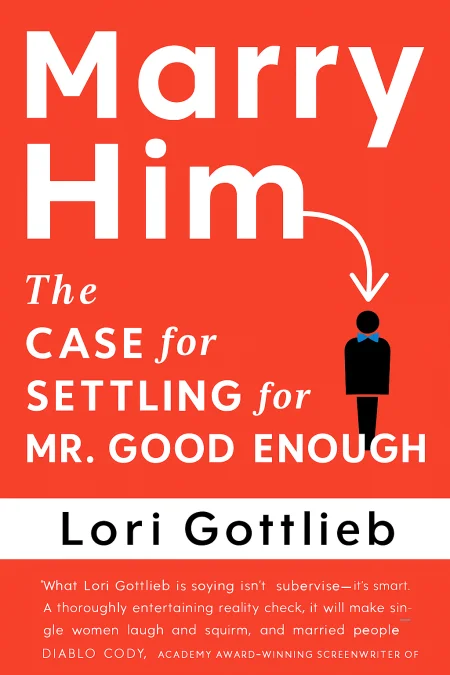
Marry Him
The Case for Settling for Mr. Good Enough
Book Edition Details
Summary
At 40, Lori Gottlieb faced a startling reality: what if "The One" was a myth? "Marry Him" tackles this heart-stirring question with wit and candor, challenging the fairy tale ideals that many women hold dear. Gottlieb delves into her own experiences and the tangled web of modern romance, encouraging readers to rethink their checklist of partner perfection. Through conversations with experts from marital researchers to neuropsychologists, she explores why so many miss out on love by dismissing the "good enough" guy. This provocative narrative isn't just a guide to finding a partner; it's a lively, humorous exploration of redefining happiness and understanding what truly matters in love.
Introduction
Modern dating culture has created an unprecedented paradox: never before have women had such freedom to choose their romantic partners, yet never before have so many educated, accomplished women found themselves single and searching well into their thirties and forties. This phenomenon challenges our most cherished assumptions about love, compatibility, and what constitutes a fulfilling romantic partnership. The contemporary approach to mate selection, heavily influenced by romantic ideals and consumer culture mentalities, may actually be sabotaging women's chances of finding lasting happiness. The prevailing wisdom suggests that holding out for "the one" who meets every criterion on an extensive checklist represents empowerment and self-respect. However, this philosophy warrants serious examination through multiple lenses: behavioral economics, marriage research, cross-cultural analysis, and practical relationship dynamics. By dissecting the gap between romantic fantasies and marital realities, we can uncover how the pursuit of perfection often leads to prolonged solitude rather than meaningful connection. This analysis will trace the evolution from practical partnership models to contemporary romantic maximalism, revealing why the very standards meant to ensure relationship success may instead be ensuring relationship failure.
The Paradox of Choice: Why Modern Dating Standards Create Unhappiness
The application of consumer choice theory to romantic relationships reveals a fundamental flaw in contemporary dating approaches. When faced with seemingly unlimited options through online platforms and extended social networks, many women adopt a "maximizer" rather than "satisficer" mentality. Maximizers continuously seek the absolute best option available, while satisficers establish reasonable criteria and commit once those standards are met. Research demonstrates that maximizers consistently report lower satisfaction with their choices, even when objectively superior outcomes are achieved. This paradox intensifies in romantic contexts where the stakes feel impossibly high. The fear of "settling" creates a psychological trap where good relationships are abandoned in pursuit of perfect ones that may not exist. The abundance of choice generates analysis paralysis, with potential partners subjected to increasingly granular evaluation criteria. Minor incompatibilities become disqualifying factors, while major relationship predictors like kindness, reliability, and shared values receive insufficient weight in the decision-making process. The temporal dimension adds another layer of complexity. Unlike consumer goods, romantic relationships exist within biological and social timelines that narrow options over time. The opportunity cost of extended searching compounds with each passing year, yet the maximizer mindset intensifies rather than adapts to these changing circumstances. This creates a devastating feedback loop where the pursuit of the ideal partner systematically eliminates access to genuinely compatible partners. The cultural narrative that "there's someone better out there" becomes a self-fulfilling prophecy of perpetual dissatisfaction. The constant possibility of upgrade prevents the deep investment required for relationships to develop their full potential, creating a pattern of premature abandonment that leaves promising connections unexplored.
From Fantasy to Reality: Distinguishing Wants from Needs in Partners
The distinction between romantic preferences and fundamental relationship requirements represents one of the most critical yet poorly understood aspects of mate selection. Popular culture conflates surface-level attractions with deeper compatibility indicators, leading to systematic misallocation of priorities in partner evaluation. Physical appearance, profession, educational pedigree, and lifestyle preferences occupy disproportionate mental space, while character traits that predict long-term relationship satisfaction receive cursory attention. Research in relationship psychology reveals that successful long-term partnerships depend primarily on three core elements: emotional stability, mutual respect, and aligned life goals. These fundamental needs create the foundation upon which all other relationship dynamics build. In contrast, wants represent preferences that enhance but do not determine relationship quality. A partner's height, profession, or cultural sophistication may influence initial attraction but prove irrelevant to daily relationship satisfaction. The challenge lies in the fact that wants often masquerade as needs in conscious evaluation processes. The belief that physical chemistry must be immediately intense, or that intellectual stimulation requires identical interests and references, artificially constrains the pool of viable partners. Many women unknowingly prioritize characteristics that correlate with exciting courtships but not sustainable marriages. The confusion between dating compatibility and marriage compatibility leads to systematic selection errors. The process of distinguishing wants from needs requires honest self-examination about what actually contributes to personal happiness and relationship stability. This involves questioning inherited assumptions about what romantic relationships should provide and examining whether current selection criteria align with stated relationship goals. The goal is not to eliminate preferences but to properly weight them against more fundamental compatibility factors.
The Economics and Psychology of Romantic Compromise
The application of economic principles to relationship decisions illuminates the hidden costs of perfectionist partner selection strategies. Every relationship choice involves opportunity costs, sunk costs, and risk-reward calculations that operate largely below conscious awareness. The decision to end a relationship in pursuit of a "better" option generates both measurable and immeasurable costs that compound over time, particularly for women operating within biological constraints. The concept of depreciation applies differently to male and female romantic market value as individuals age. While men's relationship prospects often improve through their thirties due to increased financial stability and maturity, women face declining options and increased competition from younger cohorts. This asymmetry creates a strategic imperative for earlier commitment that conflicts with cultural messages about extended exploration and self-discovery. Behavioral economics research reveals systematic biases in how individuals evaluate relationship trade-offs. The availability heuristic leads people to overweight memorable examples of passionate relationships while undervaluing stable but less dramatic partnerships. Loss aversion creates excessive attachment to hypothetical "perfect" partners while minimizing the value of available options. The grass-is-greener syndrome prevents accurate assessment of current relationship quality by maintaining focus on imagined alternatives. The sunk cost fallacy operates in reverse in dating contexts, where significant emotional and temporal investments in relationship development are abandoned due to minor incompatibilities. This pattern becomes particularly destructive when individuals repeatedly invest heavily in relationships with fundamentally incompatible partners while dismissing potentially suitable matches due to surface-level concerns. The cumulative effect creates a portfolio of failed investments rather than a successful long-term partnership.
Redefining Love: From Chemistry to Compatibility in Marriage
The contemporary conflation of intense romantic chemistry with love compatibility represents a fundamental category error that undermines relationship decision-making. Initial attraction and long-term partnership satisfaction operate through different psychological and neurological mechanisms, yet dating culture treats them as synonymous. This confusion leads to systematic selection for relationships that provide intense short-term experiences but lack the stability required for sustained satisfaction. Neurological research demonstrates that the brain chemistry associated with early romantic passion resembles addiction more than stable affection. The dopamine-driven reward system that creates the "high" of new romance naturally diminishes over time, typically within eighteen to thirty-six months. Relationships built primarily on this neurochemical foundation face inevitable decline as the brain adapts to familiar stimuli. In contrast, partnerships founded on compatibility, mutual respect, and shared goals develop deeper satisfaction as couples build shared experiences and mutual dependence. The arranged marriage model, despite its cultural unfamiliarity, provides instructive evidence about alternative approaches to partner selection. Research comparing arranged marriages to "love marriages" reveals comparable or superior satisfaction rates, suggesting that initial chemistry may be neither necessary nor sufficient for relationship success. These partnerships prioritize compatibility assessment and commitment before emotional investment, allowing love to develop within a stable framework rather than requiring it as a prerequisite. The redefinition of love from feeling to action transforms relationship evaluation criteria. Love as commitment, daily kindness, and mutual support provides a more reliable foundation for long-term happiness than love as passion, excitement, and emotional intensity. This shift requires cultural reeducation about what romantic relationships can and should provide, moving away from entertainment-based models toward partnership-based frameworks that acknowledge the practical dimensions of shared life.
Summary
The central insight emerging from this analysis is that the very standards and strategies meant to ensure relationship success have become the primary obstacles to achieving it. The pursuit of romantic perfection, enabled by unprecedented choice and cultural messaging about empowerment through selectivity, systematically eliminates opportunities for the compromised but fulfilling partnerships that characterize successful marriages. The solution requires not lowering standards but correctly calibrating them toward characteristics that actually predict long-term satisfaction rather than short-term excitement. This represents a profound shift from consumer-oriented dating toward partnership-oriented mate selection, acknowledging that the most rewarding relationships often develop through commitment and shared experience rather than instant recognition and perfect compatibility. The path forward demands both individual introspection about authentic needs versus socially constructed wants, and cultural evolution away from maximalist romantic ideals toward more realistic and ultimately more satisfying relationship models.
Related Books
Download PDF & EPUB
To save this Black List summary for later, download the free PDF and EPUB. You can print it out, or read offline at your convenience.
By Lori Gottlieb
