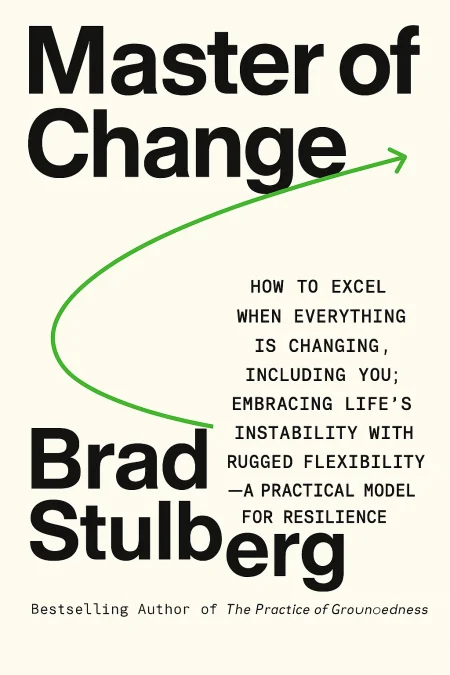
Master of Change
How to Excel When Everything Is Changing - Including You
Book Edition Details
Summary
Amidst the chaos of modern life, where change is the only certainty, Brad Stulberg's "Master of Change" emerges as a beacon of clarity and resilience. This transformative guide challenges our instinctual resistance to life's relentless upheavals, offering a paradigm shift that celebrates change as an opportunity rather than a threat. With eloquence and insight, Stulberg introduces the concept of 'rugged flexibility'—a dynamic mindset that thrives on the dance between order and disorder. Drawing from the rich tapestry of ancient philosophies and the latest scientific discoveries, he crafts a practical blueprint for embracing life's unpredictability with grace and strength. As we navigate personal and societal shifts—from career pivots to global disruptions—this book equips us with the tools to evolve, adapt, and ultimately flourish, redefining stability as a vibrant, ever-evolving journey.
Introduction
Why do some people thrive through major life changes while others crumble under the pressure? The traditional view suggests we should seek stability and resist change, yet this approach leaves us unprepared for life's inevitable disruptions. Modern neuroscience and ancient wisdom converge on a surprising truth: our relationship with change determines our capacity for growth, resilience, and sustainable excellence. This book introduces the concept of "rugged flexibility" - a revolutionary framework that combines the toughness to endure difficult transitions with the adaptability to bend without breaking. Rather than viewing change as something that happens to us, we can learn to engage in an ongoing conversation with it. The theoretical foundation draws from allostasis, the biological principle that healthy systems achieve stability through change rather than despite it. This paradigm shift reveals how we can navigate cycles of order, disorder, and reorder that define human experience. The framework addresses fundamental questions about identity persistence, meaning-making during uncertainty, and the development of anti-fragile responses to disruption. Through this lens, change becomes not an enemy to resist but a dance partner in the choreography of a meaningful life.
Developing a Rugged and Flexible Mindset
The foundation of navigating change successfully begins with adopting what researchers call a "rugged and flexible mindset" - a cognitive orientation that embraces both the inevitability of change and our capacity to work with it skillfully. This mindset represents a fundamental departure from the homeostatic model that views disruption as deviation from normal functioning, instead embracing the allostatic principle that stability emerges through adaptive variation. The framework consists of two complementary components that work in tandem. First is "openness to the flow of life" - the recognition that impermanence is not a bug in the system but a feature of existence itself. This involves shifting from a "having" orientation, where identity depends on external possessions and circumstances, to a "being" orientation that draws strength from core values and response capabilities. The second component involves setting realistic expectations about the difficulty of change while maintaining hope and agency. Central to this mindset is the concept of "tragic optimism" - the ability to acknowledge life's inherent challenges while maintaining forward momentum. This approach recognizes that suffering often equals pain multiplied by resistance, suggesting that our relationship with difficulty matters more than the difficulty itself. Unlike toxic positivity that denies hardship or nihilistic pessimism that abandons hope, tragic optimism creates space for the full spectrum of human experience while directing energy toward constructive action. Consider how master athletes approach competition. They don't pretend failure is impossible, nor do they become paralyzed by its potential. Instead, they train with the understanding that setbacks are part of excellence, developing both the grit to persist through difficulties and the flexibility to adapt their strategies. This same principle applies to navigating career transitions, relationship changes, health challenges, or any significant life disruption. The mindset becomes a cognitive immune system that transforms obstacles into opportunities for growth.
Cultivating a Fluid Sense of Self and Identity
Traditional concepts of identity often emphasize consistency and permanence, yet this rigid approach creates fragility when circumstances change. A fluid sense of self offers a more resilient alternative - maintaining core continuity while allowing for adaptive evolution. This theoretical framework draws from complexity science, which shows that the most enduring systems combine differentiation with integration, creating stable yet dynamic structures. The model operates on multiple levels simultaneously, embracing what philosophers call "non-dual thinking." Rather than choosing between independence or interdependence, a fluid identity incorporates both orientations as tools to be deployed situationally. Sometimes we need the autonomous self that takes charge and influences outcomes; other times we benefit from the relational self that adapts to environmental conditions and seeks collaborative solutions. This flexibility prevents us from becoming trapped in any single mode of being. The framework distinguishes between conventional and ultimate aspects of selfhood. The conventional self manages daily tasks, maintains boundaries, and pursues goals - it's the "you" reading these words right now. The ultimate self recognizes the interconnected nature of existence, understanding that identity extends beyond individual boundaries to include relationships, experiences, and contributions to larger systems. Both aspects are simultaneously true and necessary for psychological health. Think of identity like water in a riverbank. The water itself is constantly flowing and changing, never the same from moment to moment, yet the river maintains its essential character through time. The banks provide structure and direction without rigidly constraining the flow. Similarly, core values serve as the banks of identity - stable boundaries that give shape to our evolution without preventing necessary adaptation. A professional athlete might maintain dedication to excellence while shifting from competitive performance to coaching to mentorship, expressing the same fundamental value through different forms as circumstances change.
Taking Rugged and Flexible Actions Through Change
The transition from understanding change to skillfully navigating it requires a systematic approach to action during uncertainty. The "respond versus react" framework provides the essential distinction: reactions are automatic, emotional, and often counterproductive, while responses are deliberate, values-based, and strategically effective. This difference becomes crucial during periods of disruption when our natural fight-or-flight mechanisms may lead us astray. The neuroscience reveals why this matters so profoundly. The brain contains competing pathways - the RAGE system that triggers reactive behaviors and the SEEKING system that enables purposeful action. These systems operate in a zero-sum relationship: activating one automatically diminishes the other. When we pause to respond rather than immediately react, we engage the prefrontal cortex and stimulate dopamine release, which fuels continued constructive behavior and builds what psychologists call "self-efficacy" - confidence in our ability to handle future challenges. The practical methodology follows a four-step process that creates space between stimulus and response. First, pause by naming emotions specifically and accurately, which research shows reduces amygdala activation and creates psychological distance from immediate reactions. Second, process the situation by examining it from multiple perspectives, perhaps imagining how you'd advise a friend facing similar circumstances. Third, plan by considering options that align with core values rather than merely addressing immediate discomfort. Finally, proceed with small experimental actions, treating initial steps as learning opportunities rather than permanent commitments. Consider how emergency room physicians operate under extreme pressure. They don't react to every crisis with panic or emotional overwhelm. Instead, they've trained systematic response patterns that automatically engage during high-stakes situations. They assess, prioritize, act, and adjust based on results. This same approach applies to personal disruptions - job loss, relationship difficulties, health challenges, or family crises. The key lies in developing response capabilities during calm periods so they're available when urgency strikes. Over time, this practice builds genuine resilience rather than mere coping mechanisms, transforming us into people who can navigate uncertainty with grace and effectiveness.
Making Meaning and Moving Forward with Purpose
The final dimension of rugged flexibility addresses how we construct coherent narratives from chaotic experiences and extract growth from difficulty. This process cannot be forced or rushed - meaning emerges according to its own timeline through what researchers call the "psychological immune system." Just as physical healing requires time and proper conditions, emotional and spiritual recovery from major disruptions follows predictable patterns that resist artificial acceleration. The framework acknowledges that not every experience needs immediate meaning or obvious lessons. Sometimes the most profound service we can provide ourselves is patient presence with difficulty, allowing natural healing processes to unfold without pressure for premature insight or gratitude. Research on trauma recovery shows that meaning-making typically occurs months or years after difficult events, and attempts to force positive interpretation often backfire by creating additional self-judgment about our inability to find silver linings in genuine tragedy. However, certain practices support healthy meaning-making without forcing outcomes. These include maintaining basic routines that provide stability during chaos, seeking appropriate help from others who understand our struggles, and practicing what researchers call "voluntary simplicity" - temporarily reducing life's complexity to focus on essential activities. The goal is creating conditions where natural resilience can operate effectively rather than trying to manufacture specific emotional or cognitive outcomes. The ultimate purpose transcends individual recovery to encompass contribution and legacy. As we develop skill at navigating change ourselves, we become resources for others facing similar challenges. The compassion born from our own struggles creates capacity to support family members, colleagues, and community members through their difficult transitions. This transformation from victim to helper to wisdom-keeper represents the highest expression of rugged flexibility - using our hard-won experience to strengthen the social fabric that supports everyone during periods of disruption and uncertainty.
Summary
Rugged flexibility emerges from the profound recognition that stability in an impermanent world comes not from resisting change but from developing the capacity to dance skillfully with life's inevitable rhythms of order, disorder, and reorder. This comprehensive framework offers both theoretical understanding and practical tools for transforming our relationship with uncertainty from one of fear and resistance to one of curiosity and capability. As individuals master these principles, they contribute to communities and organizations better equipped to navigate an accelerating pace of change while maintaining their essential humanity and values.
Related Books
Download PDF & EPUB
To save this Black List summary for later, download the free PDF and EPUB. You can print it out, or read offline at your convenience.
By Brad Stulberg
