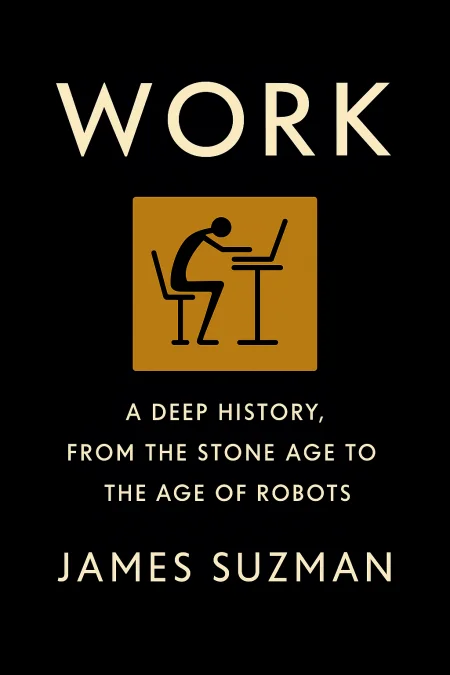
Work
A Deep History, from the Stone Age to the Age of Robots
Book Edition Details
Summary
From the dawn of time to the brink of an automated future, James Suzman invites readers on a provocative exploration of humanity's most defining endeavor: work. This isn't just a recount of labor through the ages—it's a revelation of how our very identity is entwined with our toil. Unpacking millennia of human history with the precision of an anthropologist, Suzman challenges deeply held beliefs about our relentless pursuit of productivity. Were our prehistoric ancestors truly as work-driven as we? And what seismic shifts await as technology redefines labor's role in our lives? With insights spanning anthropology, biology, and economics, Suzman crafts a narrative that questions if our current path might lead to a fairer, more balanced society. In "Work," every page beckons readers to rethink the rhythms of their daily grind and the potential for a more equitable tomorrow.
Introduction
Imagine a hunter-gatherer in ancient Africa, working just fifteen hours a week to provide for their family, spending the rest of their time in leisure and storytelling. Now picture a medieval peasant, bound to the land and toiling from sunrise to sunset. Finally, envision today's knowledge worker, checking emails at midnight while algorithms threaten to automate their profession. This dramatic transformation reveals humanity's most profound journey: how work evolved from a simple survival activity into the defining force of modern civilization. This exploration uncovers three revolutionary insights that reshape our understanding of human progress. First, scarcity is not humanity's natural condition but a cultural invention born from agricultural societies, challenging our deepest economic assumptions. Second, each technological leap that promised liberation from toil paradoxically created new forms of labor and anxiety, from farming's seasonal demands to industrialization's time discipline. Third, as artificial intelligence reshapes our world, we stand at the threshold of a transformation as significant as agriculture itself, offering both unprecedented opportunity and existential challenge. Whether you're questioning the purpose of modern work culture, seeking to understand humanity's relationship with technology, or preparing for an automated future, this historical journey provides essential wisdom. By understanding how our ancestors navigated previous transformations, we gain the perspective needed to shape our own destiny in an age of intelligent machines.
Hunter-Gatherer Abundance: The Original Leisure Society (300,000-12,000 BC)
For over ninety-five percent of human existence, our ancestors lived as mobile foragers, and their approach to work would astonish most contemporary people. Archaeological evidence and studies of surviving hunter-gatherer societies reveal a startling truth: these communities achieved what economist Marshall Sahlins called "the original affluent society" not by producing much, but by wanting little. The Ju/'hoansi people of the Kalahari Desert, for instance, worked only fifteen to twenty hours per week to meet all their material needs. This abundance wasn't born from naive optimism but from sophisticated social technology. Hunter-gatherers practiced "demand sharing," where anyone could request anything from anyone else, and refusal was considered deeply antisocial. Wealth accumulation was not just discouraged but actively ridiculed through powerful social mechanisms that prevented inequality from taking root. The !Kung had a saying that captured this wisdom: "The worst thing is not giving gifts." This philosophy reflected a profound understanding that in small-scale societies, everyone's survival depended on mutual cooperation and the free flow of resources. The mastery of fire around 400,000 years ago marked humanity's first great technological revolution. Fire transformed nutrition through cooking, making previously indigestible foods available and potentially fueling the dramatic expansion of human brain size. More importantly, campfires created the world's first leisure spaces, where our ancestors developed language, art, and the complex social bonds that would become civilization's foundation. These evening gatherings, free from survival tasks, became humanity's original think tanks, devoted to storytelling, planning, and the creative activities that distinguished us from other species. This foraging lifestyle reveals a profound truth that challenges modern assumptions: our ancestors lived within natural limits without experiencing the anxiety about scarcity that dominates contemporary economic thinking. They trusted in environmental abundance and focused on immediate needs rather than endless accumulation, achieving remarkable equality and leisure despite material simplicity.
Agricultural Revolution: Birth of Scarcity and Social Hierarchy (12,000 BC-1750 AD)
The end of the last Ice Age created climatic conditions that made agriculture possible, but human ingenuity transformed this opportunity into civilization's second great revolution. In the Fertile Crescent, communities began experimenting with wild grains, gradually developing techniques that would transform scattered seeds into reliable harvests. This transition unfolded over millennia as people slowly learned to domesticate wheat, barley, and livestock, fundamentally altering humanity's relationship with work and time. Agriculture brought unprecedented productivity but at a steep cost that reverberates today. Where foragers had worked seasonally and shared freely, farmers faced relentless daily labor tied to rigid seasonal cycles. Archaeological evidence tells a sobering story: early farmers were shorter, less healthy, and died younger than their foraging ancestors. Skeletal remains reveal repetitive stress injuries, nutritional deficiencies, and bone deformations from lifetimes of backbreaking labor. Yet agriculture's surplus energy enabled specialization, monumental construction, and the complex social hierarchies that would define civilization. The agricultural revolution introduced humanity to a fundamentally new concept: manufactured scarcity. Where foragers had lived within natural limits, farmers pushed constantly against environmental boundaries, creating the boom-and-bust cycles that would characterize agricultural societies. Thomas Malthus later identified this pattern: whenever productivity increased, populations grew to consume the surplus, trapping societies in cycles of growth and potential collapse. This "Malthusian trap" drove the expansion of farming peoples across the globe, often displacing hunter-gatherer populations who could not compete with agricultural societies' sheer numbers. Perhaps most significantly, agriculture created the first permanent inequality in human history. Surplus food enabled some people to specialize in activities other than food production, leading to the emergence of priests, warriors, and rulers. The egalitarian ethos of foraging societies gave way to hierarchical structures that concentrated power and resources in the hands of elites, establishing patterns of inequality that persist today.
Industrial Transformation: Machines, Time Discipline and Modern Labor (1750-1980)
The Industrial Revolution shattered agriculture's ancient rhythms with unprecedented speed and force. Steam engines powered by coal suddenly made it possible to concentrate production in factories, drawing millions from countryside to rapidly growing cities. This transformation created entirely new forms of work and fundamentally altered humanity's relationship with time, efficiency, and human potential. Frederick Winslow Taylor's "scientific management" epitomized this new approach to human labor. Armed with stopwatches, Taylor broke down every task into its smallest components, eliminating what he saw as wasted motion and inefficient practices. His methods dramatically increased productivity but reduced workers to cogs in an industrial machine. The craftsman's pride in skill and creativity gave way to mind-numbing repetition on assembly lines, where workers performed the same simple task thousands of times daily. Yet industrialization also brought unprecedented prosperity, at least eventually. Real wages began rising in the mid-nineteenth century, and by the twentieth century, industrial workers enjoyed living standards their agricultural ancestors could never have imagined. The forty-hour work week became standard, weekends were invented, and paid vacations became common. John Maynard Keynes, writing in 1930, predicted that technological progress would reduce the work week to just fifteen hours by 2030 while maintaining high living standards. However, the Great Decoupling of the 1980s shattered this optimistic trajectory. For decades, worker productivity and wages had risen together, but suddenly they diverged. Productivity continued climbing while wages stagnated, and economic growth's benefits increasingly flowed to capital owners rather than workers. This period witnessed the explosive growth of the service sector and what anthropologist David Graeber termed "bullshit jobs" roles that seemed to exist primarily to keep people busy rather than serve essential human needs, highlighting fundamental contradictions in supposedly efficient market economies.
Digital Age Disruption: Automation's Challenge to Traditional Work (1980-Present)
Today we stand at the threshold of what may be the third great transformation in human work. Artificial intelligence and robotics advance at breathtaking speed, with machines now capable of performing tasks once thought to require uniquely human skills. Oxford researchers estimate that forty-seven percent of current jobs face automation within two decades, while entire industries may be transformed beyond recognition. This technological revolution arrives amid profound inequality. The richest one percent of humanity controls forty-five percent of global wealth, while automation threatens to eliminate many middle-class jobs while further enriching machine owners. Unlike previous technological disruptions that created new work categories to replace those destroyed, artificial intelligence may be fundamentally different. When machines can think, learn, and create, what uniquely human contributions will remain valuable in the marketplace? The COVID-19 pandemic offered a glimpse of potential transformation. Suddenly, societies distinguished between "essential" and "non-essential" workers, revealing how much of our economy consists of activities that don't directly contribute to human welfare. The pandemic also demonstrated our capacity for rapid social change when circumstances demand it, suggesting that the seemingly impossible task of reorganizing our relationship with work may be more achievable than we imagine. Climate change adds urgency to this transformation. Our current economic system's relentless pursuit of growth drives environmental destruction on a scale that threatens civilization itself. The transition to sustainable economies will require fundamental changes in how we work, what we produce, and how we measure success. Automation could be the key to achieving prosperity within environmental limits, but only if we can overcome political and social obstacles to sharing its benefits equitably across society.
Summary
The sweep of human history reveals work not as a timeless constant but as a relationship fundamentally transformed twice before and poised for a third great transformation. From the egalitarian sharing of hunter-gatherers to the hierarchical complexity of agricultural societies to the industrial regimentation of the modern era, each transition reshaped not just how we labor but how we understand ourselves and our place in the world. The central tension running through this story is between abundance and scarcity, cooperation and competition, human flourishing and economic efficiency. Our foraging ancestors achieved remarkable equality and leisure despite material simplicity, while industrial civilization created unprecedented wealth alongside persistent inequality and environmental destruction. The agricultural revolution introduced the concept of scarcity that still dominates economic thinking, even as our productive capacity has grown beyond anything our ancestors could have imagined. As we face the age of automation, we have the opportunity to choose which aspects of our past to carry forward and which to leave behind. We could embrace the egalitarian values of our foraging ancestors while maintaining the technological capabilities of industrial civilization. We could prioritize human welfare over economic growth, cooperation over competition, and sustainability over short-term profit. The tools exist; what remains is the collective will to use them wisely. The future of work is not predetermined by technological forces but will be shaped by the choices we make today about what kind of society we want to become.
Related Books
Download PDF & EPUB
To save this Black List summary for later, download the free PDF and EPUB. You can print it out, or read offline at your convenience.
By James Suzman
