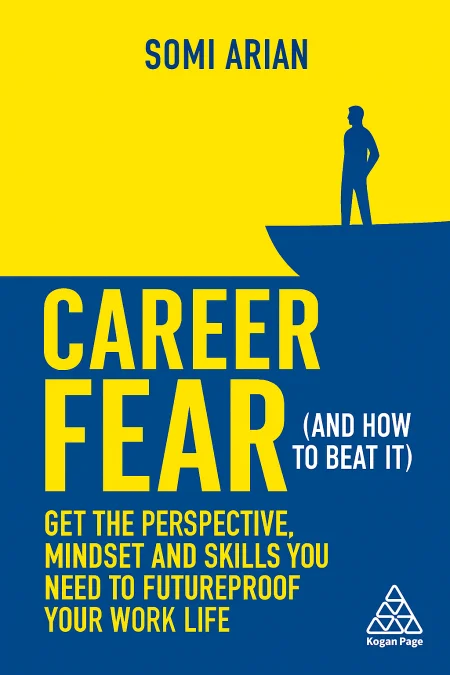
Career Fear (and how to beat it)
Get the Perspective, Mindset and Skills You Need to Futureproof Your Work Life
Book Edition Details
Summary
A seismic shift rattles the landscape of work, casting shadows of uncertainty over our professional futures. Amid this whirlwind of change, "Career Fear (and how to beat it)" emerges as your compass in the storm. Somi Arian offers a blueprint for navigating the evolving job market, equipping you with the essential tools to not just survive, but thrive. This book is a lifeline, blending insightful analysis with tangible strategies to conquer the fear that holds your career hostage. Uncover the human skills and mindset that set you apart in an AI-driven world, enriched with real-life examples and transformative case studies. Prepare to reshape your career narrative, embracing a future where you are the architect of your success, no matter the technological tide.
Introduction
Picture a world where the very concept of "work" didn't exist in human vocabulary. Just centuries ago, our ancestors lived without job interviews, career anxiety, or the Sunday night blues. Yet today, work has become so central to our identity that we introduce ourselves by what we do, not who we are. This transformation didn't happen overnight—it's the result of three major industrial revolutions that fundamentally rewired human society. The story of work is really the story of how humans adapted to machines, and how machines increasingly adapted to humans. From the first steam engine that replaced muscle power to today's algorithms that challenge mental labor, each technological leap has forced us to redefine our place in the world. What makes this moment particularly fascinating is that we're not just witnessing another industrial shift—we're experiencing the birth of artificial intelligence that can think, learn, and create in ways that mirror human cognition. This exploration traces the remarkable journey from physical labor through knowledge work to our current AI-enhanced reality. It's essential reading for anyone who's ever wondered why work feels so different from what our grandparents experienced, or anyone preparing for a career in an age where the rules are being rewritten in real time.
From Physical Labor to Knowledge Work (1760s-1990s)
The transformation of human work began in earnest during the 1760s, when ingenious minds started harnessing steam power to amplify human capability. This wasn't merely about making things faster or cheaper—it represented a fundamental shift in how humans related to their environment. For millennia, work had been seasonal, communal, and directly tied to survival. Suddenly, the rhythmic patterns of agricultural life gave way to the relentless tick of factory clocks. Key figures like James Watt with his improved steam engine and later, Henry Ford with his assembly line, didn't just invent machines—they reimagined the entire structure of human cooperation. Ford's genius wasn't just mechanical; it was social. By breaking complex tasks into simple, repeatable components, he made it possible for ordinary people to produce extraordinary things. However, this came at a cost that we're still grappling with today. Workers became interchangeable parts in a larger machine, losing the holistic connection to their craft that had defined work for centuries. The deeper transformation was psychological. Industrial work introduced the radical idea that time could be subdivided, measured, and sold. Frederick Taylor's "scientific management" treated human workers like biological machines to be optimized. This mechanistic view of human potential created unprecedented productivity but also planted the seeds of worker alienation. As Charlie Chaplin would later satirize in "Modern Times," humans began to move like machines, losing something essentially human in the process. By the early 20th century, this industrial transformation had birthed an entirely new social class: knowledge workers. Unlike their ancestors who worked with their hands, these professionals worked with their minds, analyzing data, managing processes, and coordinating complex systems. This shift from brawn to brain set the stage for everything that would follow, creating the educational systems and corporate hierarchies that still shape our working lives today.
The Digital Revolution and Platform Economy (1990s-2010s)
The 1990s brought a revolution that made the Industrial Revolution look gradual by comparison. Personal computers and the internet didn't just change how we worked—they obliterated the traditional boundaries between workplace and home, producer and consumer, local and global markets. Suddenly, a programmer in Silicon Valley could collaborate in real-time with a designer in Tokyo and a manager in London, creating products that existed entirely in digital space. This period witnessed the birth of platform capitalism, where companies like Google, Amazon, and Facebook built their fortunes not by manufacturing products, but by creating digital spaces where others could create, buy, and sell. The platform economy introduced a paradox that defines modern work: while technology theoretically democratized opportunity, making it possible for anyone to start a business from their laptop, it also concentrated unprecedented wealth and power in the hands of a few platform owners. The most profound change was the emergence of data as the new oil. Every click, every search, every social media post became valuable raw material that could be processed and monetized. Workers found themselves unknowingly contributing to this data economy, creating value for platforms even during their leisure time. Social media posts, product reviews, and online interactions all became forms of unpaid labor that enriched digital platforms. This era also saw the rise of the "gig economy," where traditional employment relationships gave way to project-based work and independent contracting. While this offered flexibility and autonomy for some, it also shifted risks and responsibilities from employers to workers. The promise of being your own boss came with the reality of being responsible for your own health insurance, retirement planning, and career development. The digital revolution had created new opportunities, but it had also made work more precarious and uncertain than it had been since the early industrial age.
AI Era and Human-Machine Collaboration (2010s-Present)
We are now living through the early stages of the fourth industrial revolution, characterized by artificial intelligence systems that can learn, adapt, and perform cognitive tasks that were previously the exclusive domain of human intelligence. Unlike previous technological shifts that primarily affected manual labor, AI is challenging knowledge work itself, forcing us to reconsider what makes human intelligence unique and valuable. The current AI revolution differs fundamentally from earlier automation because it targets pattern recognition, decision-making, and even creative tasks. Machine learning algorithms can now diagnose diseases, write poetry, compose music, and analyze legal documents with increasing sophistication. This isn't just about replacing human workers—it's about augmenting human capabilities in ways that were previously unimaginable. The most successful professionals today are those who learn to dance with AI, using these tools to amplify their uniquely human strengths. However, this collaboration between humans and machines is creating new forms of inequality and displacement. While AI can process vast amounts of data and identify patterns beyond human capability, it lacks the contextual understanding, emotional intelligence, and ethical reasoning that humans bring to complex problems. The challenge is learning to leverage AI's computational power while preserving and developing our distinctly human capabilities. The psychological impact of this transformation cannot be understated. For the first time in history, humans are working alongside systems that can outperform them in specific cognitive tasks. This is forcing a fundamental reevaluation of human value and purpose in work. The most resilient professionals are those who focus on developing skills that complement rather than compete with AI: emotional intelligence, creative problem-solving, ethical reasoning, and the ability to work across disciplines and cultures.
Future Skills for Human-Centered Careers
Looking ahead, the most valuable human skills will be those that machines cannot easily replicate or that become more valuable when combined with AI capabilities. Emotional intelligence stands at the forefront of these skills, as the ability to understand, manage, and respond to human emotions becomes crucial in an increasingly automated world. Unlike machines that process information logically, humans bring empathy, cultural understanding, and the ability to navigate complex social dynamics. Critical thinking represents another irreplaceable human capacity, particularly the ability to ask the right questions rather than simply finding answers. While AI excels at processing information and identifying patterns, humans must provide the context, set the parameters, and make the ethical judgments that guide AI systems. This requires the ability to think across disciplines, question assumptions, and consider the broader implications of technological decisions. Creative problem-solving in context represents perhaps the most uniquely human contribution to future work. While AI can generate novel combinations of existing ideas, humans excel at understanding the cultural, emotional, and social contexts that make solutions meaningful and effective. This contextual creativity involves the ability to see connections across seemingly unrelated fields and to innovate in ways that serve human needs and values. Perhaps most importantly, the future belongs to those who can maintain their humanity while working with increasingly sophisticated machines. This means developing mindfulness and self-awareness, maintaining the ability to connect authentically with other humans, and preserving the curiosity and adaptability that have always been humanity's greatest strengths. The goal isn't to compete with machines, but to create symbiotic relationships where human and artificial intelligence complement each other in service of human flourishing.
Summary
The evolution of work reveals a consistent pattern: each technological revolution initially displaces human capabilities but ultimately creates new opportunities for those who adapt thoughtfully. From the steam engines that replaced muscle power to the AI systems that augment mental power, the story of work is fundamentally about humanity's relationship with its tools and the continuous redefinition of human value. The central tension throughout this history has been between efficiency and humanity, between the benefits of technological progress and the preservation of human dignity and purpose. Today's AI revolution represents both the culmination of this tension and an opportunity to resolve it. Unlike previous industrial revolutions that often diminished human agency, the AI revolution offers the possibility of amplifying human capabilities while freeing us from routine tasks to focus on more meaningful and creative work. The path forward requires three essential shifts in how we approach work and career development. First, we must embrace lifelong learning not as an obligation but as a source of vitality and relevance. Second, we need to cultivate distinctly human skills—emotional intelligence, contextual creativity, and ethical reasoning—that become more valuable as AI handles routine cognitive tasks. Finally, we must learn to see AI not as a threat to human employment but as a powerful collaborator that can help us achieve things neither humans nor machines could accomplish alone. The future of work isn't about humans versus machines, but about humans with machines, creating value that serves human flourishing in ways we're only beginning to imagine.
Related Books
Download PDF & EPUB
To save this Black List summary for later, download the free PDF and EPUB. You can print it out, or read offline at your convenience.
By Somi Arian
