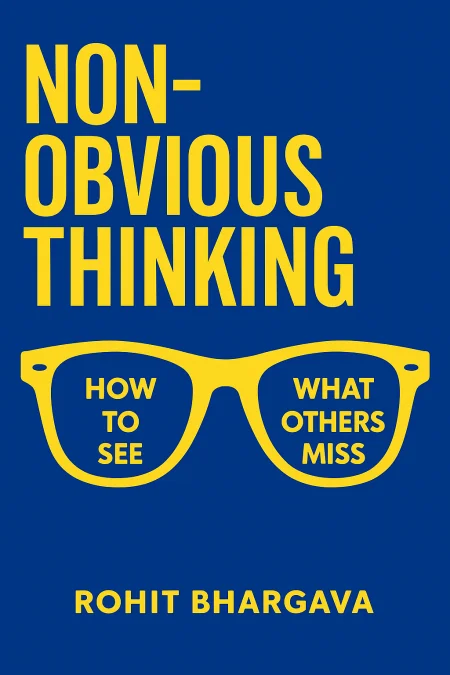
Non-Obvious Thinking
How to See What Others Miss
Book Edition Details
Summary
Ever wondered what it takes to see the world in a way few others can? In "Non-Obvious Thinking," visionary minds Rohit Bhargava and Ben duPont unveil a revolutionary blueprint for unlocking hidden possibilities with the SIFT framework. Journey from the architectural marvels of termite mounds in Zimbabwe to the mysterious tales of a vanishing Australian island, and discover a world brimming with untapped potential. This isn't your typical business book crammed with jargon—it's a vibrant guide to sparking creativity and cultivating originality. With each chapter, you'll hone your ability to carve out mental space for fresh ideas, sharpen your observational skills, and craft unique perspectives that stand out. Ready to shift gears and redefine your thinking? This book is your ticket to transforming everyday moments into extraordinary insights.
Introduction
The world rewards those who see what others cannot. While most people look at the same information and arrive at identical conclusions, a select few possess the ability to spot hidden patterns, uncover buried insights, and develop breakthrough solutions that seem obvious only in hindsight. This extraordinary skill isn't reserved for geniuses or visionaries—it's a learnable capability that anyone can develop through intentional practice and the right mindset. The ability to think non-obviously becomes your competitive advantage in a world saturated with conventional wisdom and predictable responses. When you master this approach, you'll find yourself consistently ahead of trends, solving problems others can't crack, and creating value where others see only obstacles. The journey begins with understanding that what appears obvious today was once revolutionary thinking to someone brave enough to challenge the status quo.
Create Space for Breakthrough Thinking
Creating mental space represents the foundation of all innovative thinking, yet it's the step most people skip in their rush toward solutions. True breakthrough thinking requires more than just finding extra time in your schedule—it demands cultivating the mental agility to welcome new perspectives and challenge existing assumptions. Consider James Cameron's approach to filmmaking. When he was supposed to begin shooting the Avatar sequel, he chose instead to spend four years exploring the deepest ocean trenches in a submarine. This wasn't procrastination—it was intentional space creation. While critics questioned the delay, Cameron understood that groundbreaking work requires mental spaciousness that can't be rushed. His willingness to allow time for ideas to mature resulted in revolutionary filmmaking techniques that changed cinema forever. The transformation occurs when you stop viewing time as a scarce resource to be optimized and start seeing it as creative fuel to be invested. Cameron's submarine journey wasn't just personal adventure—it informed the underwater sequences that became some of the most visually stunning scenes in film history. By creating both physical and mental space for exploration, he discovered solutions that would have been impossible under deadline pressure. Start by examining your daily routines and identifying where you can inject novelty. Change your morning ritual, take different routes to familiar destinations, or simply practice deeper breathing throughout the day. These small disruptions in your automatic patterns signal to your brain that today is different, opening neural pathways for fresh thinking. The goal isn't to add stress but to gently stretch your mental flexibility, creating the conditions where non-obvious insights can emerge naturally.
Uncover Hidden Insights Around You
Insights represent the bridge between surface-level observation and deep understanding, revealing not just what's happening but why it matters. The most powerful insights often hide in plain sight, waiting for someone with the right perspective to recognize their significance. Pulitzer Prize-winning journalist Jacqui Banaszynski revolutionized interviewing by abandoning traditional question lists in favor of what she calls "story questions." Instead of asking subjects to provide information, she invites them to relive scenes from their lives, encouraging them to describe sensory details and specific moments. This technique transforms interviews from data-gathering sessions into rich storytelling experiences that reveal deeper truths about human nature and motivation. When reporters use Banaszynski's method, something remarkable happens. Subjects stop delivering rehearsed talking points and start sharing authentic experiences. A CEO might begin describing the exact feeling of walking into their first board meeting, complete with the smell of coffee and the sound of papers rustling. These vivid details create emotional resonance that reveals character and motivation in ways that standard questions never could. Practice this approach in your daily conversations by focusing on specifics rather than generalities. Instead of asking someone how their vacation was, ask them to describe their favorite single moment from the trip. Rather than inquiring about someone's job satisfaction, invite them to walk you through their most memorable day at work. These story-focused questions unlock insights about what truly motivates people, what challenges they face, and what opportunities they see that others might miss.
Focus Your Ideas with Purpose
Focus represents the crucial skill of distillation, separating meaningful signals from overwhelming noise to concentrate your energy where it will create the most impact. Without proper focus, even the most brilliant insights remain scattered and ineffective. The story of Elisha Otis exemplifies focused problem-solving at its finest. While Otis didn't invent the elevator, he recognized that the real challenge wasn't mechanical—it was psychological. People feared riding in elevators because they might plummet to their deaths if the cable snapped. Otis could have focused on improving elevator mechanics, but instead he concentrated on the trust problem. His solution was theatrical: at the 1853 World's Fair, he stood on an elevator platform while an assistant cut the supporting rope with an axe. When his safety brake engaged and saved his life, he demonstrated that elevators could be trusted. This dramatic performance solved the deeper issue preventing elevator adoption. Otis understood that convincing the market mattered more than perfecting the technology. His focus on the right problem—building public confidence rather than mechanical efficiency—transformed urban architecture by making tall buildings feasible. Cities could now grow vertically, fundamentally changing how humans organize themselves in space. Apply this focused thinking by identifying the real problem beneath surface complaints. When customers say your product is too expensive, they might actually mean it doesn't provide enough value. When employees resist change, they might fear losing competence rather than opposing innovation. Use the "five whys" technique to dig deeper, asking why something matters and following each answer with another why. This process reveals the core issue where your focused effort will create breakthrough results.
Define Your Unique Twist
The twist represents the moment when your understanding transforms into something genuinely original, taking familiar concepts in unexpected directions that create new value. This isn't about radical innovation—it's about seeing existing elements through fresh eyes and combining them in ways others haven't considered. James Dyson's revolutionary vacuum cleaner exemplifies twist thinking perfectly. He didn't invent cyclonic separation—that technology had existed in industrial sawmills for decades. Instead, Dyson wondered whether this powerful dust-collection method could be miniaturized for household use. After 5,000 failed prototypes, he created the first bagless vacuum cleaner that used dual cyclone technology. His twist wasn't inventing new physics—it was reimagining industrial solutions for domestic problems. The transformation came from Dyson's willingness to see beyond traditional boundaries. While other manufacturers focused on improving existing vacuum designs, he looked to completely different industries for inspiration. The cyclonic separator that cleared sawdust from factory air could just as effectively remove dirt from carpets. This cross-industry insight created a billion-dollar business and revolutionized home cleaning worldwide. Develop your twist by practicing "flip thinking"—deliberately doing the opposite of conventional wisdom. Aaron Sams and Jonathan Bergmann flipped traditional education by moving lectures online and using classroom time for hands-on learning and discussion. Their "flipped classroom" model challenged the assumption that instruction must happen in person while homework happens alone. By reversing this formula, they created more engaging learning experiences and better educational outcomes. Look for assumptions in your field that everyone accepts without question, then imagine what would happen if you turned those assumptions upside down.
Summary
The ability to see what others miss isn't a mysterious talent reserved for exceptional individuals—it's a systematic skill that anyone can develop through intentional practice and mental discipline. As this exploration reveals, "Non-obvious thinkers are the instigators who come up with bold, original ideas that propel all of us forward—and have the courage and determination to turn them into reality." The world desperately needs more people who can break free from conventional thinking patterns, spot hidden opportunities, and create solutions that seem obvious only after someone brave enough points them out. Your journey toward non-obvious thinking begins today with a simple commitment: start questioning one assumption you've never challenged before, create space for one new perspective, and take one small action based on an insight others are missing. The future belongs to those who see differently, and that future starts with your next non-obvious thought.
Related Books
Download PDF & EPUB
To save this Black List summary for later, download the free PDF and EPUB. You can print it out, or read offline at your convenience.
By Rohit Bhargava
