
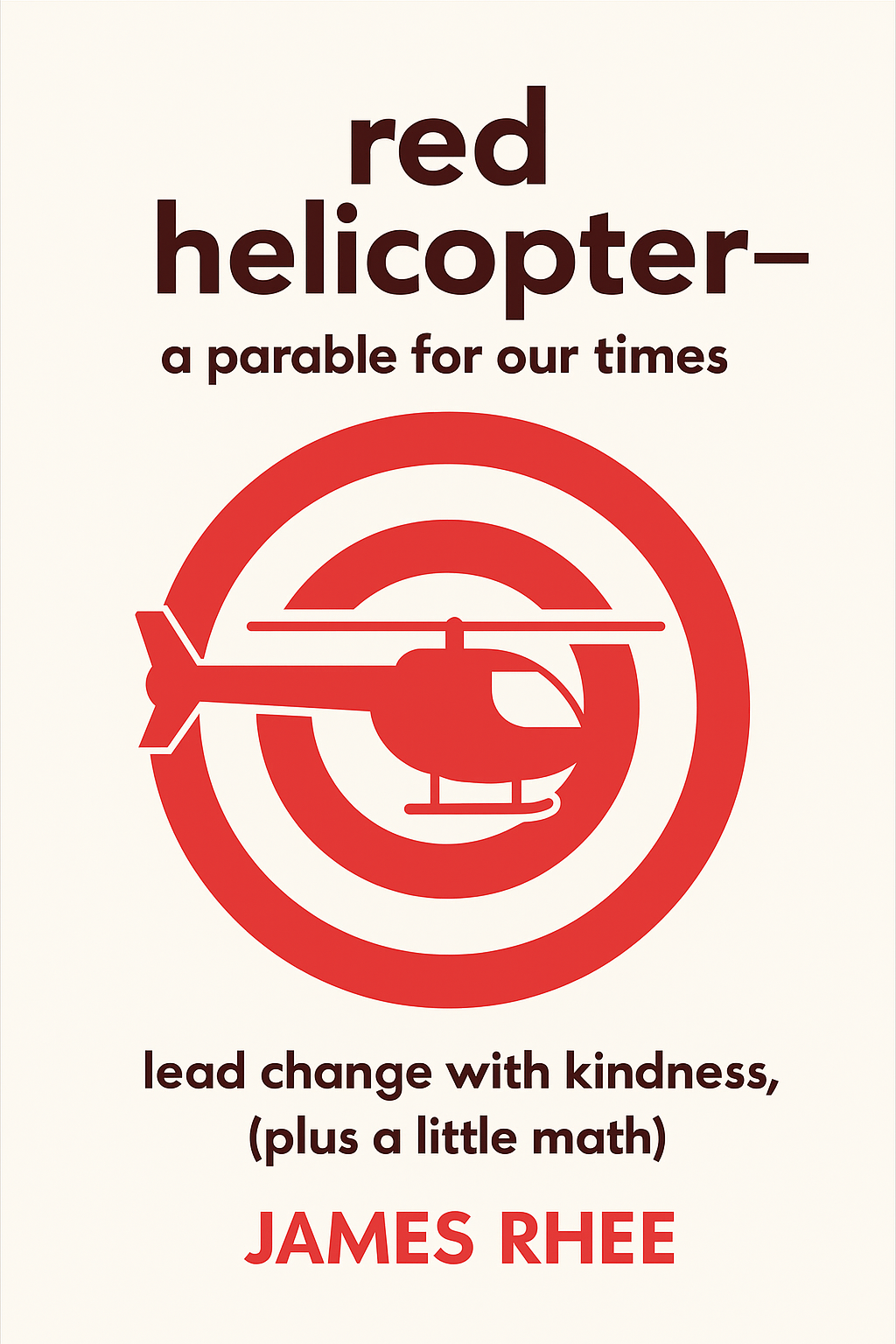
Red helicopter
Lead Change with Kindness (Plus a Little Math)
Book Edition Details
Summary
When a red toy helicopter gifted in kindergarten becomes a lifelong metaphor for triumph, James Rhee's journey from classroom to boardroom unfolds with unprecedented charm and wisdom. "Red Helicopter" is more than a memoir; it's a revolution in thought. It artfully intertwines personal history with business acumen, demonstrating that kindness can indeed be a force for monumental success. Witness Rhee as he navigates the turbulent waters of a struggling company, driven by the principles his immigrant parents imparted. Through his eyes, discover the untapped power of goodwill and its profound impact on both bottom lines and human lives. A tale of redemption and renewal, this book offers a unique blueprint for those yearning to blend humanity with leadership, proving that true success is both a number and a narrative.
Introduction
In a sterile conference room filled with skeptical investors, a Korean-American private equity executive found himself defending an impossible proposition: saving a twice-bankrupt clothing company that served plus-size Black women in urban neighborhoods. The room fell silent as he spoke about kindness and math, two concepts that seemed utterly foreign in the world of high finance. Yet this unlikely combination would become the foundation for one of the most remarkable business transformations in recent memory. This is a story about rediscovering what truly matters when everything familiar falls away. It's about a man who thought he knew who he was until he found himself in a windowless warehouse in New Jersey, surrounded by women who would teach him lessons no MBA program could provide. Through their eyes, he would learn that the most powerful force in business isn't fear or greed, but something far more radical: authentic human connection. The journey ahead reveals how ancient wisdom and modern mathematics can work together to create extraordinary results. It shows us that success isn't just about the numbers on a balance sheet, but about the goodwill we generate and the lives we touch along the way. In a world that often feels divided and disconnected, this story offers a different path forward, one where kindness becomes a competitive advantage and where the most unlikely partnerships can yield the most profound transformations.
From Wall Street to Warehouse: An Unlikely Leadership Journey
The call came on a crisp autumn morning that would change everything. James Rhee, a successful private equity investor, was asked to serve as interim CEO of Ashley Stewart, a clothing retailer for plus-size Black women that had filed for bankruptcy twice. Standing in the company's dreary Secaucus warehouse, surrounded by outdated equipment and demoralized employees, he felt completely out of place. Here was a Harvard-educated Korean-American man in pleated khakis, tasked with leading a company whose customers and employees looked nothing like him. His first town hall meeting was held in a windowless cafeteria with folding chairs and an industrial lunch warmer. The assembled employees stared at him with a mixture of curiosity and skepticism. When he asked what the company was really selling, expecting answers about clothing and fashion, he heard something entirely different: "Safety." "Confidence." "A place where we belong." These women understood something he was just beginning to grasp – that Ashley Stewart wasn't just a retailer, but a sanctuary. The numbers told a grim story. The company had no WiFi, no cash, and creditors demanding immediate payment. Vendors required armed escorts to feel safe entering the building. Yet in the stores themselves, James witnessed something magical. Store managers like Chary and Shelley created environments where customers felt valued and beautiful, where relationships mattered more than transactions. They operated with a wisdom that no business school had taught him. This stark contrast between the corporate dysfunction and the store-level excellence revealed a profound truth: the company's greatest assets weren't on any balance sheet. They lived in the hearts and minds of women who had been overlooked by the broader business world, yet who possessed an intuitive understanding of what real value creation looked like.
Building Bridges: When Kindness Meets Mathematical Precision
The transformation began not with spreadsheets or strategic plans, but with genuine human connection. James spent countless hours in store back rooms, sharing meals and stories with managers who had been dismissed as "just retail workers" by previous leadership. These conversations revealed the depth of wisdom that existed at the front lines, wisdom that had been systematically ignored by executives focused solely on financial metrics. Shelley, an assistant manager in New Jersey, became one of his most important teachers. During their first meeting, she playfully examined his phone while they bonded over Tom Brady and discovered their mothers were both nurses. What seemed like small talk was actually the foundation of trust being built brick by brick. These women had learned to read people quickly – their survival in difficult neighborhoods depended on it – and they were testing whether this new CEO was genuine or just another suit passing through. The breakthrough came when James made a radical decision: he would trust the store managers completely. No more surveillance cameras watching their every move. No more micromanagement from corporate headquarters. Instead, he gave them the tools, resources, and authority to run their stores as they saw fit. The results were immediate and dramatic. Theft decreased, morale soared, and sales began to climb as managers felt empowered to serve their customers authentically. This approach flew in the face of conventional retail wisdom, which emphasized control and standardization. But James was learning that kindness wasn't weakness – it was a sophisticated business strategy that unlocked human potential in ways that fear-based management never could. When people feel trusted and valued, they don't just work harder; they become creative problem-solvers and passionate advocates for the mission.
Through Crisis and Loss: Finding Strength in Authentic Connection
The company's remarkable turnaround was tested by profound personal tragedy. As Ashley Stewart was achieving unprecedented success, James received the devastating news that his father was dying of Parkinson's disease. The man who had sacrificed everything to give his family opportunities in America was slipping away, unable to communicate or care for himself. James found himself torn between his responsibilities to the company and his duty to his family. The wake became an unexpected convergence of worlds. In a small New Jersey funeral home, James's entire life came together in one room. His father's former patients, childhood friends, college roommates, and business associates mingled with something unprecedented: the entire Ashley Stewart corporate team, led by store managers who had driven hours to pay their respects. Chary, the store manager who had become like family, gripped his hand and said simply, "Where else would I be?" This moment crystallized everything James had learned about authentic leadership. These women hadn't come because they were required to – they came because relationships had been built on genuine care and mutual respect. They understood that supporting each other through life's challenges wasn't separate from business success; it was the foundation of it. The goodwill they had created together was now sustaining them all through grief and loss. The tragedy also revealed the hidden strength of the women he worked with. Many had faced losses and challenges that dwarfed his own, yet they continued to show up with grace, resilience, and an unwavering commitment to caring for others. They taught him that true leadership isn't about having all the answers – it's about creating space for people to support each other through whatever comes.
Legacy of Transformation: Measuring Success Beyond the Balance Sheet
Years later, as James prepared to leave Ashley Stewart, the company had achieved something remarkable: financial success built on a foundation of human dignity and authentic relationships. The numbers were impressive – record profits, industry awards, recognition from major media outlets – but the real measure of success was harder to quantify. It lived in the confidence of customers who found clothes that made them feel beautiful, in the pride of employees who felt valued and heard, in the ripple effects of kindness that spread far beyond any single transaction. The final Finding Ashley Stewart event at the Kings Theatre in Brooklyn became a celebration of everything they had built together. Three thousand people gathered to honor unsung female leaders in their communities, with performances by legendary artists and scholarships awarded to deserving students. But the real magic happened in the connections being made – between generations, across racial lines, among people who might never have met otherwise but who shared a common commitment to lifting each other up. As James looked out at the audience that night, he saw his mother's values reflected back at him. The Korean immigrant who had taught him to treat everyone with dignity, who had shown him that true wealth was measured in relationships rather than bank accounts, who had demonstrated daily that small acts of kindness could compound into transformational change. The women of Ashley Stewart had helped him see his own heritage more clearly, and in doing so, had shown him a path toward leadership that honored both head and heart. The story of Ashley Stewart became proof that business could be a force for good in the world, that profit and purpose weren't opposing forces but complementary ones. When we measure success not just by what we take but by what we give, not just by the wealth we accumulate but by the lives we touch, we discover that the most sustainable competitive advantage is also the most human one: the ability to see others as they truly are and to help them become who they're meant to be.
Summary
The red helicopter that began this journey as a simple childhood toy became a symbol of something far more profound: the power of unexpected kindness to transform lives and organizations. Through the unlikely partnership between a Korean-American private equity executive and the predominantly Black women of Ashley Stewart, we discover that the most sophisticated business strategy is often the most fundamentally human one. When we lead with genuine care, when we measure success by the goodwill we create rather than just the profits we generate, we unlock potential that traditional management approaches leave dormant. The lessons from this transformation extend far beyond retail or even business itself. They remind us that in our increasingly disconnected world, the ability to build authentic relationships across lines of difference isn't just morally right – it's strategically essential. Whether we're leading teams, raising families, or simply trying to live meaningful lives, the principles remain the same: trust people with agency, measure what truly matters, and never underestimate the compound interest of consistent kindness. The story challenges us to examine our own balance sheets – not just the financial ones, but the human ones that track the relationships we've built, the lives we've touched, and the positive change we've created in the world. In the end, the most important question isn't how much we've accumulated, but how much we've contributed to the collective goodwill that makes life worth living for everyone.
Related Books
Download PDF & EPUB
To save this Black List summary for later, download the free PDF and EPUB. You can print it out, or read offline at your convenience.
By James Rhee
