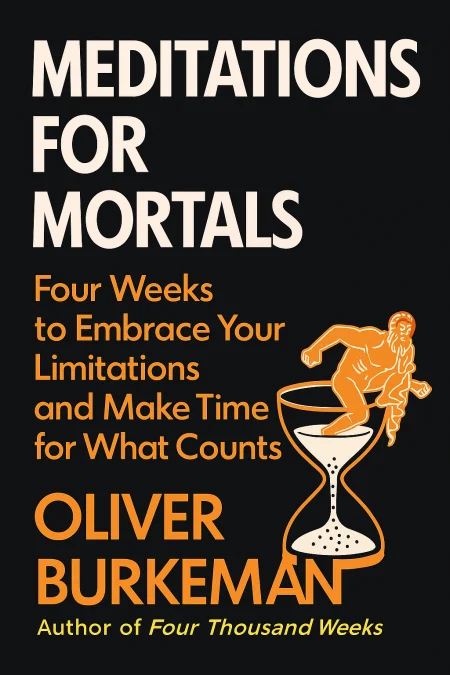
Meditations for Mortals
Four Weeks to Embrace Your Limitations and Make Time for What Counts
Book Edition Details
Summary
In a world that glorifies the unattainable, "Meditations for Mortals" dares to celebrate the imperfect beauty of reality. Oliver Burkeman offers a liberating manifesto that gently dismantles the myth of perfectionism, encouraging us to embrace our inherent limitations and find contentment within them. This thought-provoking guide draws wisdom from a rich tapestry of philosophy, literature, and psychology, challenging conventional self-help mantras with its profound yet accessible insights. With a keen eye for the human condition, Burkeman invites readers to shift their perspectives, discover purpose in the mundane, and unlock a life brimming with authentic fulfillment. Perfect for those seeking solace and clarity in turbulent times, this book is not just a read but a revelation—a call to live deeply in the present and find joy in the here and now.
Introduction
Sarah stared at her overflowing inbox, the cursor blinking mockingly at 11:47 PM. Another day had slipped away in a blur of meetings, urgent requests, and half-finished projects. She'd promised herself she'd finally start that creative writing course, call her grandmother, and maybe even cook a real dinner instead of microwaving leftovers again. But here she was, drowning in digital demands, feeling like she was perpetually behind on life itself. Sound familiar? Most of us live with this gnawing sense that we're not quite keeping up, that real life is always just around the corner, waiting for us to finally get our act together. This persistent feeling of being overwhelmed isn't a personal failing. It's the natural consequence of being finite humans in an age of infinite possibilities. We've been sold the myth that with enough productivity hacks, perfect planning, and relentless optimization, we can somehow transcend our limitations and achieve that elusive state of having it all under control. But what if the path to fulfillment lies in the opposite direction? What if embracing our limitations, rather than fighting them, is the key to living with greater joy, purpose, and peace? This exploration reveals how accepting our finite nature doesn't diminish us but liberates us. When we stop exhausting ourselves trying to do everything perfectly, we discover the energy to do meaningful things wholeheartedly. When we release the fantasy of complete control, we find the courage to engage authentically with life's beautiful unpredictability.
The Liberation of Imperfection: Why Accepting Limits Sets Us Free
Marcus had always prided himself on being thorough. His to-do lists were legendary works of organizational art, color-coded and cross-referenced with military precision. Yet the more sophisticated his systems became, the more anxious he felt. Each completed task spawned three new ones, and the growing mountain of obligations left him feeling like Sisyphus, eternally pushing a boulder up an impossible slope. One particularly stressful Tuesday, overwhelmed by his latest productivity methodology, Marcus experienced an unexpected moment of clarity. He realized he'd been treating his limitations as problems to solve rather than as fundamental features of being human. The revelation hit him like a gentle thunderbolt: what if the endless stream of tasks wasn't a temporary problem but a permanent reality? Instead of feeling defeated, Marcus found this thought strangely liberating. If he could never complete everything, then the pressure to do so was not just unrealistic but absurd. This wasn't about lowering standards or giving up ambition. Rather, it was about recognizing that the quest for total control was the very thing preventing him from engaging meaningfully with what actually mattered. The Buddhist concept of "beginner's mind" teaches us that approaching life with fresh eyes, free from the burden of supposed expertise, opens us to possibilities we couldn't see when we insisted on having everything figured out. Marcus discovered that accepting his limitations didn't make him less capable; it made him more present, more focused, and paradoxically more productive because he was no longer wasting energy fighting reality itself. When we surrender the fantasy of perfect control, we discover something remarkable: the space to show up authentically for the life we actually have, with all its glorious imperfections and surprising gifts.
From Paralysis to Action: Moving Forward Despite Uncertainty
Elena had been planning to start her freelance graphic design business for three years. She'd researched competitors, created mood boards, drafted business plans, and subscribed to every entrepreneurship podcast she could find. Yet despite all this preparation, she remained frozen in the planning phase, convinced she needed just a little more knowledge, one more certification, the perfect logo before she could begin. Her friend Jake, tired of hearing about Elena's perpetual preparations, finally asked her a simple question: "What's the smallest thing you could do today to move forward?" The question caught Elena off guard. She'd been so focused on becoming an entrepreneur that she'd forgotten about simply doing entrepreneurial work. That afternoon, she sent a single email to a local café, offering to redesign their menu. Within a week, she had her first client. The work wasn't perfect, and she made mistakes, but something magical happened: she was no longer preparing to be a graphic designer; she was actually being one. This shift from preparation to action represents a fundamental truth about human progress. We often believe we need to fully understand something before we can engage with it, but understanding frequently comes through doing, not before it. The kayak metaphor captures this beautifully: life is like navigating rapids where you can only see the next few meters ahead. You must paddle and adjust as you go, responding to what emerges rather than waiting for a complete map of the river. Elena's story illustrates how our desire for certainty can become the very obstacle preventing us from creating the life we want. Action in the face of uncertainty isn't reckless; it's the only way forward for beings who can never possess complete information about an unknowable future.
The Art of Letting Go: When Control Becomes the Enemy
James was a masterful planner. He scheduled his days down to fifteen-minute intervals, maintained elaborate systems for tracking his goals, and felt a genuine thrill when everything aligned perfectly with his vision. But he noticed a peculiar problem: the more control he exerted over his life, the more lifeless it seemed to become. Conversations felt scripted, spontaneous opportunities were declined because they didn't fit his schedule, and even activities he once enjoyed felt like items to check off a list rather than experiences to savor. The breakthrough came during a family vacation that went spectacularly wrong. Flights were canceled, reservations were lost, and their carefully crafted itinerary crumbled. Yet something unexpected happened: freed from their agenda, the family discovered hidden gems they never would have found otherwise. They had deeper conversations, made genuine connections with locals, and created memories that would last far longer than any perfectly executed plan. James realized he'd been managing his life so efficiently that he'd forgotten to actually live it. This paradox runs deeper than personal productivity. The German philosopher Hartmut Rosa observed that modern life's obsession with optimization often destroys the very experiences we're trying to optimize. When we approach relationships, creativity, and even leisure with a controlling mindset, we strip them of their capacity to surprise and delight us. The jazz musician doesn't know exactly where the improvisation will lead; that uncertainty is what makes the music alive. True fulfillment emerges not from imposing our will upon reality but from dancing with it, remaining open to possibilities we couldn't have imagined and allowing life to unfold in ways that transcend our limited vision of how things should be.
Living Fully Now: Showing Up for Our Imperfect Lives
Dr. Sarah Chen had spent decades preparing for the "real" phase of her career. First medical school, then residency, then fellowship, then building her practice. Each stage was just preparation for the next level when she'd finally feel like a "real" doctor. At forty-five, established and successful, she realized with startling clarity that she'd been living in a perpetual state of rehearsal, always becoming but never being. The patients she'd helped, the lives she'd saved, the knowledge she'd gained—all of it was real life, not preparation for it. This revelation struck during a particularly difficult case. While treating a young accident victim, Sarah found herself fully present in a way she hadn't experienced in years. The uncertainty was terrifying, but it was also vitalizing. She wasn't thinking about her reputation, her next promotion, or whether she was qualified enough. She was simply there, bringing all her skills and attention to bear on this one crucial moment. Later, she reflected that this was perhaps the most "real" she'd felt in her entire career. The provisional life—always preparing for some future moment when real living can begin—is a trap that ensnares many of us. We tell ourselves that once we're financially secure, once we find the right relationship, once the kids are grown, then we'll start truly living. But as Sarah discovered, this moment right now, with all its imperfections and uncertainties, is the only moment we ever really have. The Buddhist teacher Pema Chödrön speaks of "nowhere to go" not as limitation but as liberation. When we realize that this imperfect present is not a stepping stone to somewhere better but the actual substance of our lives, we can finally stop postponing joy, connection, and meaning. We discover that showing up wholeheartedly for our flawed, uncertain, beautifully human existence is not just enough—it's everything.
Summary
The stories woven throughout this exploration reveal a profound truth: our limitations are not obstacles to overcome but the very conditions that make a meaningful life possible. Marcus discovered that accepting the impossibility of completing everything freed him from the prison of perfectionism. Elena learned that action in uncertainty is not just possible but essential for growth. James found that releasing control opened space for genuine connection and joy. Sarah realized that this imperfect present moment is the only real life we ever get. These revelations point to a radical shift in how we approach human existence. Instead of exhausting ourselves trying to transcend our finite nature, we can embrace it as the source of life's richness and meaning. When we accept that we cannot do everything, we gain the clarity to choose what matters most. When we acknowledge that we cannot control outcomes, we discover the courage to act authentically. When we release the fantasy of someday having it all figured out, we find the freedom to engage wholeheartedly with the beautiful mystery of being human. The path forward isn't about becoming superhuman but about becoming more fully human. It's about showing up for our one precious, imperfect, gloriously limited life with open hearts and willing hands, ready to create meaning not despite our constraints but because of them.
Related Books
Download PDF & EPUB
To save this Black List summary for later, download the free PDF and EPUB. You can print it out, or read offline at your convenience.
By Oliver Burkeman
