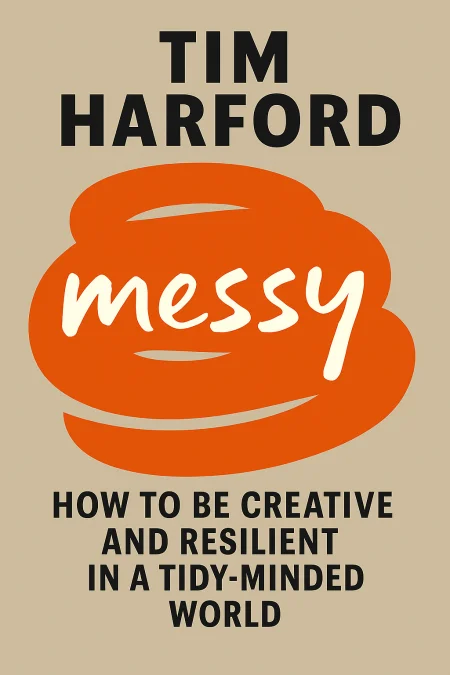
Messy
How to Be Creative and Resilient in a Tidy-Minded World
Book Edition Details
Summary
In a world increasingly obsessed with order and precision, Tim Harford champions the beauty of chaos in "Messy." This provocative manifesto reveals how our relentless pursuit of tidiness might just be stifling creativity, resilience, and genuine human connection. Harford uncovers the surprising power of disorder—from the cluttered desk of a creative genius to the improvisational flair of successful entrepreneurs. He makes the case for embracing the unpredictable, illustrating how a bit of mess can ignite innovation and adaptability. Prepare to challenge your inner neat freak and discover the transformative potential of a little disarray, whether in business, relationships, or personal growth. "Messy" is an invitation to break free from the shackles of excessive organization and find magic in the muddle.
Introduction
On a cold January evening in 1975, seventeen-year-old Vera Brandes stood backstage at the Cologne Opera House, watching her dreams crumble. The piano for Keith Jarrett's concert was completely wrong—tiny, out of tune, with broken keys and sticky pedals that barely produced sound. Jarrett took one look at the instrument and walked out, leaving 1,400 expectant audience members and a devastated young promoter. In desperation, Brandes chased him through the rain, pleading with him to return. Something in her vulnerability moved him, and reluctantly, he agreed to perform. What happened next became legendary. Forced to work with an unplayable instrument, Jarrett created something extraordinary. He avoided the tinny high notes, pounded the bass keys to generate volume, and discovered rhythms and melodies he never could have imagined on a perfect piano. The resulting recording became the best-selling solo jazz album of all time. Years later, Jarrett would say he had completely "missed" what he was trying to achieve that night—yet in embracing the mess, he had created magic. This story illuminates a profound truth that challenges everything we believe about success and creativity. We live in a world obsessed with order, control, and optimization, yet our greatest breakthroughs often emerge from chaos, disruption, and the willingness to work with imperfection. The very obstacles we try so hard to eliminate might actually be the secret ingredients of innovation, resilience, and extraordinary achievement.
When Broken Pianos Make Beautiful Music: The Creative Power of Constraints
David Bowie arrived in Berlin in 1976 as a man on the run—from fame, from drugs, from the suffocating perfection of his previous work. The divided city was hardly an obvious choice for creating groundbreaking music, yet it was here that he would craft some of his most influential albums. Working with producer Brian Eno in a makeshift studio, they developed a radical approach to creativity. Whenever their sessions felt too comfortable or predictable, they would deliberately introduce chaos. Eno brought with him a deck of cards called "Oblique Strategies," each containing a cryptic instruction designed to jolt artists out of their habitual patterns. "Emphasize the flaws," one might read, or "Change instrument roles." During one session, Carlos Alomar, one of the world's greatest guitarists, was ordered to play drums instead. Another time, Eno randomly pointed at chords on a blackboard, forcing the band to follow his chaotic directions. Musicians threw beer cans in frustration, yet this seemingly insane process produced "Low" and "Heroes," two of the decade's most critically acclaimed albums. What Eno understood intuitively, neuroscience now confirms. When we're forced out of our comfort zones, when familiar patterns are disrupted, our brains become more flexible and creative. The prefrontal cortex, which normally acts as a strict editor filtering our ideas, relaxes its grip. This allows unexpected connections to form, letting us discover possibilities we never would have found in perfect conditions. Like Jarrett's broken piano, constraints don't limit creativity—they liberate it by forcing us to find new paths we never would have explored otherwise.
Building Bridges Through Chaos: Why Diverse Teams Need Productive Friction
In the summer of 1954, twenty-two eleven-year-old boys arrived at a Boy Scout camp in Oklahoma, unaware they were subjects in one of psychology's most revealing experiments. The researchers divided them into two groups, keeping them separate initially. The boys naturally formed tight tribes—the "Eagles" and the "Rattlers"—complete with flags, songs, and fierce loyalty. When the groups were finally brought together for competitions, the results were immediate and shocking: name-calling, food fights, and genuine hatred between children who had never met before. The experiment revealed both the power and danger of cohesive teams. While bonding creates loyalty and efficiency, it also breeds insularity and conflict with outsiders. When the researchers tried traditional team-building activities to restore peace, they failed miserably. Sharing meals and watching movies together only provided more opportunities for conflict. The solution came through manufactured crises that required cooperation: a "broken" water supply that both groups had to fix together, a truck that needed all the boys pulling on a rope to get started. This mirrors what happens in the most innovative organizations. Research consistently shows that breakthrough ideas emerge not from harmonious teams of similar people, but from collaborations that bridge different worlds of expertise. The most successful video game development teams weren't homogeneous groups or complete strangers, but networks of different tight-knit teams forced to work together on challenging projects. These arrangements created productive tension—familiar enough to trust each other, different enough to spark new ideas. The friction wasn't a problem to be solved but the very source of their creative power.
The Automation Trap: When Perfect Systems Create Imperfect Outcomes
At 11:02 PM on May 31, 2009, Captain Marc Dubois left the cockpit of Air France Flight 447 for a rest, confident in leaving his co-pilots with one of the world's most advanced aircraft. The Airbus A330's fly-by-wire system was legendary for its safety, smoothly translating even clumsy pilot inputs into graceful maneuvers. But when ice crystals blocked the plane's airspeed sensors over the Atlantic, the autopilot disconnected, and the protective system downgraded to a less forgiving mode. What happened next revealed the dark side of perfect automation. Co-pilot Pierre-Cédric Bonin, panicking in the storm, pulled back on his controls and sent the plane into a steep climb. The aircraft began warning "STALL STALL STALL" seventy-five times over the next four minutes, but the crew never acknowledged the warnings. Bonin continued pulling back, believing the ultra-safe A330 couldn't possibly stall. His experience had been so cushioned by automation that he had never learned to recognize this fundamental flight emergency. When Captain Dubois returned to find his plane falling toward the ocean, it was too late. This tragedy illustrates what researchers call the "paradox of automation"—the better our systems become at handling routine tasks, the less practice humans get dealing with problems, making them more vulnerable when those systems fail. The same pattern appears everywhere: GPS users who drive into lakes because they trust their devices more than their eyes, doctors who lose diagnostic skills by relying too heavily on computers, financial systems so automated that no human understands what's happening when they malfunction. The goal shouldn't be replacing human judgment but supporting and enhancing it, keeping us engaged and capable rather than turning us into passive monitors of machines we don't understand.
Summary
The stories woven throughout this exploration reveal a counterintuitive truth about human potential: our instinct to impose order and eliminate uncertainty often undermines the very outcomes we seek. Keith Jarrett's broken piano didn't prevent a masterpiece—it enabled one. Bowie's chaotic Berlin sessions didn't sabotage creativity—they unleashed it. The diverse, tension-filled teams didn't hinder innovation—they accelerated it. And the ultra-reliable autopilot didn't make flying safer—it created new forms of danger by disconnecting humans from their essential skills. This isn't an argument for embracing chaos everywhere, but rather a recognition that our tidy-minded instincts can lead us astray. The most resilient systems aren't the most organized but those that maintain enough diversity and redundancy to adapt when circumstances change. The most creative breakthroughs emerge not from perfect conditions but from the productive friction of working with constraints and collaborating across differences. Perhaps our greatest competitive advantage lies not in perfecting our systems, but in preserving our ability to thrive when those systems inevitably break down, finding opportunity in disruption and strength in the very messiness we try so hard to avoid.
Related Books
Download PDF & EPUB
To save this Black List summary for later, download the free PDF and EPUB. You can print it out, or read offline at your convenience.
By Tim Harford
