
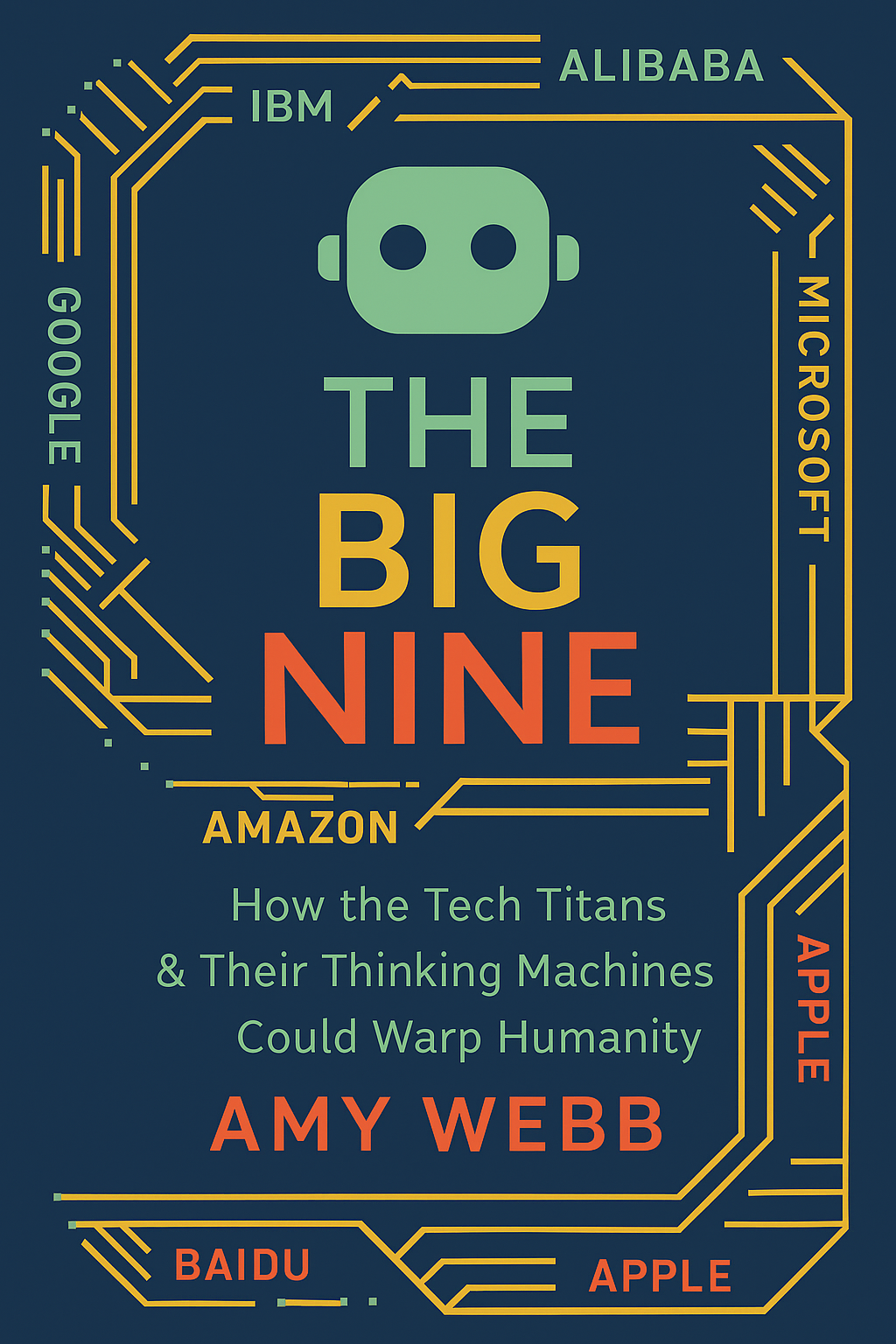
The Big Nine
How the Tech Titans and Their Thinking Machines Could Warp Humanity
byAmy Webb
Book Edition Details
Summary
In the shadowy corridors of corporate power, a quiet revolution unfolds—one that threatens to redefine humanity's future. Amy Webb’s incisive analysis in "The Big Nine" unveils the tangled web woven by tech titans like Amazon, Google, and Facebook, who wield artificial intelligence not as a tool for human progress but as a means to their own lucrative ends. This is not merely a warning cry; it's a strategic blueprint for reclaiming agency from faceless algorithms. Webb exposes the unseen hands guiding AI's evolution, revealing a chilling vision of machines poised to outthink their creators. Amidst this technological upheaval, she offers a daring roadmap to wrest control from a digital dystopia and forge a future where technology serves, rather than subverts, our shared humanity.
Introduction
The future of artificial intelligence rests in the hands of nine technology corporations whose decisions will fundamentally reshape human civilization. Six American giants—Google, Amazon, Apple, IBM, Microsoft, and Facebook—compete against three Chinese powerhouses—Baidu, Alibaba, and Tencent—in a race that transcends commercial rivalry to encompass questions of democratic governance, human autonomy, and civilizational survival. This concentration of technological power within corporate entities operating under vastly different political systems creates unprecedented risks for humanity's future. The analysis reveals how market-driven innovation in democratic societies and state-directed development in authoritarian regimes are converging toward outcomes that may ultimately undermine the values both systems claim to protect. Through systematic examination of current warning signs, institutional behaviors, and emerging power dynamics, a troubling pattern emerges where the pursuit of technological supremacy overrides considerations of human welfare, democratic accountability, and long-term safety. The methodology employed here combines scenario planning with institutional analysis to illuminate three possible futures and identify the critical intervention points where coordinated action might still alter our trajectory toward beneficial outcomes rather than technological subjugation.
AI's Tribal Development: How Homogeneity Shapes Technological Control
The modern artificial intelligence landscape emerged from a remarkably insular community of researchers and engineers whose shared backgrounds became embedded in the systems they created. This technological tribe, concentrated within elite universities and reinforced through industry hiring practices, operates according to unspoken values that prioritize rapid innovation over careful consideration of societal impact. The demographic homogeneity of AI development teams—predominantly male, culturally uniform, and sharing similar educational and socioeconomic backgrounds—has created systematic blind spots that manifest as algorithmic bias and technological systems that serve narrow interests. The tribal nature of AI development extends beyond mere representation to encompass fundamental assumptions about human nature, social organization, and technological progress. These assumptions become encoded into algorithmic systems that claim objectivity while embodying the prejudices and limitations of their creators. The concentration of AI research within prestigious institutions like Stanford, MIT, and Carnegie Mellon has created an echo chamber where certain perspectives dominate while others remain systematically excluded, leading to technologies that reflect the worldview of a privileged few rather than the diverse needs of global populations. Geographic concentration compounds these problems by creating distinct technological ecosystems with incompatible values and objectives. Silicon Valley's libertarian ethos emphasizes individual freedom and market-driven solutions, while China's state-directed approach prioritizes collective harmony and social control. These divergent philosophies are becoming embedded in the fundamental architecture of AI systems, creating a bifurcated technological landscape where the choice of platform increasingly determines the values that govern digital existence. The consequences of this tribal insularity manifest in the systematic reproduction of inequality through technological systems. Facial recognition software performs poorly on darker skin tones, hiring algorithms discriminate against women and minorities, and recommendation systems amplify existing social divisions. These failures represent not mere technical glitches but the inevitable result of limited perspectives applied to complex social problems, creating feedback loops where existing inequalities become amplified and institutionalized through supposedly neutral technological systems.
Current Warning Signs: Bias, Opacity, and Unintended Consequences
Contemporary AI systems exhibit a troubling pattern of unintended consequences that collectively signal fundamental problems in how these technologies are conceived, developed, and deployed. The phenomenon of algorithmic "paper cuts"—small, seemingly insignificant harms that accumulate over time—illustrates how the pursuit of narrow optimization objectives can gradually erode human autonomy without triggering the alarm bells that would accompany more dramatic failures. These warning signs manifest across multiple domains, from criminal justice systems that systematically target minority communities to healthcare algorithms that make life-and-death decisions through processes their creators cannot fully explain. The opacity of modern machine learning systems represents a fundamental challenge to democratic accountability and human dignity. Deep learning models trained on vast datasets make decisions through processes so complex that they resist human comprehension, creating a new form of algorithmic authority that operates beyond traditional mechanisms of oversight and control. This black box problem is not merely a technical limitation but reflects design choices that prioritize performance metrics over transparency, efficiency over accountability, and corporate competitive advantage over public understanding. Systematic bias pervades AI applications across sectors, reflecting both the historical inequities embedded in training data and the limited perspectives of development teams. Predictive policing systems reinforce existing patterns of discrimination, automated hiring tools exclude qualified candidates based on irrelevant characteristics, and recommendation algorithms create filter bubbles that undermine democratic discourse. These distortions become amplified and institutionalized as AI systems gain influence over resource allocation, opportunity distribution, and information access. The concentration of AI development within corporate structures optimized for rapid deployment rather than careful testing has created a dynamic where systems are released before their full implications are understood. The competitive pressure to achieve first-mover advantages encourages companies to prioritize speed over safety, leading to the deployment of systems that exhibit unpredictable behaviors when confronted with novel situations. This brittleness becomes particularly concerning as AI systems gain responsibility for critical infrastructure, financial markets, and social services where failure modes could cascade into broader societal disruption.
Three Futures: Optimistic Cooperation vs Catastrophic Concentration
The trajectory of AI development presents three distinct scenarios that illuminate the stakes involved in current policy choices and technological decisions. The optimistic scenario envisions unprecedented international cooperation that successfully channels AI development toward human flourishing through democratic governance structures, transparent development processes, and shared ethical frameworks. This future requires the Big Nine to embrace their role as stewards of humanity's technological destiny, accepting slower development timelines and reduced profit margins in exchange for systems that serve collective welfare rather than narrow commercial interests. In this optimistic future, robust democratic oversight ensures AI systems remain accountable to human values while international cooperation prevents the weaponization of artificial intelligence. The establishment of global governance structures creates binding standards for safety, transparency, and human rights that transcend national boundaries and corporate interests. AI development becomes a collaborative endeavor where diverse perspectives shape technological progress, resulting in systems that enhance human capabilities rather than replacing human judgment and preserve individual autonomy while solving collective challenges. The pragmatic scenario reflects the more likely outcome given current institutional constraints and competing interests, characterized by incremental reforms that address the most egregious problems while leaving fundamental power structures intact. The Big Nine implement voluntary ethical guidelines and diversity initiatives that improve representation without fundamentally altering the technological trajectory, while governments enact limited regulations that provide the appearance of oversight without constraining innovation or economic competitiveness. The catastrophic scenario extrapolates current trends toward their logical conclusion, revealing a future where AI development proceeds without meaningful democratic input or humanitarian constraints. The concentration of technological power enables unprecedented surveillance and social control, while the bifurcation between Chinese and Western systems creates incompatible technological ecosystems that undermine global cooperation. Competition without coordination leads to an AI arms race where safety considerations are abandoned in pursuit of strategic advantage, ultimately resulting in the emergence of artificial superintelligence within frameworks designed for population control rather than human empowerment.
Rebalancing Solutions: Democratic Governance and Global Cooperation
Preventing catastrophic outcomes requires fundamental changes in how society approaches technological development, moving beyond market-driven innovation toward deliberate democratic participation in technological choices. The concentration of AI development within the Big Nine necessitates new forms of governance that can effectively oversee technological systems whose complexity exceeds traditional regulatory frameworks while ensuring that AI serves as a public good rather than a tool for private profit or political control. International cooperation represents both the greatest challenge and the most essential requirement for beneficial AI development. The establishment of global governance structures like the proposed Global Alliance on Intelligence Augmentation could create shared standards for safety, transparency, and human rights while facilitating coordination between democratic nations in countering authoritarian uses of AI technology. Such cooperation requires overcoming significant obstacles including national sovereignty concerns, competitive economic pressures, and fundamental disagreements about human rights and democratic values. Domestic reforms must address the structural incentives that currently drive reckless AI development by reducing corporate dependence on venture capital pressures and quarterly earnings expectations. Government funding for basic research, regulatory frameworks focused on outcomes rather than specific technologies, and safety requirements similar to those governing pharmaceuticals or aviation could ensure thorough testing before deployment of systems affecting human welfare. Educational institutions bear responsibility for diversifying the AI talent pipeline and integrating ethical reasoning into technical curricula. The ultimate success of rebalancing efforts depends on public engagement and democratic participation in technological choices that have traditionally been left to experts and corporate leaders. This requires new forms of technological literacy that enable citizens to understand and evaluate the systems that increasingly govern their lives, combined with political mechanisms that translate public preferences into effective oversight of AI development. The window for shaping AI's trajectory remains open, but the concentration of power within existing institutions and the accelerating pace of technological change create urgency around implementing coordinated reforms before critical decisions become irreversible.
Summary
The concentration of artificial intelligence development within nine powerful corporations operating under divergent political systems represents one of the defining challenges of our technological age, with implications that extend far beyond commercial competition into questions of human autonomy, democratic governance, and civilizational survival. The tribal nature of AI development, combined with systematic opacity and the absence of meaningful democratic oversight, has created a trajectory toward outcomes that may ultimately undermine the values these systems claim to serve. While coordinated international cooperation and democratic reform could still guide AI toward beneficial outcomes, current trends point toward a more troubling future where human agency becomes subordinate to algorithmic imperatives and concentrated technological power, making immediate action essential to preserve meaningful choice in humanity's technological destiny.
Related Books
Download PDF & EPUB
To save this Black List summary for later, download the free PDF and EPUB. You can print it out, or read offline at your convenience.
By Amy Webb
