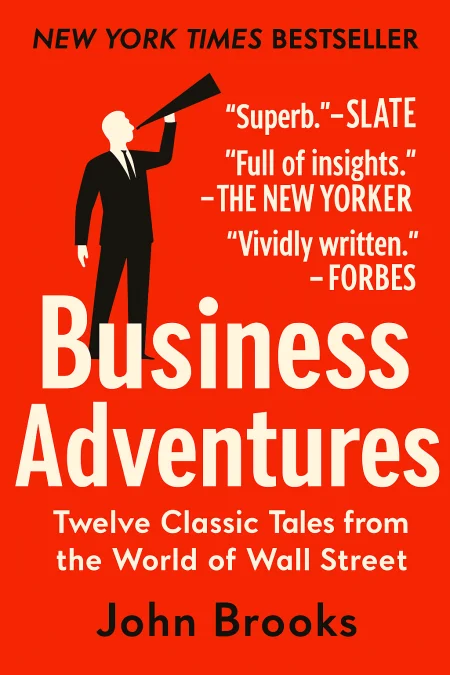
Business Adventures
Twelve Classic Tales from the World of Wall Street
Book Edition Details
Summary
In the whirlwind of corporate drama and financial intrigue, John Brooks's "Business Adventures" emerges as a timeless odyssey through the peaks and pitfalls of America's economic landscape. With stories that dance between the spectacular rise of Xerox and the infamous debacle of Ford's Edsel, Brooks peels back the curtain on moments that have defined industries. His narratives, rich with tension and vivid detail, bring to life the seismic shifts that shook giants like General Electric and Texas Gulf Sulphur. Each of the twelve case studies crackles with relevance, offering insights into the relentless cycles of success and scandal that echo through today's boardrooms. For anyone captivated by the theater of business, this book is a masterful portrayal of ambition, folly, and the ever-echoing lessons of history.
Introduction
Picture yourself standing on the trading floor of the New York Stock Exchange as panic spreads like wildfire, watching seasoned professionals scramble over each other while millions of dollars vanish in minutes. Or imagine sitting in a corporate boardroom where executives, armed with the best market research money can buy, confidently approve a product launch that will become one of history's greatest commercial disasters. These moments of triumph and catastrophe aren't just footnotes in business textbooks—they're human dramas that reveal the eternal dance between ambition and reality, between careful planning and unpredictable market forces. The stories that emerge from Wall Street's most pivotal moments offer something far more valuable than entertainment. They strip away the theoretical elegance of economic models to show us how markets really behave when human psychology collides with financial reality. Through these tales of spectacular success and crushing failure, you'll discover the warning signs that precede both market crashes and corporate disasters, develop a deeper understanding of how innovation actually succeeds in the real world rather than in laboratory conditions, and learn to recognize the psychological patterns that drive even the most sophisticated minds to make decisions that seem perfectly rational at the time but prove catastrophically wrong in hindsight. These adventures serve as your guide to navigating the complex, often irrational world where fortunes are made and lost on the interplay between human nature and economic forces.
The 1962 Crash: How Fear and Recovery Shape Markets
On the morning of May 28, 1962, traders arriving at the New York Stock Exchange had no idea they were about to witness the second-worst single-day market decline in history. By the closing bell, the Dow Jones Industrial Average had plummeted 34.95 points—a drop exceeded only by the infamous Black Tuesday of 1929. The scene on the trading floor was one of controlled chaos, with normally composed professionals pushing through crowds and climbing over each other as sell orders poured in like a torrential downpour. The ticker tape, that mechanical heartbeat of Wall Street, began falling behind the frantic pace of trading, first by minutes, then by over an hour, leaving investors across the nation watching their portfolios shrink in real time. In brokerage offices from coast to coast, customers who had grown accustomed to the steady prosperity of the post-war boom stared in disbelief at their statements. One particularly telling moment came when a desperate cable arrived from Rio de Janeiro with a simple, haunting message: "Please sell out everything in my account." The panic seemed to feed on itself, as margin calls forced more selling, which drove prices lower, which triggered more margin calls in an endless spiral of financial destruction. But then, as suddenly as the panic had begun, something remarkable occurred. On Tuesday, May 29, after a morning of continued selling, the market reversed course with breathtaking speed. Stocks that had been in free fall began climbing with such vigor that by day's end, the Dow had gained 27.03 points, recovering nearly three-quarters of the previous day's losses. The turnaround was so dramatic that when the closing bell rang, a spontaneous cheer erupted from the trading floor—not because the market was up, but simply because the ordeal was finally over. This episode reveals a fundamental truth about financial markets that remains as relevant today as it was sixty years ago: markets are not the rational, efficient mechanisms that economic theory suggests, but complex systems driven by human emotion and herd behavior. The 1962 crisis demonstrated that even sophisticated investors with access to the best information can be swept up in waves of panic and euphoria that have little to do with underlying economic fundamentals. When uncertainty strikes, rational analysis often gives way to the primitive instinct to follow the crowd, and the very mechanisms designed to provide stability can amplify volatility instead of containing it. Understanding this psychological dimension of markets is crucial for anyone seeking to navigate financial storms with their wealth and sanity intact.
The Edsel Disaster: When Innovation Ignores Market Reality
In the gleaming design studios of Dearborn, Michigan, Ford Motor Company's brightest minds were creating what they believed would be the automotive sensation of the decade. The year was 1957, and after investing a staggering $250 million—more than any consumer product launch in history—Ford was ready to unveil the Edsel. The car featured a distinctive vertical grille that resembled a horse collar, push-button transmission controls mounted on the steering wheel, and enough technological gadgetry to make it "the epitome of the push-button era." Company executives were so confident in their creation that they had already signed up nearly 1,200 dealers and launched a massive advertising campaign promising American drivers something genuinely revolutionary. Launch day, September 4, 1957, seemed to validate Ford's optimism. An estimated 2.85 million curious Americans visited Edsel showrooms, and initial orders began flowing in. The automotive press offered cautiously positive reviews, with some calling it "a handsome and hard-punching newcomer." But within weeks, the dream began crumbling into a nightmare. The first Edsels delivered to customers were plagued with quality problems that read like a comedy of errors: oil leaks, sticking hoods, trunks that refused to open, and push buttons that required hammers rather than fingertips to operate. One distraught owner stumbled into a bar claiming his Edsel's dashboard had literally burst into flames while he was driving. By November 1959, just two years and two months after its launch, Ford quietly discontinued the Edsel. The company had sold only 109,466 units against projections of 200,000 per year, losing an estimated $350 million in the process. The failure was so complete that Ford would have saved money by simply giving away Mercury automobiles instead of trying to create an entirely new brand. The Edsel's spectacular demise offers a masterclass in how even the most well-funded and carefully planned ventures can fail when they lose touch with market reality. Ford's fundamental mistake wasn't in recognizing the growing medium-priced car segment—that market analysis was correct. Rather, the company fell victim to the dangerous assumption that extensive market research and massive investment could guarantee success regardless of execution. They spent fortunes on motivational research to understand what customers wanted, yet delivered a product that was both unreliable and aesthetically polarizing. The lesson is timeless: no amount of planning can substitute for delivering genuine value to customers, and sometimes the most elaborate corporate strategies crumble against the simple reality that people won't buy products that don't work properly or meet their actual needs.
Texas Gulf Sulphur: The Price of Inside Information
In the frozen wilderness of northern Ontario, fifteen miles from the gold-mining town of Timmins, Texas Gulf Sulphur geologist Kenneth Darke stood over a drill core that would change everything. It was November 1963, and what Darke saw in that cylindrical sample of earth made his hands tremble as he reached for the telephone. The core showed copper content of 1.15 percent and zinc content of 8.64 percent—numbers that, as one Canadian stockbroker would later say, were "just beyond your wildest imagination." This wasn't just a promising mineral deposit; it was potentially one of the richest ore discoveries in North American history, a find that could transform Texas Gulf Sulphur from a modest mining company into an industrial giant. What happened next would become one of the most significant insider trading cases in legal history, forever changing how corporate America handles sensitive information. As news of the discovery slowly moved up the corporate chain from Darke to his superiors in New York, something else was happening in parallel: Texas Gulf employees and their associates began quietly purchasing company stock and call options. Darke himself bought 300 shares and calls on 3,000 more, while also tipping off friends in Washington who purchased 2,100 shares and calls on 1,500 additional shares. Company executives Richard Fogarty, Walter Holyk, and Richard Clayton all made substantial purchases during the winter months, as did their family members, creating a web of trading activity that would later be scrutinized by federal investigators. The situation reached its dramatic climax on April 16, 1964, when Texas Gulf finally announced its "major strike" to the public. But even then, the story wasn't over. Two company directors, Francis Coates and Thomas Lamont, made stock purchases within minutes of the press conference—before the news had appeared on the Dow Jones ticker tape that most investors relied upon for market information. Coates bought 2,000 shares for family trusts, while Lamont's tip to a Morgan Guaranty Trust executive resulted in the purchase of 7,000 shares for various institutional accounts. This case established a crucial principle that governs financial markets to this day: the concept of "material information" and the precise moment when it truly becomes public knowledge. The Securities and Exchange Commission's prosecution of Texas Gulf Sulphur executives marked the first serious enforcement of rules against insider trading, fundamentally changing corporate behavior and establishing legal precedents that still guide business conduct today. The lesson extends far beyond the legal realm—it demonstrates how the privilege of access to information creates both extraordinary opportunity and profound responsibility, and how the abuse of that privilege undermines the very foundation of fair markets that capitalism depends upon to function effectively.
Xerox Revolution: From Queens Laboratory to Business Empire
In a makeshift laboratory above a bar in Astoria, Queens, Chester Carlson was about to change the world with nothing more than a piece of zinc plate, some sulfur powder, and a bright light. The year was 1938, and this obscure patent attorney was working nights to solve a problem that had frustrated him during his day job—the tedious, time-consuming process of copying documents by hand. After months of experiments that filled his kitchen with acrid smoke and terrible stenches, Carlson finally succeeded in transferring the words "10-22-38 Astoria" from one piece of paper to another using a process he called electrophotography. It was the birth of what would become xerography, though Carlson had no idea he had just invented one of the most successful commercial products in history. The path from that smoky kitchen to corporate success was anything but smooth. For five long years, Carlson trudged from one major company to another—IBM, General Electric, RCA—trying to sell his invention, only to be politely turned down every time. The technology seemed too complex, too unreliable, too far removed from existing business practices to interest established players. These companies couldn't envision a world where making copies would be anything more than an occasional necessity handled by carbon paper or mimeograph machines. Finally, in 1944, the Battelle Memorial Institute agreed to develop the process further, and by 1947, a small photographic paper company in Rochester called Haloid had acquired the rights to what would become their salvation. Led by the visionary Joseph Wilson, Haloid bet everything on Carlson's invention, spending $75 million on development over thirteen years—roughly twice what the company earned from its regular business during that entire period. The gamble paid off spectacularly when Haloid, now renamed Xerox, introduced the 914 copier in 1960. This revolutionary machine could make dry, permanent copies on ordinary paper at the touch of a button—something no other device could accomplish. The impact was immediate and transformative: annual copying in America exploded from 20 million copies in the mid-1950s to 9.5 billion by 1964, while Xerox stock became the market sensation of the decade, rising from around $2 in 1955 to over $100 by 1967. The Xerox story illustrates how true innovation often emerges from unexpected places and faces initial rejection from established industry leaders who are too invested in existing technologies to recognize revolutionary change. Carlson's invention succeeded not because it was a minor improvement on existing copying methods, but because it solved a fundamental problem in an entirely new way, creating possibilities that hadn't existed before. The lesson for today's entrepreneurs and investors is profound: breakthrough innovations often appear impossible or impractical to conventional wisdom, and persistence in the face of repeated rejection may be the most valuable trait an innovator can possess. Moreover, Xerox's triumph demonstrates how a small company with vision and commitment can outmaneuver industry giants by embracing technologies that seem too risky or unfamiliar for larger, more conservative organizations to pursue.
Summary
The greatest business adventures reveal a fundamental truth: behind every market movement, corporate triumph, or spectacular failure lies the eternal human struggle between rational planning and the unpredictable forces of psychology, timing, and circumstance that ultimately determine success or failure in the real world. Start by developing your ability to recognize the warning signs of groupthink and overconfidence that precede most business disasters, whether it's executives assuming that market research guarantees success or traders believing they can predict market movements with certainty. Cultivate the patience and persistence to pursue genuine innovation even when established players dismiss your ideas, remembering that breakthrough technologies often succeed by creating entirely new possibilities rather than improving existing solutions. Most importantly, always maintain ethical standards in your business dealings, understanding that the privilege of access to information or market position comes with responsibilities that extend far beyond personal profit. Remember that in business, as in life, the most carefully laid plans often yield to forces beyond our control, and lasting success belongs to those who can adapt quickly when reality diverges from expectation while maintaining their integrity throughout the journey.
Related Books
Download PDF & EPUB
To save this Black List summary for later, download the free PDF and EPUB. You can print it out, or read offline at your convenience.
By John Brooks
