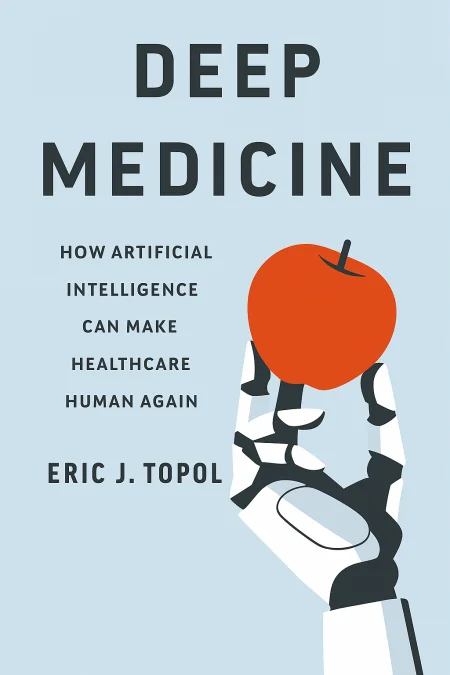
Deep Medicine
How Artificial Intelligence Can Make Healthcare Human Again
Book Edition Details
Summary
Picture a world where technology resuscitates the heart of medicine. In "Deep Medicine," Dr. Eric Topol unveils a future where artificial intelligence is not just a tool but a transformative ally in healthcare. With clinicians often trapped in a whirlwind of paperwork and protocol, the sacred bond between doctor and patient frays, risking errors and misdiagnoses. Topol envisions AI stepping in to shoulder mundane tasks, allowing physicians to focus on what truly matters: genuine human connection. This isn't merely a tale of tech prowess; it's a hopeful manifesto for a healthcare renaissance, promising to rekindle empathy and precision in medical care. A provocative and visionary exploration, this book challenges us to imagine a healing environment where listening is as critical as the cutting-edge technology that makes it possible.
Introduction
A renowned cardiologist finds himself lying on an examination table, experiencing the very system he has spent decades working within—but this time as a patient. The orthopedist's recommendation catches him completely off guard: "You should have your internist prescribe anti-depression medications." This wasn't what he had come to discuss during his post-operative visit following knee replacement surgery. He was in severe physical pain, unable to sleep, barely able to walk. Yet instead of addressing the root cause of his distress, his doctor offered a prescription for his emotional response to untreated suffering. This moment crystallizes a profound crisis in modern healthcare—one that extends far beyond individual encounters to touch every aspect of how we deliver and receive medical care. We live in an age of unprecedented medical knowledge and technological capability, yet patients feel increasingly disconnected from their doctors, and physicians struggle with burnout, depression, and the inability to provide the compassionate care that drew them to medicine in the first place. The promise of technology to enhance healthcare has, in many ways, created barriers between the very people it was meant to serve. But what if artificial intelligence, rather than further dehumanizing medicine, could actually restore the human connection that lies at its heart? This exploration reveals how the thoughtful integration of AI tools could free physicians from administrative burdens, enhance diagnostic accuracy, and ultimately create space for what matters most—the profound human bond between healer and patient that has always been medicine's greatest therapeutic force.
The Crisis of Shallow Medicine: When Technology Divides
Robert walked into the cardiology office carrying a weight far heavier than his medical records. A fifty-six-year-old store manager who had transformed his life after a heart attack—losing twenty-five pounds, exercising religiously—he now faced a terrifying new reality. During what seemed like an ordinary afternoon, his vision had blurred and his face had gone numb. The emergency room doctors called it a "ministroke" and sent him home with instructions to continue his daily aspirin. No changes, no new strategies, just the same routine that had preceded this frightening event. The neurologist found nothing definitive. Brain MRI, normal. Carotid ultrasounds, clear. Frustrated and still vulnerable, Robert was referred to a cardiologist who discovered a small hole in his heart—a patent foramen ovale present in about twenty percent of adults. "A-ha!" the cardiologist exclaimed with the satisfaction of a detective solving a case. This hole, he declared, must have allowed a blood clot to travel to Robert's brain. The solution seemed obvious: a procedure to plug the hole, scheduled for ten days later. But Robert's story illustrates everything wrong with what we might call shallow medicine. Rather than conducting a thorough investigation of all possible causes, the cardiologist had latched onto the first abnormal finding and constructed a narrative around it. The hole in Robert's heart was common enough that if it routinely caused strokes, millions more people would be suffering them. More troubling still, the cardiologist had failed to order the most appropriate test—a simple heart rhythm monitor that would have revealed the true culprit: episodes of atrial fibrillation occurring silently, even during sleep. This rush to diagnosis and treatment reflects a healthcare system that has lost its way, prioritizing speed and efficiency over thoroughness and understanding. We perform millions of unnecessary procedures each year, miss critical diagnoses, and leave patients feeling unheard and uncared for. The very technology meant to enhance medical practice has created a barrier between doctors and patients, reducing complex human beings to data points and billing codes.
AI's Promise and Perils: Patterns, Biases, and Black Boxes
In a small startup company's modest offices, two former Google engineers faced what seemed like an impossible challenge. AliveCor had hired Frank Petterson and Simon Prakash to transform their struggling business of smartphone electrocardiograms into something revolutionary. Their mission was audacious: develop an algorithm that could detect dangerous heart rhythms and, even more remarkably, determine blood potassium levels from a simple watch-based ECG. Meanwhile, just six miles away, a team of more than twenty Apple engineers with seemingly unlimited resources was working on the same problem. The breakthrough came not from superior technology or larger teams, but from a fundamental insight about how machines learn. When their first attempt failed spectacularly—with actual potassium levels of nearly 7 being predicted as 4.5—the team discovered they had made a classic mistake. They had filtered their data too aggressively, removing hospitalized patients to focus on "healthier" outpatients. This human assumption about what constituted better data had nearly killed the project. Only when they embraced the messy, unfiltered reality of all patients—sick and healthy, hospitalized and ambulatory—did their algorithm achieve the 1 percent error rate that would eventually earn FDA approval. This story reveals both the extraordinary potential and the hidden dangers of artificial intelligence in medicine. When properly trained on comprehensive, unbiased data, AI can detect patterns invisible to human eyes, predict outcomes with remarkable accuracy, and process information at scales no human could manage. Deep learning algorithms can now diagnose skin cancer as accurately as dermatologists, identify diabetic retinopathy in retinal photographs, and predict heart rhythm abnormalities from subtle changes in activity patterns. Yet these same systems carry profound risks. They can perpetuate and amplify human biases, make decisions through opaque processes we cannot explain, and fail catastrophically when confronted with situations outside their training. The promise of AI to revolutionize healthcare will only be realized when we acknowledge both its transformative potential and its fundamental limitations, ensuring that these powerful tools serve to enhance rather than replace the irreplaceable human elements of medical care.
From Algorithms to Empathy: Rebuilding the Healing Bond
Dr. Pearse Keane adjusted the optical coherence tomography machine as his patient settled in for what would become a glimpse into the future of eye care. At Moorfields Eye Hospital in London, this routine scan was about to demonstrate something remarkable. Within seconds, the machine captured cross-sectional images of the retina, and an artificial intelligence algorithm—developed in partnership with DeepMind—analyzed them with superhuman precision. The AI could diagnose more than fifty different eye diseases, predict which patients needed urgent referral, and do so with an accuracy that exceeded human specialists while eliminating the delays that often led to preventable blindness. This transformation extends far beyond ophthalmology. In radiology departments worldwide, algorithms are learning to spot the subtle signs of cancer in mammograms, identify brain hemorrhages in CT scans, and detect pneumonia in chest X-rays with accuracy that often surpasses human radiologists. Pathologists are discovering that neural networks can identify microscopic cancer metastases they might miss, while dermatologists find that smartphone cameras equipped with AI can diagnose melanoma as accurately as trained specialists using dermoscopes. But perhaps the most profound change isn't in replacing human expertise—it's in freeing clinicians to focus on what they do best. When radiologists no longer spend their days in dark rooms reading routine scans, they can emerge to counsel patients about their results, serve as gatekeepers to prevent unnecessary procedures, and provide the independent medical perspective that patients desperately need. When pathologists are liberated from the microscope for routine diagnoses, they can integrate molecular data with tissue findings and communicate directly with patients about what their biopsies really mean. The future of medical practice isn't about humans versus machines—it's about humans with machines, each contributing their unique strengths to create something greater than either could achieve alone. This partnership promises to restore the human connection that has been steadily eroded by the demands of modern healthcare, while simultaneously improving the accuracy and efficiency of medical diagnosis and treatment.
The Future of Deep Medicine: Technology Serving Humanity
In a neonatal intensive care unit, a premature infant lies fighting for life, his tiny body wracked by seizures that threaten permanent brain damage or death. Traditional medicine offers little hope—the seizures resist powerful medications, and time is running out. But in this case, artificial intelligence becomes a lifeline. Within hours, a machine learning algorithm analyzes the baby's genome, identifies a rare genetic variant causing the seizures, and recommends a simple treatment: vitamin B6 and dietary modifications. The seizures stop. The child goes home healthy, his future restored by the marriage of human compassion and machine intelligence. This story embodies the promise of deep medicine—a future where artificial intelligence doesn't replace the human touch but amplifies it. When algorithms handle the routine pattern recognition that consumes so much of physicians' time, doctors can return to what drew them to medicine in the first place: listening to patients, providing comfort in times of fear, and applying wisdom gained through years of caring for human suffering. The technology that once threatened to dehumanize healthcare becomes the very tool that restores its humanity. Deep medicine requires three essential elements working in harmony. First, we must deeply understand each individual through comprehensive data—not just symptoms and test results, but the full biological, social, and environmental context that makes each person unique. Second, we need deep learning systems that can process this vast information and reveal patterns beyond human perception. But most critically, we must cultivate deep empathy and connection between patients and caregivers, using the gift of time that AI provides to rebuild the sacred bond of healing. The path forward demands courage from all of us. Healthcare professionals must advocate for systems that prioritize patient care over profit margins. Technologists must build AI tools that enhance rather than replace human judgment. Patients must engage as partners in their care, contributing their voices to ensure technology serves human needs. Together, we can create a future where the most advanced artificial intelligence serves the most fundamental human need—to be seen, heard, and cared for in our moments of greatest vulnerability.
Summary
The intersection of artificial intelligence and healthcare stands at a crossroads that will define the future of human healing. Through stories of both triumph and failure—from the premature infant saved by genomic AI to the patient whose suffering was dismissed with a prescription for antidepressants—we see that technology alone cannot solve medicine's deepest challenges. The crisis in healthcare isn't fundamentally about diagnostic accuracy or efficiency, though AI can dramatically improve both. It's about the erosion of human connection, the loss of time for listening and caring, and the transformation of healing into a series of transactions. The promise of deep medicine lies not in replacing physicians with algorithms, but in creating a partnership where artificial intelligence handles the tasks machines do best—pattern recognition, data processing, and routine analysis—while freeing humans to do what they do best: provide empathy, wisdom, and the irreplaceable comfort of human presence in times of illness and fear. When radiologists emerge from dark reading rooms to counsel patients, when primary care doctors can spend fifteen minutes listening instead of typing, and when the art of healing is restored alongside the science of diagnosis, we will have achieved something revolutionary. This transformation requires more than technological innovation—it demands a fundamental recommitment to the values that make healthcare truly healing. We must choose to use AI's gifts of time and accuracy to rebuild rather than further erode the bonds between caregivers and patients. The future of medicine depends not on how smart our machines become, but on how wisely we choose to remain human in an age of artificial intelligence.
Related Books
Download PDF & EPUB
To save this Black List summary for later, download the free PDF and EPUB. You can print it out, or read offline at your convenience.
By Eric J. Topol
