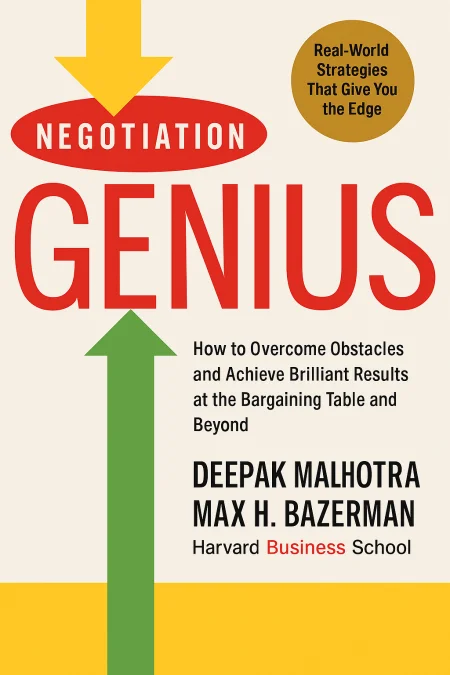
Negotiation Genius
How to Overcome Obstacles and Achieve Brilliant Results at the Bargaining Table and Beyond
byDeepak Malhotra, Max H. Bazerman
Book Edition Details
Summary
In the high-stakes world of negotiation, what transforms the average negotiator into a true virtuoso? "Negotiation Genius" unravels the secrets wielded by the most adept deal-makers, equipping you with mental frameworks and battle-tested strategies drawn from the hallowed halls of Harvard. Whether you're navigating the complexities of a multi-million dollar deal or seeking a raise, this guide arms you with the tools to see opportunities others overlook, decipher hidden motives, and gracefully sidestep common pitfalls. Dive into the minds of negotiation maestros who turn confrontation into collaboration, sidestep threats with ease, and forge trust amid tension. With this book, you won't just walk away with a plan; you'll stride confidently into your next negotiation as a master in the making.
Introduction
Every conversation you have carries the potential to transform your relationships, advance your career, and create opportunities you never imagined possible. Whether you're discussing project deadlines with your team, navigating a salary conversation, or resolving a disagreement with someone you care about, your ability to find mutually beneficial solutions determines not just what you achieve, but how others perceive and respond to you. Yet most of us approach these critical moments with outdated assumptions, emotional reactions, and incomplete strategies that leave tremendous value on the table. The difference between those who consistently create breakthrough results and those who struggle through difficult conversations isn't natural talent or luck. It's a learnable set of skills that transforms how you prepare for, engage in, and follow up on every meaningful interaction. When you understand how to uncover hidden interests, create value for all parties, and navigate the psychological dynamics that drive human behavior, you gain the power to turn seemingly impossible situations into collaborative victories. This journey will equip you with the frameworks and insights that separate true masters from everyone else, giving you the confidence to approach any conversation knowing you can create outcomes that benefit everyone involved.
Master Value Creation Over Position Taking
The foundation of exceptional negotiation lies in recognizing that most situations aren't zero-sum battles where one person's gain must equal another's loss. True masters understand that their primary job isn't just to claim value, but to create it by expanding possibilities before deciding how to divide them. This fundamental shift from position-taking to interest-exploration transforms adversarial encounters into collaborative problem-solving sessions. Consider the story of Chris, a Fortune 500 executive called in to rescue a failing negotiation between his company and a European supplier. For months, both sides had agreed on price—eighteen dollars per pound for a million pounds annually—but remained deadlocked over exclusivity rights. The supplier absolutely refused to grant exclusive access, even when the Americans offered higher prices and guaranteed minimum orders. The American team was baffled and frustrated, assuming the supplier was simply holding out for more money or being unreasonably difficult. When Chris arrived, he didn't make a bigger offer or apply additional pressure. Instead, he asked one simple but powerful question that changed everything: "Help me understand why exclusivity is impossible for you." The supplier's answer revealed the real issue. Granting exclusivity would force him to break a promise to his cousin, who purchased just 250 pounds annually for a small local product. Within minutes, Chris structured a deal granting full exclusivity with a tiny exception for the cousin's needs. Both sides got exactly what they truly needed. This breakthrough happened because Chris focused on underlying interests rather than stated positions. While the Americans saw only two options—complete exclusivity or no deal—Chris discovered that their real interest was protecting their competitive advantage, while the supplier's real interest was honoring his family commitment. These interests weren't conflicting; they were completely compatible once properly understood. To apply this approach, start every important conversation by identifying what you really need versus what you think you want, then invest genuine effort in understanding what truly matters to the other party. Ask "why" questions instead of making assumptions, and look for creative trades across different issues rather than compromises on single points.
Navigate Psychology and Overcome Mental Traps
Even brilliant people fall victim to predictable psychological biases that can derail otherwise sound strategies and damage valuable relationships. Understanding these mental traps in yourself and others becomes essential for achieving consistent success in any negotiation. The most dangerous bias is the fixed-pie assumption—the belief that any gain for the other party must come at your expense. The 2004-2005 NHL lockout provides a devastating example of how this thinking destroys value for everyone involved. Team owners and players became so focused on salary caps and revenue percentages that they lost an entire season, costing both sides hundreds of millions of dollars. They treated the negotiation as a battle over a fixed amount of money, completely ignoring opportunities to grow revenues through rule changes, marketing initiatives, or scheduling innovations that could have benefited everyone. The lockout finally ended when players accepted terms that were actually worse than what owners had offered months earlier. Why did the players hold out so long only to accept a worse deal? They fell victim to escalation of commitment—the tendency to throw good money after bad rather than admit that an initial strategy isn't working. Each side became so invested in their position that backing down felt like admitting failure, even when continuing the fight was clearly destructive. The vividness bias also played a role, as both parties became fixated on highly visible salary numbers while overlooking less dramatic but equally important factors like fan loyalty, television revenues, and long-term league growth. To protect yourself from these biases, develop systematic preparation habits before important conversations. Create objective scoring systems that help you evaluate offers based on substance rather than emotion. When you feel strongly about rejecting a proposal, pause and ask whether you're responding to the actual terms or just the way they were presented. Set clear limits in advance for how much time, energy, or resources you're willing to invest, and stick to those boundaries even when emotions run high. Remember that your counterpart likely experiences these same biases, so sometimes helping them think more clearly will benefit you both.
Handle Complex Situations with Strategic Wisdom
Real-world negotiations rarely unfold in the clean, controlled environments of textbook examples. They involve multiple parties with hidden agendas, time pressures, emotional baggage, and relationship dynamics that can derail even the most carefully planned strategies. Negotiation masters know how to navigate these complexities while maintaining their integrity and strengthening their relationships rather than damaging them. The window bars dispute illustrates how quickly reasonable disagreements can spiral into destructive conflicts. A Manhattan co-op dispute over just 909 dollars in window bar installation costs eventually consumed more than 100,000 dollars in legal fees over six years of bitter fighting. The residents argued that the building should pay for safety equipment; the board insisted that residents should cover costs for their personal choice. What started as a legitimate disagreement about responsibility became a war of principles, with each side escalating their commitment rather than finding a practical solution. This case demonstrates how emotions and ego can transform rational people into irrational negotiators who lose sight of their real interests. Both parties stopped caring about resolving the dispute cost-effectively and became focused on winning at any cost. They fell into reactive devaluation, automatically rejecting proposals from the other side simply because they came from an adversary. The tragedy is that numerous off-ramps existed throughout this six-year battle—binding arbitration, mediation, or simply agreeing to split the costs—but once positions hardened and legal fees mounted, admitting the fight wasn't worth it became psychologically impossible. When you find yourself in a complex, emotionally charged situation, step back and ask what you're really trying to accomplish. Are you solving a problem or proving a point? Consider bringing in neutral third parties who can see solutions that aren't visible to the combatants. Set clear limits on how much time, money, and energy you're willing to invest, and build in regular checkpoints to reassess whether your strategy is working. Remember that sometimes the best negotiation strategy is knowing when not to negotiate—if the relationship is damaged beyond repair or the costs exceed any possible benefit, walking away might be your wisest choice.
Summary
True negotiation genius isn't about being the toughest person in the room or getting everything you want at others' expense. It's about approaching every interaction with curiosity instead of assumptions, focusing on interests rather than positions, and recognizing that the best agreements create value for everyone involved. As the research consistently shows, "negotiation genius is achievable" because it's built on learnable skills rather than innate talent. When negotiations seem impossible, most people panic or hope for the best, but masters strengthen their resolve to find creative solutions that serve everyone's deeper interests. The path forward starts with changing how you prepare for your next important conversation. Before you sit down to discuss anything significant, invest time in understanding not just what you want, but why you want it, and what the other party might truly need. Approach the interaction as a collaborative problem-solving session rather than a battle to be won. This shift in mindset from adversarial to collaborative will transform not just your immediate results, but your long-term relationships and reputation as someone others genuinely want to work with.
Related Books
Download PDF & EPUB
To save this Black List summary for later, download the free PDF and EPUB. You can print it out, or read offline at your convenience.
By Deepak Malhotra
