
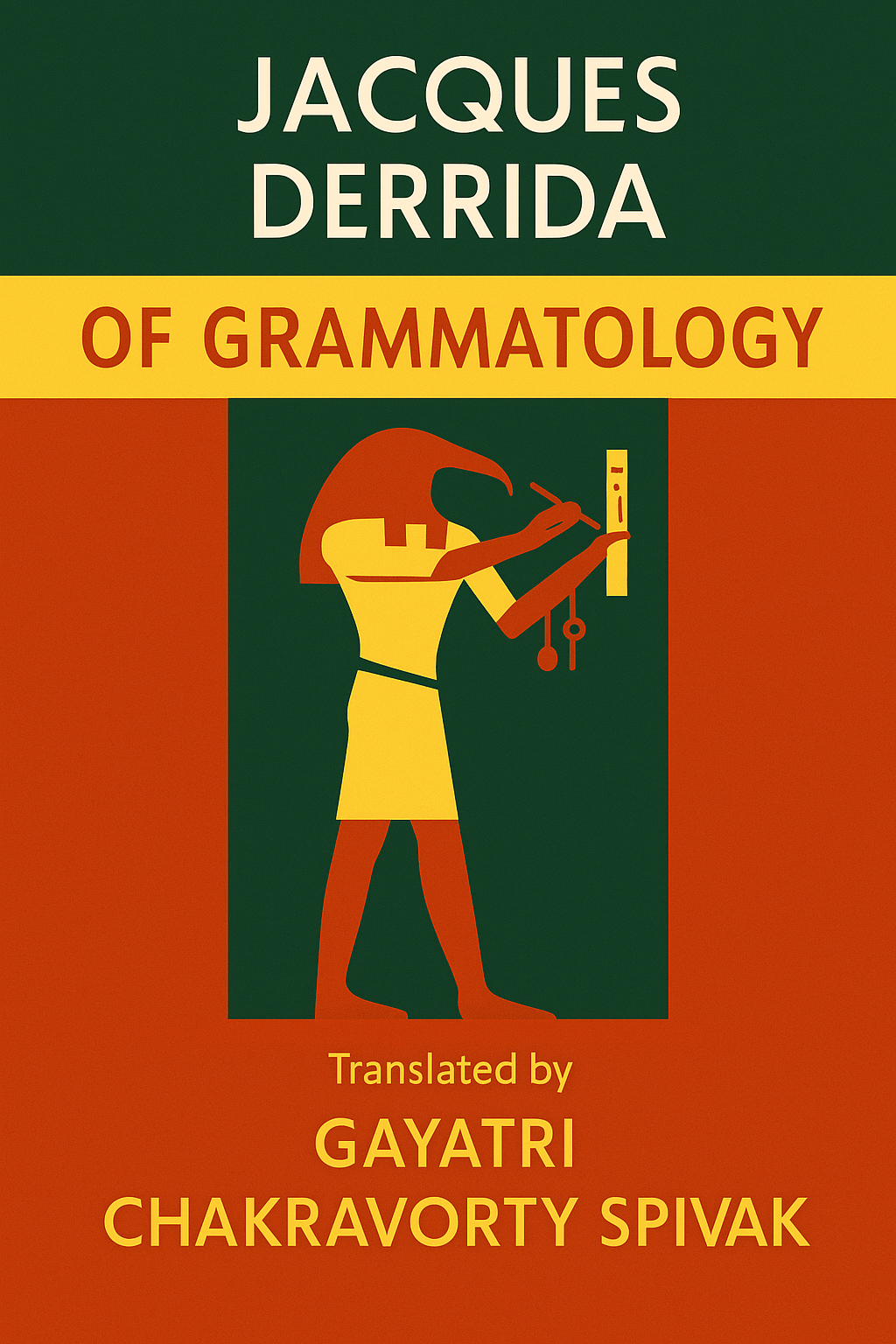
Of Grammatology
The Foundations of Language, Writing, and Meaning
byJacques Derrida, Gayatri Chakravorty Spivak
Book Edition Details
Summary
In the vibrant intellectual landscape of the 1960s, Jacques Derrida's *Of Grammatology* emerged as a seismic shift in the way we perceive language and meaning. Challenging the very foundations of Western thought, Derrida dismantles traditional binaries, revealing writing as a profound architecture of understanding—not merely a shadow of speech. Translated with finesse by Gayatri Spivak, this work remains a touchstone of poststructuralist philosophy, igniting spirited debates across literary and philosophical domains. This edition, enriched with a new index, invites a fresh wave of thinkers to question the established norms, offering tools to explore the underpinnings of knowledge, language, and culture. Engage with a text that continues to defy convention and inspire a deeper inquiry into the essence of communication itself.
Introduction
Western philosophical tradition has maintained an unwavering commitment to the superiority of speech over writing, treating spoken language as the immediate presence of thought while relegating writing to a derivative, secondary status. This hierarchical arrangement masks a deeper metaphysical architecture that shapes not merely our understanding of language, but our entire conception of truth, presence, and meaning itself. The challenge to this logocentrism reveals that what appears natural and self-evident actually represents a historically constructed system of thought that systematically excludes and marginalizes the very structures that make meaning possible. The investigation that follows employs a rigorous method of textual analysis that exposes the internal contradictions within seemingly coherent philosophical systems. Rather than simply reversing traditional valuations, this approach demonstrates how the opposition between speech and writing rests on unstable foundations that cannot withstand careful scrutiny. Through detailed examination of key figures from Plato to Rousseau to Saussure, the analysis reveals how writing operates not as an external representation of speech, but as the fundamental condition that enables all linguistic signification. The implications extend far beyond questions of language and communication, touching on foundational issues of presence, difference, and the nature of meaning that continue to influence contemporary thought across multiple disciplines. This deconstructive reading opens possibilities for understanding how our most basic conceptual frameworks both enable and constrain thinking itself.
The Critique of Phonocentrism in Western Metaphysics
The philosophical tradition from Plato through modern linguistics has consistently privileged the spoken word as the authentic presence of meaning while treating writing as a dangerous supplement that threatens the purity of immediate expression. This phonocentric prejudice assumes that speech maintains a direct, unmediated relationship between consciousness and linguistic expression, whereas writing introduces elements of absence and potential misunderstanding that corrupt original intention. The apparent naturalness of this hierarchy draws support from observations about language acquisition and cultural development—children speak before they write, oral cultures precede literate ones, and speech seems to flow directly from thought while writing requires material mediation. Yet this seemingly obvious distinction dissolves under rigorous analysis. Ferdinand de Saussure's structural linguistics, despite its revolutionary insights into language as a system of differences rather than positive terms, maintains that writing merely represents speech like a "garment" clothing the living body of spoken language. This position becomes problematic when examining how writing systems actually function and their relationship to the languages they supposedly represent. The treatment of non-alphabetic writing systems as primitive or incomplete forms reveals the extent to which phonocentric assumptions distort our understanding of how different cultures organize meaning and signification. The critique of phonocentrism exposes how the privilege accorded to speech reflects not its essential superiority but its ability to conceal the complex differential structures that make all meaning possible. Speech appears immediate only by repressing its dependence on the same systems of spacing, repetition, and difference that characterize written signs. The spoken word operates through conventional markers, systematic relationships, and temporal delays that prevent any moment of pure presence from ever being achieved. The deconstruction of this hierarchy does not simply reverse the traditional valuation but questions the entire framework that establishes such hierarchical oppositions. By examining the conditions that make both speech and writing possible, a more fundamental structure emerges—one that precedes and enables both forms of expression while being reducible to neither.
Writing as the Originary Condition of Language and Meaning
Rather than serving as a secondary representation of speech, writing reveals itself as the condition of possibility for language in general. This claim requires expanding the concept of writing beyond graphic inscription to encompass the general structure of spacing, temporalization, and différance that makes all signification possible. In this broader sense, writing includes the intervals and differences that constitute spoken language no less than written texts, challenging the traditional boundary between these supposedly distinct forms of expression. The conventional understanding of writing as external to speech depends on a metaphysics of presence that assumes meaning can exist in pure, self-identical form before linguistic expression. However, careful analysis reveals that meaning emerges only through differential relationships and temporal deferrals that prevent any moment of absolute presence. The spoken word operates through the same system of traces and references that characterize written signs, relying on the possibility of repetition, recognition, and contextual variation that enables signs to function across different situations. This originary structure of writing manifests itself in the fundamental requirement that signs be iterable—capable of functioning across different contexts while maintaining recognizable identity. This iterability introduces an essential element of absence into every present moment of signification, since signs must be able to operate even when their original contexts are no longer available. The possibility of citation, quotation, and repetition that seems characteristic of written texts actually defines all linguistic signs, including those produced in speech. The recognition of writing as originary does not eliminate distinctions between speech and writing but situates both within a more comprehensive economy of signification. Speech and writing become different modes of the same fundamental process of inscription, each with specific characteristics and effects, but neither enjoying priority in terms of proximity to meaning or truth. This insight transforms our understanding of how language operates while revealing the extent to which traditional philosophical categories depend on unexamined assumptions about presence and representation.
Rousseau's Contradictory Treatment of Writing and Nature
Jean-Jacques Rousseau's essay on the origin of languages provides a particularly revealing site for examining tensions within logocentric thinking. Rousseau explicitly condemns writing as a supplement that corrupts the natural purity of speech, associating it with the artificial constraints of civilized society that alienate humans from their original condition. Yet his own textual analysis repeatedly demonstrates the necessity of supplementary structures for constituting what he calls natural language, creating contradictions that illuminate the impossibility of maintaining pure oppositions between nature and culture, presence and representation. Rousseau's account of linguistic origins posits an initial state of pure vocal expression that gradually becomes corrupted through the introduction of consonants, articulation, and eventually writing. However, his description of this supposedly natural language reveals that it already contains the structures of difference and absence he associates with writing. The movement from cry to speech, from natural expression to conventional signification, from gesture to voice, all involve the same logic of supplementarity that governs the relationship between speech and writing. The concept of the supplement operates throughout Rousseau's text according to a peculiar logic that simultaneously adds to and substitutes for what it supplements. Writing supplements speech by providing what speech lacks—permanence, precision, communication across distance—yet this supplementation reveals that speech was never complete in itself. The supplement appears both inessential, since it comes from outside, and essential, since it fulfills necessary functions that the original cannot provide. This supplementary logic extends beyond language to encompass Rousseau's entire philosophical system. The relationship between nature and culture, education and natural development, law and freedom, all follow the same pattern where what appears as external addition proves to be the condition of possibility for what it supposedly corrupts. The supplement cannot be simply excluded without destroying what it supplements, yet its inclusion undermines the purity and self-presence of the original.
The Supplementary Logic that Undermines Presence
The logic of supplementarity that emerges from textual analysis has implications extending far beyond questions of language and writing. This logic reveals the impossibility of establishing any pure presence or origin that would not already be inhabited by structures of difference and deferral that make signification possible. Every attempt to ground meaning in immediate presence discovers that such presence is always already constituted through relationships to what is absent, creating an irreducible complexity that resists reduction to simple origins or foundations. The supplement operates according to a temporal structure that disrupts simple oppositions between past and present, origin and derivation. The supplement comes after what it supplements, yet its necessity reveals that the origin was never complete in itself. The supplement is thus simultaneously belated and originary, external and internal to what it supplements. This temporal complexity prevents any linear narrative of development or corruption while revealing how hierarchical oppositions function to organize meaning and value. The recognition of supplementary logic does not lead to relativism that would make all distinctions meaningless. Rather, it calls for more careful analysis of how differences are established and maintained, and how systems of meaning operate through the play of presence and absence, identity and difference. The deconstruction of logocentrism does not eliminate the effects of hierarchical oppositions but reveals the complex forces that produce these effects while making their transformation possible. This analysis has profound implications for understanding the relationship between philosophy and writing. If philosophical discourse depends upon the very structures of inscription and transmission that it often seeks to subordinate or transcend, then philosophy must acknowledge its constitutive relationship to material conditions of communication. The attempt to ground philosophical truth in pure presence or immediate intuition encounters the irreducible mediation that makes philosophical discourse possible while preventing it from achieving the transparency it seeks.
Summary
The deconstruction of Western logocentrism demonstrates that the traditional hierarchy privileging speech over writing rests on metaphysical assumptions about presence and meaning that cannot withstand rigorous analysis. Through examination of supplementary logic, particularly as it operates in Rousseau's linguistic theory, writing emerges not as a derivative representation of speech but as the general condition of spacing and différance that makes all language possible. This recognition transforms understanding of how meaning operates, revealing that what appears as natural presence is always already constituted through differential structures that introduce absence into the heart of the immediate. The analysis challenges foundational assumptions of Western metaphysics while opening new possibilities for thinking about language, representation, and the material conditions that enable philosophical discourse itself, offering essential insights for readers seeking to understand how conceptual frameworks shape and constrain thinking across disciplines.
Related Books
Download PDF & EPUB
To save this Black List summary for later, download the free PDF and EPUB. You can print it out, or read offline at your convenience.
By Jacques Derrida
