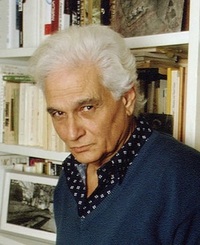
Jacques Derrida
Born in French Algeria, Jacques Derrida emerged as a preeminent philosopher whose intellectual pursuits redefined the boundaries of language and meaning. He received his formative education at the École Normale Supérieure in Paris, where the philosophical tenets of Heidegger, Husserl, and Levinas left a profound imprint on his thinking. A pioneering force in the development of deconstruction, Derrida's work interrogated the certainties of Western metaphysical thought, positioning him at the forefront of contemporary philosophical discourse. Among Derrida's influential texts, "Of Grammatology" stands as a hallmark of his critical repertoire, published in the pivotal year of 1967 alongside "Writing and Difference" and "Speech and Phenomena." These works collectively challenged entrenched notions of language and interpretation, advocating for a nuanced understanding of textuality. Central to Derrida's philosophy is the concept of différance, a term that encapsulates the perpetual deferral of meaning, thereby unsettling the quest for absolute truth. His later contributions, such as "Specters of Marx" and "The Politics of Friendship," expanded his inquiry into the ethical and political dimensions of democracy and justice. Derrida's prose is characterized by its intricate and often elusive nature, mirroring the complexity of the ideas he sought to unravel. His critique of binary oppositions, such as the privileging of speech over writing, underscored a broader challenge to the conventional hierarchies that pervade philosophical thought. Despite the formidable density of his writing, Derrida's legacy endures as a transformative force in philosophy, literary theory, and cultural criticism, compelling scholars to reconsider the fluidity of meaning and the architecture of language itself.


by Paul J. Zak
by Rory Vaden
by Robert C. Solomon, Fernando Flores
by Brett Gardner
by Dennis S. Reina
by Julian Baggini
by Larry Downes, Omar Abbosh, Paul Nunes
by Jacqueline Woodson
by Kevin Oakes
by Lindsey Pollak, Kimberly B. Cummings, Kimberly Brown
