
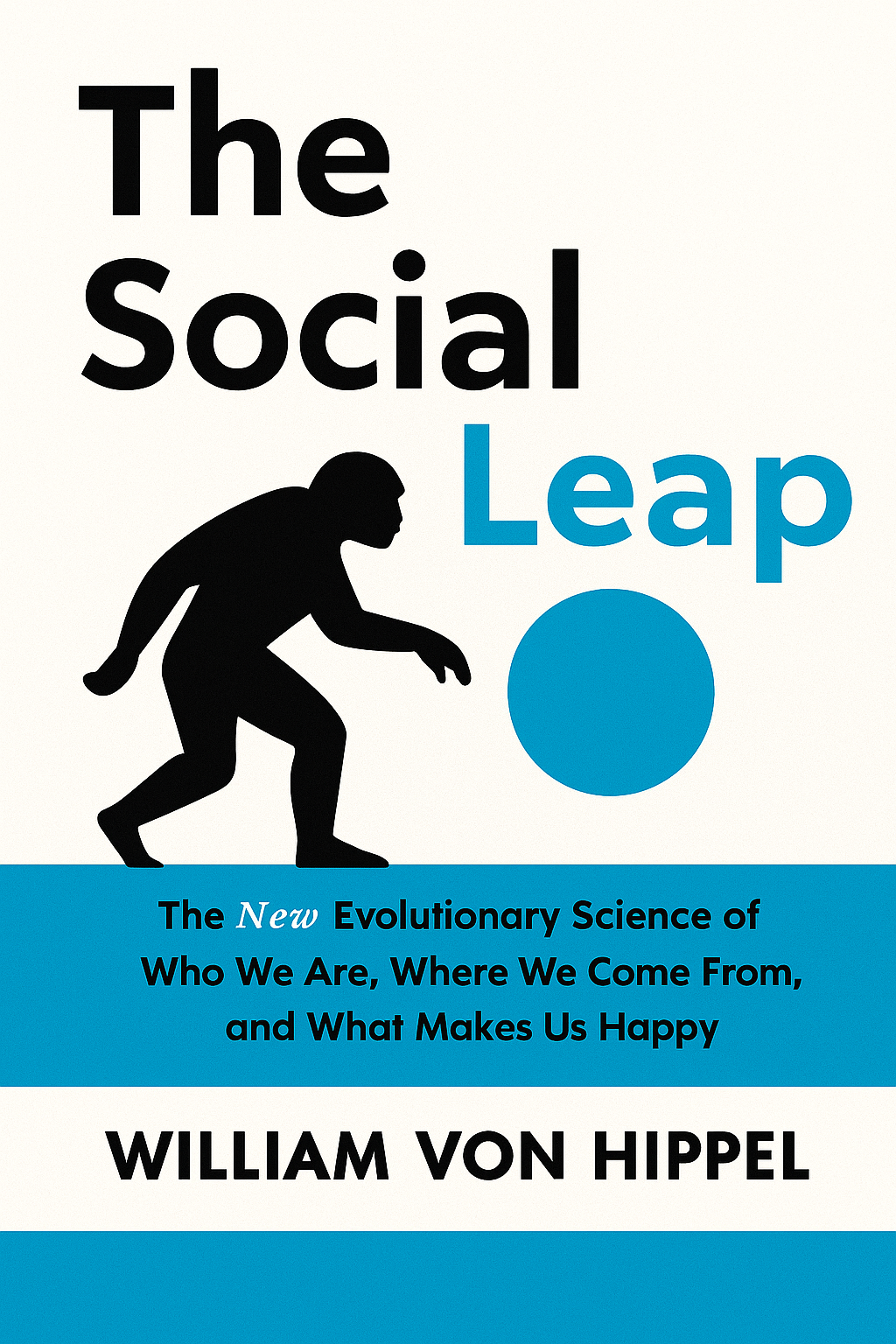
The Social Leap
The New Evolutionary Science of Who We Are, Where We Come From, and What Makes Us Happy
Book Edition Details
Summary
In the kaleidoscope of human history, a pivotal shift from forest to savannah sculpted the essence of who we are today. "The Social Leap" by William von Hippel delves into this transformative journey, where survival demanded a metamorphosis from solitary instincts to communal ingenuity. This exhilarating exploration weaves anthropology, psychology, and evolutionary science to unravel how the trials of ancient landscapes engineered our modern psyche. It’s an eye-opening narrative that traverses the terrain of human behavior—from leadership dynamics to the paradoxes of happiness. Von Hippel deftly illuminates the threads linking our ancestral past to the challenges of today, offering insights into our tendencies for conflict, innovation, and societal fulfillment. Here lies a profound revelation: understanding the roots of our nature can illuminate pathways to enrich our lives and societies. Dive into the compelling narrative that challenges and redefines our understanding of human evolution and its enduring legacy.
Introduction
Picture our ancestors six million years ago, small and vulnerable primates forced from their comfortable forest homes onto the dangerous African savannah. Surrounded by predators far larger and stronger than themselves, they faced what seemed like certain extinction. Yet somehow, these unlikely survivors not only endured but eventually came to dominate the planet. The secret wasn't bigger teeth, sharper claws, or faster legs. It was something far more revolutionary: the ability to work together in ways no other species had ever achieved. This remarkable transformation reveals how cooperation became humanity's superpower, shaping everything from our massive brains to our complex societies. Through examining our evolutionary journey, we discover why we form lasting relationships, why we're obsessed with fairness, and why we're capable of both extraordinary kindness and devastating conflict. The story illuminates three fundamental questions that define human nature: How did we evolve from forest dwellers to global dominators? Why do we cooperate so intensely within groups while often fighting so fiercely between them? And what can our deep past teach us about finding happiness and building better societies today? Anyone curious about human behavior, from parents wondering why their children share toys to leaders seeking to understand group dynamics, will find profound insights in this evolutionary tale. Our modern challenges, from workplace cooperation to international relations, become clearer when viewed through the lens of our ancient past.
From Forest to Savannah: The Origins of Cooperation
Around six million years ago, massive geological forces fundamentally altered the course of human evolution. Tectonic activity along the East African Rift Valley slowly transformed lush rainforests into open grasslands, forcing our chimp-like ancestors from their safe arboreal homes onto the perilous savannah. This wasn't a choice but an environmental catastrophe that should have spelled doom for creatures so poorly adapted to ground life. On the savannah, our ancestors faced a terrifying reality. During daylight, they had been fierce predators swinging through the trees, but darkness transformed them into prey for lions, leopards, and saber-toothed tigers. Their small size, slow ground speed, and lack of natural weapons made them easy targets. Unlike their baboon cousins who developed massive teeth and aggressive dominance hierarchies, our ancestors chose a different path entirely. The breakthrough came through collective stone throwing. While individual Australopithecines like Lucy were no match for large predators, groups working together could drive off even the most formidable hunters. This simple innovation required unprecedented cooperation, forcing our ancestors to overcome their naturally competitive instincts. Those who learned to work together survived and reproduced, while individualists perished alone. This social revolution triggered a cascade of evolutionary changes that would define humanity. Cooperation demanded new psychological traits: the ability to share information, coordinate actions, and punish free riders who benefited without contributing. Our ancestors developed white eye sclera to advertise where they were looking, evolved complex emotions like guilt and shame to regulate group behavior, and began the long journey toward the massive brains that would eventually enable language, culture, and civilization itself.
Agricultural Revolution: Cities, Hierarchy, and Social Complexity
Twelve thousand years ago, humans took another revolutionary leap that would reshape society forever. The development of agriculture began innocuously when hunter-gatherers started planting seeds rather than simply collecting them, but this seemingly minor change unleashed profound transformations in human psychology and social organization. Farming demanded a completely different mindset from the immediate-return lifestyle of hunter-gatherers. Where nomadic groups shared everything and owned nothing they couldn't carry, farmers needed to accumulate tools, defend land, and plan seasons ahead. This shift toward private property and delayed gratification required new psychological adaptations that often conflicted with our evolved egalitarian instincts. The agricultural revolution created humanity's first significant inequality. Some families accumulated more land, tools, and livestock than others, leading to the emergence of social hierarchies previously unknown among hunter-gatherer groups. Women's status often declined as plough-based farming favored male physical strength, while powerful men could now support multiple wives and dozens of children, creating reproductive advantages that reinforced social stratification. As farming communities grew into towns and eventually cities, humans faced another unprecedented challenge: living among strangers. For the first time in our species' history, people had to cooperate with individuals whose reputations and intentions were unknown. This led to the development of formal politeness, increased reliance on appearances over substance, and eventually the complex legal and governmental systems needed to maintain order among thousands of people who would never know each other personally.
Modern Challenges: Leadership, Innovation, and Global Peace
The psychological traits that helped our ancestors survive on the savannah continue to shape modern human behavior in ways both beneficial and problematic. Our evolved tendency toward tribalism, originally essential for survival, now manifests as political polarization and international conflict. The same in-group cooperation that once protected us from predators can fuel nationalism and prejudice against outsiders. Modern leadership often reflects an ancient tension between two evolutionary strategies. Elephant-style leaders, like those found in traditional egalitarian societies, serve their groups' interests and share power broadly. In contrast, baboon-style leaders exploit their positions for personal gain, creating inequality and suffering for their followers. Understanding these patterns helps explain why some organizations and nations thrive while others stagnate under corrupt, self-serving leadership. Our species' remarkable capacity for innovation also reflects our evolutionary heritage. While we often focus on technical inventions, humans actually evolved as social innovators, preferring to solve problems through cooperation and relationship-building rather than creating new tools. This explains why social media platforms and collaborative technologies have transformed society far more rapidly than many purely technical advances. Perhaps most critically, our evolutionary past illuminates the path toward global peace. Humans evolved to cooperate intensively within groups while remaining suspicious of outsiders, but we also developed the cognitive flexibility to expand our definition of community. By understanding these deep psychological patterns, we can design institutions and agreements that channel our cooperative instincts toward broader human flourishing rather than tribal conflict.
Summary
The central paradox of human evolution reveals itself in our simultaneous capacity for extraordinary cooperation and devastating conflict. We became the planet's dominant species not through individual prowess but by learning to work together in ways no other animal has achieved, yet this same tribal psychology that enabled our success also drives much of today's political division and international tension. Our journey from forest to savannah to global civilization demonstrates that human nature isn't fixed but remarkably adaptable. The same psychological mechanisms that helped our ancestors survive can be channeled toward solving modern challenges, whether building more effective organizations, creating fairer societies, or achieving lasting peace between nations. Understanding our evolutionary heritage offers three key insights for navigating today's complex world: recognize that our tribal instincts serve important purposes but need not define our choices, design institutions that align individual and group interests rather than fighting our nature, and remember that cooperation, not competition, remains humanity's greatest strength and our best hope for the future.
Related Books
Download PDF & EPUB
To save this Black List summary for later, download the free PDF and EPUB. You can print it out, or read offline at your convenience.
By William Von Hippel
