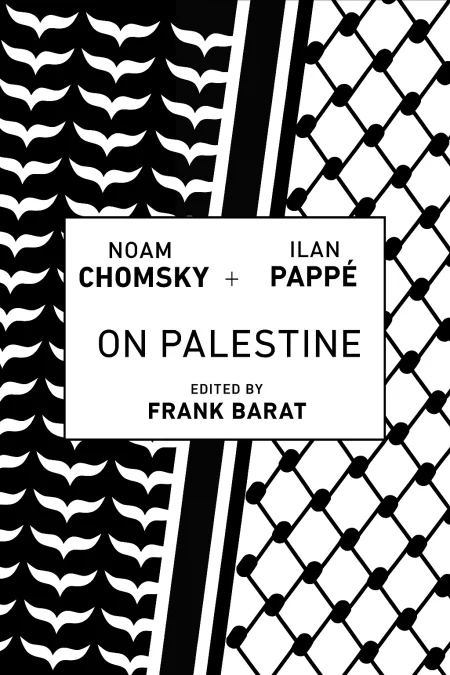
On Palestine
Examine the Roots of Conflict and the Path to Justice in Palestine
byNoam Chomsky, Ilan Pappé, Frank Barat
Book Edition Details
Summary
In the shadow of one of the world's most enduring conflicts, Ilan Pappé and Noam Chomsky unveil a powerful dialogue that challenges the status quo and urges global reflection. "On Palestine" dissects the relentless struggle faced by Palestinians, casting a critical eye on the historical and political currents that have shaped their reality. This sequel to "Gaza in Crisis" invites readers to question entrenched narratives and examine the international community's role in seeking justice and peace. Through incisive discussion, Pappé and Chomsky offer a blueprint for solidarity and transformation, igniting hope for a future where human rights prevail.
Introduction
In the bustling cafés of late 19th century Vienna and the drawing rooms of London, a political movement was taking shape that would forever alter the landscape of the Middle East. As European Jews faced rising anti-Semitism and sought new forms of identity, their gaze turned eastward toward a land already inhabited by hundreds of thousands of Palestinians. What began as a quest for safety and self-determination would evolve into one of the world's most enduring conflicts, shaped by colonial ambitions, imperial machinations, and the relentless logic of settler colonialism. This examination of the Palestine question cuts through decades of diplomatic doublespeak to reveal the underlying colonial dynamics that have driven the conflict from its inception to the present day. Through careful historical analysis and unflinching moral clarity, we trace how a 19th century settler movement transformed into a modern apartheid state, supported by Western powers who found it convenient to solve their "Jewish problem" at Palestinian expense. The story illuminates not just the particular tragedy of Palestine, but the broader patterns of how colonialism adapts and persists into the 21st century, disguised as peace processes and democratic values while systematically dispossessing an indigenous population. For anyone seeking to understand why decades of peace negotiations have failed, why Palestinian resistance continues, and what genuine justice might look like, this historical journey provides essential context often missing from contemporary debates.
The Colonial Origins: Zionism and Palestinian Dispossession (1880s-1948)
The roots of today's crisis lie not in ancient tribal hatreds, but in the concrete dynamics of European settler colonialism transplanted to the Eastern Mediterranean. When Theodor Herzl and other early Zionist leaders began organizing Jewish settlement in Palestine in the 1880s, they were remarkably candid about their colonial project. The Hebrew terms they used for their activities translated directly as "colonization" and "settlement," words they embraced proudly when colonialism still enjoyed respectability in European circles. Yet this was settler colonialism with a unique twist. Unlike other colonial ventures primarily motivated by economic extraction, Zionism combined the standard colonial drive to acquire land with an additional imperative to exclude the native population entirely. David Ben-Gurion and other pragmatic Zionist leaders understood from the beginning that creating a "Jewish democracy" in an Arab land would require not just territorial control, but demographic transformation. When Jews remained less than a third of Palestine's population even in 1947, the movement faced what its leaders saw as an existential mathematical problem. The solution emerged through systematic ethnic cleansing beginning even before the British withdrawal in 1948. Village by village, the Zionist forces implemented what they called "Plan Dalet," depopulating over 500 Palestinian villages and towns, creating over 750,000 refugees, and destroying the social fabric that had sustained Palestinian society for centuries. This was not the chaotic byproduct of war, but the methodical implementation of a demographic vision that required Palestine to be emptied of Palestinians. The international community's response revealed the deeper imperial logic supporting the Zionist project. Britain had already promised the land to Jewish settlers through the Balfour Declaration, while simultaneously assuring Arab leaders of their rights. When push came to shove, Western powers found it convenient to solve their own "Jewish problem" by enabling Jewish settlement in Palestine, regardless of the consequences for the existing population.
Occupation and Fragmentation: The Post-1967 Reality
The 1967 war marked not just a military victory, but the moment when Israel's settler colonial project could finally extend across all of historic Palestine. Within months of occupying the West Bank and Gaza Strip, Israel's most representative government in history made a series of fateful decisions that continue to shape Palestinian life today. These choices, made with remarkable consensus across Israel's political spectrum, reveal the deeper continuity between pre-1948 Zionism and post-1967 occupation policy. The first decision was to keep the territories while avoiding their formal annexation, a strategy designed to maintain international legitimacy while establishing facts on the ground. The second was to exclude these areas from any future "land for peace" deals, despite public rhetoric about territorial compromise. The third was to deny citizenship to the occupied population, creating what can only be described as the world's largest open-air prison, housing over a million people without basic rights or freedoms. The genius and cruelty of this system lay in its flexibility. Israel offered Palestinians two versions of imprisonment: an "open-air prison" that allowed limited autonomy under Israeli control, or a "maximum security prison" featuring collective punishment, curfews, and military rule. When Palestinians accepted the former, they found themselves confined to ever-shrinking bantustans. When they resisted, they faced the full force of one of the world's most powerful militaries. This period also saw the systematic fragmentation of Palestinian society. Israel deliberately separated Gaza from the West Bank in violation of the Oslo Accords' recognition of their territorial unity. Palestinians inside Israel proper faced increasing discrimination and land confiscation. Refugees in neighboring countries found their right of return increasingly forgotten by international diplomacy. Each group faced different forms of oppression, making unified resistance more difficult while allowing Israel to present itself as facing multiple separate conflicts rather than one colonial situation.
From Oslo Deception to BDS Movement: The Struggle Continues
The Oslo Accords of 1993 represented perhaps the most sophisticated attempt to legitimize permanent colonial control through the language of peace and statehood. By offering Palestinians administrative control over scattered enclaves while Israel retained security control, access routes, and economic dominance, Oslo created the illusion of progress toward independence while institutionalizing dependence. The so-called peace process became a mechanism for Israel to continue settlement expansion under international protection, with each new colonial outpost justified as creating "facts on the ground" for future negotiations. The fundamental deception lay in treating the conflict as a border dispute between two legitimate national movements rather than recognizing it as an ongoing process of settler colonial dispossession. This framing allowed Israel to position its colonial settlements as "concessions" to be rewarded, while Palestinian demands for basic rights were dismissed as unrealistic. The international community became complicit in this charade, with the United States serving not as an honest broker but as Israel's lawyer in diplomatic forums. The failure of Oslo, dramatically illustrated by the collapse of Camp David negotiations and the brutal suppression of the Second Intifada, forced a reckoning within Palestinian society and international solidarity movements. The traditional focus on achieving a Palestinian state gave way to a more fundamental challenge to Israeli apartheid itself. The emergence of the Boycott, Divestment, and Sanctions movement marked this shift, drawing explicit parallels between Israeli practices and South African apartheid. BDS represented more than just tactical evolution; it reflected a growing recognition that the problem was not Israeli policies but the colonial ideology driving those policies. Academic and cultural boycotts, divestment campaigns, and sanctions efforts began targeting not just the occupation of the West Bank and Gaza, but the entire system of Jewish supremacy from the river to the sea. This approach faced fierce resistance, precisely because it challenged the fundamental legitimacy of a state based on ethnic privilege.
Future Scenarios: One State vs Bantustanization
Today's reality belies the conventional wisdom that presents a choice between two states or one state. Instead, we face a choice between one democratic state or the continued expansion of what is already a single apartheid state stretching from the Jordan River to the Mediterranean Sea. Israel's systematic colonization of the West Bank, siege of Gaza, and discrimination against Palestinian citizens within its pre-1967 borders have created a unified system of control that bears no resemblance to partition. The bantustanization option currently being implemented involves Israel taking over approximately 60-70% of the West Bank through settlement expansion, the separation wall, and military zones, while leaving Palestinians confined to disconnected enclaves without genuine sovereignty. Unlike South African apartheid, which needed Black labor, Israel's version aims at separation and gradual displacement. This system can maintain itself indefinitely as long as it retains U.S. support and international acquiescence. The alternative requires acknowledging what already exists: one state controlled by one government that systematically privileges one ethnic group over another. The question is not whether this will be one state, but whether it will be a democratic state. This transformation would require dismantling the legal and institutional structures that privilege Jewish citizens over Palestinian ones, implementing genuine equality regardless of ethnicity or religion, and addressing the rights of Palestinian refugees to return to their homeland. Such change will not come from within Israeli Jewish society, which has moved steadily rightward and shows little inclination toward the kind of internal transformation that would voluntarily surrender ethnic privilege. Instead, it will require the kind of international pressure that ultimately proved effective against South African apartheid. The growing BDS movement, shifting public opinion especially among younger Americans and Europeans, and Israel's increasing international isolation all point toward the possibility of such pressure reaching a tipping point.
Summary
The Palestine question illuminates how 19th century settler colonialism has adapted to 21st century realities, cloaking territorial conquest and ethnic cleansing in the language of democracy, security, and peace. From its origins in European Jewish nationalism through its current manifestation as a nuclear-armed apartheid state, Israel's project has succeeded precisely because it secured the backing of successive Western empires and learned to present colonial expansion as defensive necessity. The consistent thread running through 140 years of this history is the Zionist movement's commitment to maximizing Jewish control over Palestinian land while minimizing Palestinian presence on that land. Understanding this history reveals why conventional diplomatic approaches have failed so consistently. Peace processes that treat colonizer and colonized as equal partners, that legitimize the fruits of ethnic cleansing as starting points for negotiation, and that promise Palestinian statehood while enabling continued Israeli expansion serve primarily to provide cover for ongoing dispossession. The two-state solution, whatever its theoretical merits, has become in practice a mechanism for legitimizing permanent colonial control. The path forward requires honest acknowledgment of what exists: a single state practicing institutionalized discrimination against its Palestinian population. Real progress demands dismantling this system of ethnic privilege, implementing genuine equality, and addressing the legitimate rights of Palestinian refugees. This transformation will require sustained international pressure of the kind that ultimately proved decisive against South African apartheid, combined with continued Palestinian resistance and the growing global recognition that justice delayed is justice denied. Only by calling this system by its proper name can we begin to imagine its replacement with something worthy of both peoples' hopes for freedom and dignity.
Related Books
Download PDF & EPUB
To save this Black List summary for later, download the free PDF and EPUB. You can print it out, or read offline at your convenience.

By Noam Chomsky
