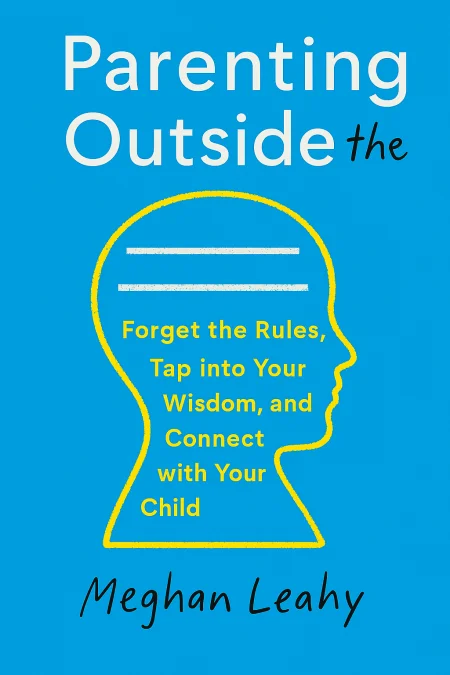
Parenting Outside the Lines
Forget the Rules, Tap into Your Wisdom, and Connect with Your Child
Book Edition Details
Summary
Drowning in a sea of parenting dos and don’ts, where every choice feels like a step toward or away from perfection? Meghan Leahy, the voice behind the Washington Post's candid parenting column, offers a lifeline with her refreshingly honest guide. In a world obsessed with flawless parenting, Leahy champions the beauty of imperfection, urging parents to toss the rulebook and embrace their instincts. Parenting Outside the Lines is a heartfelt invitation to trust yourself and connect with your child on a genuine level. It's not about serving organic meals or mastering mindful techniques during tantrums; it's about finding joy and humor amidst the chaos. Say goodbye to impossible standards and hello to parenting that's as flexible and unique as you are.
Introduction
Picture a mother standing in a grocery store aisle, her two-year-old daughter writhing in the cart, screaming for a specific cup that's buried somewhere in the dishwasher at home. Other shoppers stare. The child's demands grow louder. The mother feels her face burning with embarrassment, her anxiety spiking as she faces an impossible choice: give in to the tantrum or endure the public meltdown. In that moment, she makes a decision that will change everything about how she views parenting—she abandons her full cart and walks away. This scene, like countless others in our daily parenting lives, reveals a profound truth: we've been conditioned to believe there's always a "right" way to handle every situation, a perfect technique that will solve our problems and create compliant, grateful children. We've been taught to follow the rules, trust the experts, and implement strategies with military precision. But what if the real answer lies not in following someone else's blueprint, but in trusting our own deeper wisdom? Modern parenting has become a minefield of competing theories, overwhelming advice, and impossible expectations. We're drowning in data about child development while simultaneously losing touch with our natural instincts. We're so busy trying to be perfect parents that we've forgotten how to simply be present with our children. This book challenges every assumption about what "good parenting" looks like and invites you to step outside the rigid lines that have been drawn around how we should raise our children. It's time to rediscover the power of your own intuition and create a more authentic, joyful relationship with your family.
Breaking Free from Parenting Perfectionism and Cultural Expectations
Sarah had always imagined herself as the kind of mother who would serve organic salmon dinners to grateful children who would thank her for caring about their nutrition. She spent forty-seven dollars on sustainably-sourced fish, carefully prepared a complete meal with brown rice and fresh salad, and proudly announced that dinner was served. Her children took one look at the carefully plated meal and immediately began their protest: "This is disgusting!" "I'm not eating this!" One child started digging through the freezer for chicken nuggets while the other pushed the fish around their plate like it was roadkill. Sarah's partner looked on with a mixture of amusement and sympathy, knowing exactly how this would end. What had started as a loving gesture—a mother wanting to nourish her children—had become a battlefield. Sarah felt crushed. She had put thought, time, money, and effort into this meal, yet her children's ingratitude felt like a personal attack. The evening dissolved into threats, tears, and eventually bowls of cereal, while the expensive salmon grew cold on abandoned plates. This salmon dinner represents so much more than a failed meal. It reveals how our parenting expectations, dressed up as love and care, often become transactional agreements we've never actually made with our children. We believe that if we do A (prepare healthy food, plan special outings, make sacrifices), then B should naturally follow (gratitude, cooperation, joy). But children don't owe us happiness, and they certainly don't owe us gratitude for decisions they never asked us to make. When we parent from this place of expectation, we set ourselves up for disappointment and our children up for failure. The path forward lies not in abandoning our desire to nurture our children, but in releasing our attachment to how they should respond to our efforts.
From Control to Connection: Navigating Daily Power Struggles
Every morning became a war zone in the Martinez household. Four-year-old Luis would wake up with one mission: to build elaborate Lego structures. His focus was remarkable, his creativity boundless, but his timing was terrible. While his mother rushed around gathering lunches, signing permission slips, and managing two other children, Luis would disappear into his blocks, completely unreachable. "Luis, get dressed!" she would call from the kitchen. "Luis, eat your breakfast!" from the hallway. "LUIS!" from directly above his head, her voice sharp with frustration and time pressure. The morning routine had devolved into drive-by parenting—commands hurled over shoulders while multitasking, expectations shouted from three rooms away, and mounting anger when cooperation didn't materialize instantly. Luis wasn't trying to sabotage the family schedule; he was simply a four-year-old doing what four-year-olds do best: becoming completely absorbed in play. But his mother experienced his focus as defiance, his natural developmental behavior as personal disrespect. The harder she pushed, the more Luis seemed to retreat into his own world. Everything changed when Luis's mother realized a fundamental truth: her anger wasn't her child's fault. This little boy wasn't waking up each morning plotting to make her life difficult. He was just being four. When she stopped taking his behavior personally and started working with his nature instead of against it, the mornings transformed. She began getting down to his eye level, physically guiding him through transitions, and most importantly, building time for Legos into their routine. The shift from control to connection didn't happen overnight, but it restored peace to their home and taught her that the most effective parenting tool isn't a strategy at all—it's understanding your child's heart and meeting them where they are.
The Art of Boundaries: When to Hold Firm and When to Let Go
Eight-year-old Emma stood in front of her mother, tears streaming down her face as she demanded her special Star Wars cup—the one currently soaking in sudsy dishwater. "I will only drink from that cup!" she declared with the intensity of a union negotiator. Her mother felt that familiar tightness in her chest, the internal battle between wanting to help her child and knowing that fishing a cup out of dirty dishwater felt ridiculous. This wasn't really about the cup, and they both knew it. This was about power, control, and who gets to make the decisions in this family. Emma's mother could feel herself at a crossroads. She could give in, reinforce the demanding behavior, and teach Emma that emotional intensity gets results. She could dig in her heels, turn this into a major battle, and prove who's boss. Or she could try something different—using emotional language instead of logical explanations. "It sounds like you really love that cup," she said gently. "I can see how much you want it. I cannot get it right now, and I imagine that makes you feel pretty disappointed." Emma's protests continued, but something shifted in her mother's response. Instead of trying to convince Emma why she couldn't have the cup, her mother simply held the boundary with compassion. She acknowledged Emma's feelings without trying to change them or talk her out of them. When Emma finally dissolved into tears—not angry, manipulative tears, but the genuine sadness of a child learning that life doesn't always go her way—her mother stayed present. Those tears weren't a sign of defeat; they were the sound of resilience building in real time. Emma's brain was literally growing new neural pathways that said, "Sometimes I can't have what I want, and I can handle that disappointment." The art of boundaries isn't about being rigid or permissive—it's about holding firm with love and allowing our children to feel their way through life's inevitable frustrations.
Embracing Imperfection: Apologies, Mistakes, and Invisible Victories
The fight had been building all evening—homework resistance, sibling squabbles, and the general chaos of a Thursday night in a busy household. When fourteen-year-old Maya rolled her eyes for what felt like the fiftieth time, her mother snapped: "Your damn eyes are gonna fall out of your head if you keep rolling them like that!" The words flew out before she could stop them, harsh and sarcastic in a way that immediately made her stomach clench with regret. Maya stomped upstairs, muttering about unfair mothers, while her mom stood in the kitchen feeling like she'd just failed Parenting 101. Later that evening, after walking the dog and letting her emotions settle, Maya's mother knocked softly on her daughter's bedroom door. She didn't feel entirely sorry—part of her still bristled at the attitude she'd endured all evening. But she was the adult, and she knew her words had been unnecessarily sharp. "I apologize for snapping at you," she said simply, without excuses or conditions. No "I'm sorry, but you were being really difficult." No "I wouldn't have said that if you hadn't been rolling your eyes." Just a clean, honest apology from the grown-up in the relationship. Maya didn't immediately forgive her—teenagers rarely do—but something important happened in that moment. Her mother modeled what emotional responsibility looks like. She showed that adults can feel frustrated and still be accountable for their words. She demonstrated that relationships can be repaired, that mistakes don't have to define us, and that saying sorry doesn't make us weak—it makes us human. This is the invisible work of parenting: the moments when we choose humility over pride, connection over being right, and growth over perfectionism. No one keeps score of these quiet victories, these small acts of courage that happen behind closed doors, but they're the building blocks of trust and the foundation of resilient families.
Summary
True parenting wisdom emerges not from following rigid rules or implementing perfect strategies, but from the courage to trust our deepest instincts while remaining open to growth and change. The stories throughout this exploration reveal a powerful truth: our children don't need us to be flawless, they need us to be real. They don't need us to have all the answers, they need us to be willing to sit with uncertainty while holding them steady through life's storms. The salmon dinners will sometimes go uneaten, the morning routines will occasionally fall apart, and we will all say things we wish we could take back—and that's not failure, that's family life. The most profound parenting moments happen in the spaces between our expectations and reality, when we choose connection over control and presence over perfection. When we abandon the full cart in the grocery store because our child's meltdown matters more than our shopping list, when we hold boundaries with compassion instead of force, when we apologize without conditions—these are the moments that shape our children's understanding of love, resilience, and what it means to be human. The path forward isn't found in the latest parenting trend or expert advice, but in the quiet confidence that comes from knowing your child's heart and trusting your own. Your family's story doesn't need to look like anyone else's, and the most beautiful chapters are often written in the margins, where imperfect love meets genuine acceptance and creates something extraordinary.
Related Books
Download PDF & EPUB
To save this Black List summary for later, download the free PDF and EPUB. You can print it out, or read offline at your convenience.
By Meghan Leahy
