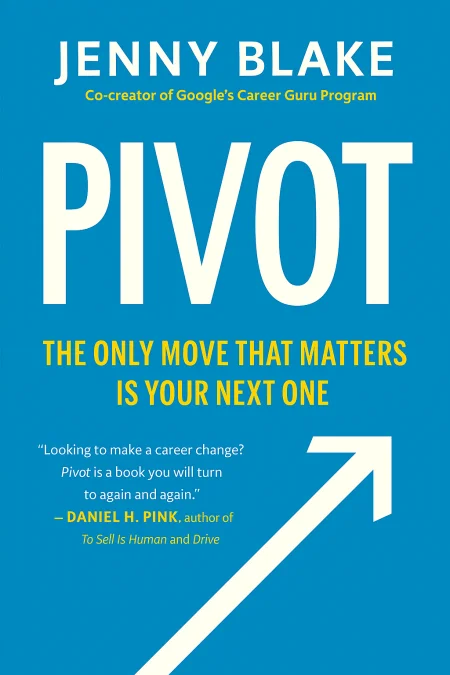
Pivot
The Only Move That Matters Is Your Next One
Book Edition Details
Summary
Lost in the maze of career decisions? Jenny Blake's "Pivot" offers a compass for those yearning to redefine their professional journey. Whether you're itching to escape a stagnant role or eager to leap into uncharted business territories, Blake provides a four-step method to harness the power of change. Drawing on her expertise from Google's career development programs, she crafts a blueprint that transforms uncertainty into opportunity. This isn't just a guide—it's a catalyst for action, inviting you to lean into what works and confidently chart your next move. For those poised at the crossroads of "What's next?", "Pivot" is your strategic ally in navigating the ever-evolving landscape of career growth.
Introduction
In today's rapidly evolving world, the traditional career ladder has become obsolete. We live in an era where the average person changes jobs every four to five years, where entire industries can emerge or disappear within a decade, and where the skills that made you valuable yesterday might not guarantee success tomorrow. Yet amidst this uncertainty lies an extraordinary opportunity. Those who learn to navigate change strategically, who can identify when it's time to pivot and execute that transition skillfully, don't just survive—they thrive. The question isn't whether you'll face career transitions, but whether you'll approach them with intention and wisdom, or be caught off guard when change inevitably arrives. What if instead of fearing these transitions, you could master a proven method that transforms career uncertainty into purposeful growth? What if you could learn to pivot before you're forced to, positioning yourself not just for your next move, but for a lifetime of meaningful, dynamic work?
Plant: Build Your Career Foundation
Every successful pivot begins with a solid foundation rooted in self-knowledge and clarity. The Plant stage isn't about dramatic reinvention or starting from scratch—it's about understanding your core values, identifying your existing strengths, and creating a compelling vision for your future that builds upon what's already working in your life. Consider Monica McCarthy, who after fifteen years as an actor in New York City, felt ready for more creative control and stability. Rather than abandoning everything she'd built, Monica examined her natural talents as a people connector and conversation facilitator. She'd been hosting monthly dinner salons called Cheshire Parlour, bringing together interesting people around big ideas. Though this passion project wasn't generating sustainable income, it revealed her core strengths and values in action. When Monica applied for an office manager role at Holstee, a lifestyle brand creating products for mindful living, she shared her experiences with Cheshire Parlour during the interview. The founders realized they needed someone exactly like Monica—not for office management, but to host events and create community experiences. This led to a custom role as events impresaria, launching their Learning Lab and delivering workshops nationwide. Monica's transition succeeded because she planted her pivot in fertile soil: her authentic strengths, values, and demonstrated expertise. To plant your own foundation, start by identifying your core values—the principles that guide your decisions and fuel your motivation. Create a vision for success one year from now that excites rather than overwhelms you. Catalog your existing strengths, experiences, and the results you've already achieved. Assess your financial runway and establish what you need to feel secure during transition. This foundation becomes your North Star, ensuring that whatever changes you make align with who you are and where you want to go, rather than leading you away from your authentic path.
Scan: Explore Smart Opportunities
The Scan stage transforms aimless searching into strategic exploration. Instead of desperately looking for any opportunity, you'll systematically identify the people, skills, and possibilities that align with your planted foundation while expanding your horizon of what's possible. Smart exploration involves three key elements: connecting with the right people, developing relevant skills, and making yourself discoverable to opportunities. Shawn Henry exemplified this approach during his FBI career, where he experienced four consecutive rejections for field supervisor roles despite being the most qualified candidate. Rather than becoming discouraged, Shawn expanded his scanning to emerging areas within the organization. When a position opened as chief of the computer investigations unit, Shawn recognized the future importance of cybercrime. Though he wasn't a programmer, he got curious about applying traditional investigative techniques to online crime. He pitched his vision to the hiring manager and finally landed the role. This pivot off the typical career ladder led him to become the FBI's recognized "cyber guy," representing the U.S. government in international cybersecurity forums and eventually becoming executive director of the Cyber Division. The key to effective scanning is asking better questions rather than seeking immediate answers. Instead of "How do I get promoted?" ask "What problems is my industry struggling to solve?" Instead of "What skills should I learn?" inquire "What expertise would make me indispensable to the people I want to work with?" Conduct informational interviews with people doing work that intrigues you. Take on projects that others avoid but that align with emerging trends. Build your platform by sharing your expertise and perspective. This systematic exploration reveals possibilities you couldn't see from your current vantage point while positioning you to capitalize on opportunities when they arise.
Pilot: Test Your Next Direction
Piloting transforms theoretical possibilities into real-world data through small, smart experiments. Rather than making dramatic leaps of faith, you'll test your hypotheses about what's next through low-risk trials that provide concrete feedback about viability, enjoyment, and potential. The most effective pilots follow three essential criteria: they connect directly to your planted strengths and vision, they start small to minimize risk, and they're designed with asymmetric upside—much more potential to gain than to lose. Consider how Seth Marbin approached his desire to create greater community impact while working at Google. Instead of leaving his job to start a nonprofit, he proposed a companywide service initiative that became GoogleServe. What began as an unofficial side project engaged 3,000 employees across forty-five offices in its first year, doubling to 6,000 participants in seventy offices by year two. The program's success demonstrated Seth's ability to create meaningful social impact while providing clear value to the organization. After three years of piloting, Seth was able to transition into a full-time role leading Google's philanthropy efforts. His systematic approach—starting small, proving value, and scaling gradually—transformed a personal passion into a career-defining opportunity. Your pilots might involve taking on volunteer projects that utilize skills you want to develop, conducting client focus groups to test new service offerings, or dedicating twenty percent of your time to emerging areas within your organization. The key is running multiple small experiments simultaneously, evaluating what works, and expanding the most promising directions. Document your results honestly: What energized you? What felt like a struggle? What generated positive response from others? These experiments provide the real-world feedback you need to make informed decisions about larger moves, removing guesswork from career transitions and replacing it with evidence-based confidence.
Launch: Make Your Strategic Move
The Launch stage is when you commit fully to your new direction, making the bigger decision that completes your pivot. This isn't about blind leaps—it's about informed courage, backed by the foundation, exploration, and experimentation you've conducted in earlier stages. Successful launches require clear criteria for decision-making. Consider Tricia Krohn, who spent years climbing the corporate ladder in banking only to realize she felt miserable despite reaching her target position. Rather than staying trapped in golden handcuffs, Tricia defined her launch criteria clearly: she would leave banking to become an English teacher, supporting herself through restaurant work and substitute teaching while returning to school. The decision felt terrifying, but she knew staying would be the greater risk to her well-being. The most challenging part of Tricia's pivot wasn't the practical logistics—it was making the decision and having difficult conversations with family and colleagues. When she finally spoke with her children and parents, their reaction surprised her. Instead of the disapproval she anticipated, they said "Go for it!" Her coworkers' responses were equally supportive, with many expressing admiration for her courage to pursue meaningful work over financial security. Your launch timing depends on your specific criteria: financial benchmarks, progress milestones, gut instinct, or external factors like program acceptance or family circumstances. The key is separating the decision itself from the communication process and from perfect conditions that may never arrive. Build your confidence through action rather than waiting for courage to magically appear. Trust the foundation you've planted, the exploration you've conducted, and the experiments you've run. When your criteria align and your inner voice says it's time, take the leap. Even if outcomes don't match your exact expectations, you'll know you moved forward intentionally, with integrity, and in service of your growth and contribution to the world.
Summary
The ability to navigate career transitions strategically has become the most essential skill for thriving in our dynamic economy. As the book emphasizes, "The only move that matters is your next one"—not because previous experiences don't matter, but because your power lies in the present moment and the intentional choices you make moving forward. The four-stage process provides a repeatable framework for approaching change with confidence rather than fear, building upon your existing strengths rather than starting from scratch, and creating opportunities rather than merely waiting for them to appear. This isn't about constant job-hopping or restless searching—it's about developing the agility to grow purposefully throughout your career, making moves that align with your values and amplify your unique contribution to the world. Begin today by taking an honest inventory of what's already working in your life and career, then identify one small experiment you can run this week to test an aspect of your desired future direction.
Related Books
Download PDF & EPUB
To save this Black List summary for later, download the free PDF and EPUB. You can print it out, or read offline at your convenience.
By Jenny Blake
