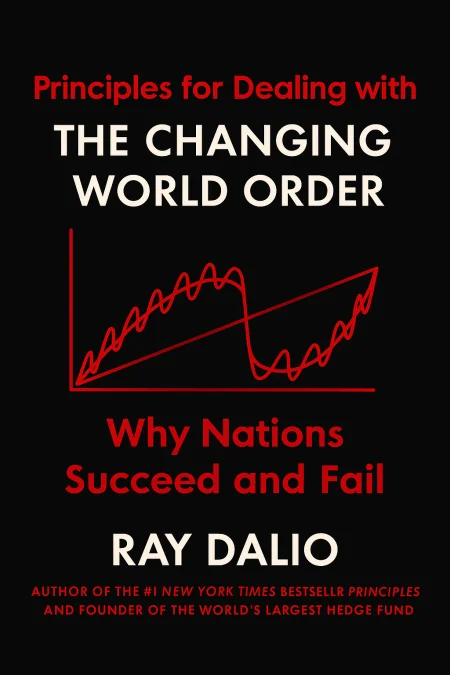
Principles For Dealing With the Changing World Order
Why Nations Succeed and Fail
Book Edition Details
Summary
History’s great cycles are more than stories of empires—they're blueprints for understanding today’s seismic shifts. In "Principles for Dealing with the Changing World Order," Ray Dalio, a legendary mind in economic theory, dissects the rhythmic rise and fall of global powers through the ages. As the United States and China echo past power struggles, Dalio unravels the underlying forces that have sculpted our world. With a half-century's worth of insights, he examines the echo of history's turbulence and projects a map for navigating the challenges ahead. This is not just a historical recount; it's a strategic guide for thriving in an era of unprecedented change. Prepare to see the past and the future with new eyes.
Introduction
In 1405, Chinese Admiral Zheng He commanded fleets of massive treasure ships that dwarfed anything Europeans could imagine, sailing across the Indian Ocean with crews numbering in the thousands. Yet within decades, China had abandoned these expeditions and turned inward, leaving the seas open for tiny Portuguese and Spanish vessels to reshape global trade. This dramatic reversal illustrates one of history's most profound mysteries: why do the world's most powerful civilizations suddenly lose their dominance to seemingly weaker rivals? The answer lies in understanding the predictable cycles that govern the rise and fall of great powers. Through careful examination of the Dutch maritime empire, British industrial supremacy, and American financial hegemony, we discover that imperial transitions follow remarkably consistent patterns driven by debt accumulation, internal discord, and external competition. These aren't random historical accidents but logical sequences that repeat across centuries and continents, offering crucial insights into our current moment of global uncertainty. This exploration proves invaluable for anyone seeking to understand today's shifting world order. Whether you're a business leader navigating international markets, an investor protecting wealth during turbulent times, or simply a curious citizen wondering about America's future and China's rise, these historical patterns provide essential context for making sense of our rapidly changing world.
The Three Great Cycles: Money, Internal Order, and External Power
History reveals three fundamental cycles that interweave to determine the fate of nations and empires. Like the gears of a vast clockwork mechanism, these forces operate with mathematical precision, creating the rhythm by which civilizations rise and fall across the centuries. The first cycle governs money, credit, and debt. Every great empire begins with sound currency and conservative financial practices, but success inevitably breeds excess. As wealth accumulates, people borrow more freely against future prosperity, creating artificial booms that feel permanent to those living through them. The Dutch pioneered sophisticated banking during their Golden Age, the British perfected industrial finance, and Americans created the world's most complex capital markets. Yet each eventually faced the same reckoning when debts exceeded their ability to pay, forcing painful choices between economic collapse and currency debasement. The second cycle shapes internal order within societies. Nations begin with strong leadership and shared purpose following periods of crisis or revolution. This unity enables rapid progress and broad-based prosperity, creating golden ages of achievement and innovation. However, success breeds complacency and inequality as wealth concentrates among elites while the masses struggle. When economic stress hits these divided societies, long-simmering tensions explode into civil conflicts that either destroy the old order or force dramatic reforms. The third cycle determines external relationships between nations. Rising powers inevitably challenge established hegemonies in predictable patterns of competition that escalate from trade disputes to technological rivalry to military confrontation. These struggles reshape global orders, with victors establishing new systems that persist until the next challenger emerges strong enough to upset the balance. Understanding how these three cycles align reveals why some eras produce unprecedented prosperity while others witness catastrophic conflicts that reshape entire civilizations.
Reserve Currency Empires: From Dutch Guilders to British Pounds (1600-1945)
The modern global economy emerged from the innovative minds of Dutch merchants who solved one of international trade's greatest challenges: the chaos of unreliable currencies. Before the Dutch revolution in finance, merchants struggled with hundreds of different coins of dubious quality, making long-distance commerce slow, expensive, and risky. The Bank of Amsterdam, established in 1609, changed everything by issuing standardized paper notes backed by precious metal reserves that traders worldwide came to trust more than local currencies. This innovation, combined with Dutch dominance in global shipping and advanced financial instruments like joint-stock companies, made the guilder the world's first true reserve currency. For over a century, roughly 40 percent of global trade settled in Amsterdam using Dutch money, granting the small republic enormous influence over international commerce. The Dutch East India Company became history's first multinational corporation, pioneering business structures that would define capitalism for centuries while generating unprecedented wealth for Dutch investors. However, the Dutch example also revealed the fatal flaw inherent in all reserve currency systems: the irresistible temptation to print money beyond one's means. When the Fourth Anglo-Dutch War strained government finances in the 1780s, the Bank of Amsterdam began issuing more paper money than it could back with gold and silver. Astute merchants quickly recognized this dangerous game and rushed to exchange their paper guilders for precious metals, creating a devastating bank run that destroyed confidence in Dutch currency and transferred reserve status to the rising British Empire. Britain then dominated global finance for over two centuries, with the pound sterling becoming synonymous with stability and prosperity. The British combined Dutch financial sophistication with superior industrial innovation and military organization, creating an empire upon which the sun never set. Yet Britain too eventually succumbed to the same pressures that felled the Dutch, as two devastating world wars, massive government debts, and the rise of American economic power gradually eroded confidence in sterling, setting the stage for the next great transition in global monetary leadership.
America's Dollar Dominance and China's Strategic Rise (1945-Present)
The devastation of World War II created a unique opportunity for American leadership that would reshape the global order for generations. While Europe and Asia lay in ruins, America emerged with its industrial capacity intact, its population largely unscathed, and its gold reserves swollen to unprecedented levels. The Bretton Woods conference of 1944 formalized this new reality, making the dollar the only currency directly convertible to gold while other nations pegged their currencies to American money. This arrangement granted America what French officials later called an "exorbitant privilege" - the ability to finance its activities by printing money that the rest of the world eagerly accepted. For nearly three decades, this system worked brilliantly as American productivity and innovation drove global economic growth while the dollar provided stability to international markets. Wall Street emerged as the undisputed center of global finance, attracting capital from every corner of the earth while American companies expanded worldwide. The inevitable reckoning came in August 1971 when President Nixon suspended the dollar's convertibility to gold, transforming the global monetary system from one based on precious metals to pure fiat currency. This decision, born of immediate fiscal necessity, fundamentally altered the nature of money itself while granting America unprecedented power to finance its activities through monetary creation. Yet it also planted the seeds of future instability by removing the last constraints on government spending and debt accumulation. Meanwhile, China was beginning its remarkable transformation from an isolated, impoverished nation into the world's second-largest economy. Starting with Deng Xiaoping's pragmatic reforms in 1978, China pursued what strategists called "peaceful rise" - building internal capabilities while avoiding direct confrontation with America. This patient strategy accelerated dramatically after China joined the World Trade Organization in 2001, creating a symbiotic relationship where Chinese savings financed American consumption while manufacturing jobs flowed westward across the Pacific. However, as China's economy approached American levels and its technological capabilities advanced rapidly, maintaining this arrangement became increasingly difficult, setting the stage for the great power competition that defines our current era.
The Coming Transition: Great Power Competition and Future Scenarios
Today we witness the classic dynamic of a rising power challenging an established hegemon, following patterns that have played out repeatedly throughout history. China has become America's peer competitor in economic output, technological innovation, and military capability, while the United States grapples with mounting debts, internal divisions, and the costs of maintaining global dominance. This confrontation was perhaps inevitable, as ascending powers naturally seek greater influence while declining empires struggle to maintain their privileged positions. The competition manifests across multiple dimensions simultaneously, escalating from trade wars to technology wars as both nations seek dominance in artificial intelligence, quantum computing, and other critical innovations. Financial warfare looms as China develops alternatives to dollar-dominated payment systems while America weaponizes its control over global finance through sanctions and restrictions. Military tensions rise in the South China Sea and around Taiwan, where competing visions of regional order threaten to spark actual conflict between nuclear-armed superpowers. Internal dynamics within both nations add dangerous complexity to this great power competition. America faces unprecedented political polarization, wealth inequality, and questions about its democratic institutions, while China confronts mounting debt, demographic challenges, and social tensions that test its authoritarian model. The outcomes of these internal struggles will significantly influence each nation's capacity to compete globally while maintaining domestic stability and legitimacy. History suggests several possible scenarios for managing this transition, ranging from peaceful accommodation to catastrophic conflict. In the best case, both powers find ways to compete while cooperating on global challenges, perhaps dividing the world into spheres of influence that acknowledge new realities. More troubling possibilities include economic decoupling, proxy wars, or even direct military confrontation that could devastate both civilizations. The choices made in the coming decade will likely determine not just the fate of these two nations, but the global order that emerges for generations to come.
Summary
The grand sweep of five centuries reveals a fundamental truth about human civilization: the forces that create imperial greatness inevitably contain the seeds of decline. Whether examining Spanish silver, Dutch innovation, British industry, or American finance, the same patterns emerge with striking consistency. Success breeds excess, excess creates vulnerability, and vulnerability opens the door for hungrier, more disciplined challengers to seize the initiative and reshape the world according to their vision. These historical cycles offer three essential lessons for navigating our current moment of transition. First, no arrangement of power lasts forever, regardless of how dominant it appears at its peak - adaptability and humility serve nations better than rigid adherence to past formulas. Second, internal cohesion and financial discipline matter more than external military adventures in determining long-term success, as empires typically collapse from within before they fall to outside conquest. Third, the greatest tragedies occur when rising and declining powers allow pride and fear to override practical wisdom, choosing conflict over accommodation when peaceful transitions remain possible. For leaders, investors, and citizens facing an uncertain future, history provides both warning and opportunity. The warning is clear: current arrangements will change whether we prepare for it or not, and those who cling too tightly to the past risk being swept away by forces beyond their control. The opportunity lies in understanding these patterns well enough to navigate them successfully, choosing cooperation over conflict when possible while building the internal strength necessary to thrive regardless of external circumstances. The future remains unwritten, but the lessons of history offer invaluable guidance for those wise enough to learn from the experiences of previous generations.
Related Books
Download PDF & EPUB
To save this Black List summary for later, download the free PDF and EPUB. You can print it out, or read offline at your convenience.
By Ray Dalio
