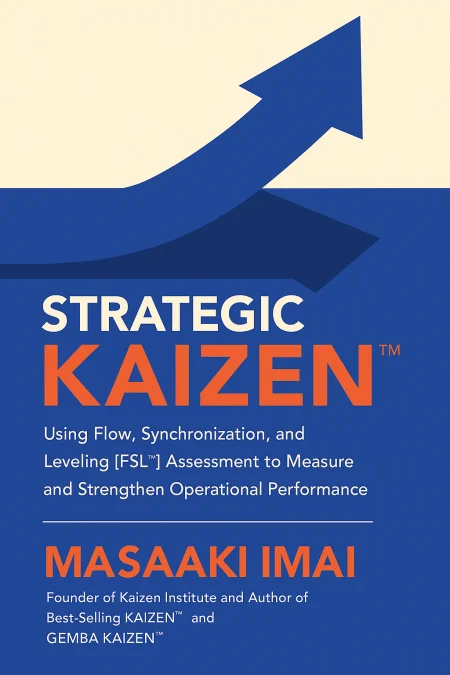
Strategic Kaizen™
Using Flow, Synchronization, and Leveling Assessment to Measure and Strengthen Operational Performance
Book Edition Details
Summary
In the realm of business innovation, Masaaki Imai returns with a new manifesto for operational excellence that defies convention. "Strategic Kaizen" invites leaders and Lean practitioners alike to reimagine their approach to efficiency and performance through the novel FSLA paradigm—Flow, Synchronization, and Leveling Assessment. This isn't just a guide; it's a blueprint for transformation, offering a dual lens on performance that marries financial savvy with operational mastery. With roots in the pioneering Toyota Production System, Imai’s insights elevate the art of continuous improvement to a strategic endeavor. Witness the synergy of incremental change and strategic vision, all aimed at redefining productivity and cutting waste. Whether you're steering a multinational corporation or a burgeoning startup, this book is your compass to streamlined success.
Introduction
Why do most companies struggle to sustain competitive advantage despite decades of management innovations and technological advances? The answer lies not in what they do, but in how they fundamentally approach the very nature of operational excellence. This exploration reveals a profound paradigm shift from traditional volume-based thinking to a flow-centered philosophy that transforms entire organizations. At its core, this framework introduces the revolutionary FSL methodology—Flow, Synchronization, and Leveling—as the hidden architecture behind sustainable operational success. This systematic approach challenges the conventional wisdom that bigger, faster, and more automated necessarily means better. Instead, it proposes that true operational excellence emerges from understanding and optimizing the continuous movement of value through interconnected processes. The theoretical foundation rests on a fundamental reconceptualization of corporate strategy itself. Rather than viewing operations as cost centers to be minimized, this perspective positions operational flow as the primary driver of customer satisfaction and long-term sustainability. The framework addresses critical questions about the relationship between short-term financial metrics and long-term operational health, the role of leadership in transformation initiatives, and the systematic assessment of organizational lean maturity.
Traditional vs Lean Companies: The Fundamental Paradigm Shift
The dichotomy between traditional and lean organizational approaches represents one of the most significant conceptual frameworks in modern operational theory. Traditional companies operate under what can be termed the "maximum resources for minimum output" paradigm, driven by century-old assumptions about economies of scale and batch production logic. These organizations typically pursue volume and speed as primary metrics, believing that producing more units faster will inevitably reduce per-unit costs. This traditional mindset manifests in several interconnected practices. Companies maintain large inventories as buffers against uncertainty, organize work around functional silos with complex handoff procedures, and prioritize machine utilization over overall flow efficiency. The underlying philosophy treats variation and demand fluctuation as problems to be absorbed through excess capacity rather than opportunities for systematic improvement. In stark contrast, lean companies embody the "minimum resources for maximum output" principle, fundamentally reorienting their operational DNA around customer value creation. These organizations recognize that excess resources—whether inventory, people, space, or time—represent waste that increases costs and reduces responsiveness. Rather than building buffers to handle problems, lean companies systematically eliminate the root causes that create problems in the first place. The transformation from traditional to lean thinking requires a profound shift in mental models. Consider a manufacturing plant where traditional thinking would install faster machines to increase throughput, while lean thinking would first question whether all the current production is actually needed by customers. Traditional approaches add resources to solve capacity constraints, while lean approaches redesign processes to eliminate the constraints entirely. This fundamental difference in problem-solving philosophy creates dramatically different organizational outcomes over time.
FSL Framework: Flow, Synchronization, and Leveling Principles
The FSL framework represents a comprehensive theoretical model for assessing and developing operational excellence through three interconnected dimensions. Flow refers to the smooth, continuous, and swift movement of materials, information, and work through all organizational processes. Unlike traditional batch-and-queue systems that create artificial bottlenecks and waiting periods, flow-based operations connect all processes in seamless sequences where work moves immediately from one value-adding step to the next. The flow principle extends beyond physical manufacturing to encompass information flows, decision-making processes, and even cash flow patterns. When properly implemented, flow creates a visual management system where problems become immediately apparent because any interruption in the continuous movement signals an abnormality requiring attention. This transparency enables real-time problem-solving and prevents small issues from accumulating into larger crises. Synchronization, the second pillar, ensures that all processes operate in harmony with actual customer demand rather than internal forecasts or capacity constraints. This involves matching the pace of work across different processes so that upstream activities produce exactly what downstream processes need, exactly when they need it. Synchronization eliminates the waste of overproduction while ensuring that customer requirements are met consistently. Leveling, the third element, addresses the natural variability in customer demand by smoothing production schedules and workloads over time. Rather than creating dramatic peaks and valleys in operational intensity, leveling distributes work evenly across available time periods. This creates stable employment conditions, reduces stress on equipment and people, and enables more predictable supplier relationships. The power of FSL lies in the synergistic interaction between these three principles. Flow without synchronization creates efficiency in the wrong directions, while synchronization without leveling creates new forms of waste through demand amplification. Only when all three elements work together does the organization achieve true operational excellence that is both efficient and sustainable.
CEO Leadership and Strategic Implementation of Lean Transformation
The role of chief executive leadership in lean transformation represents a critical theoretical framework that challenges traditional assumptions about organizational change management. Unlike other improvement initiatives that can be delegated to middle management or specialized departments, lean transformation requires what can be termed "strategic kaizen"—a fundamental reorientation of corporate strategy that only top leadership can authorize and sustain. The theoretical foundation rests on understanding the inherent conflict between short-term financial reporting pressures and long-term operational development. Traditional corporate governance structures incentivize executives to prioritize quarterly earnings over multi-year operational capability building. This creates what scholars term the "expectations market versus real market" dilemma, where leaders must choose between satisfying investor expectations and building genuine competitive advantage through operational excellence. Successful CEO leadership in lean transformation requires a sophisticated understanding of stakeholder theory that goes beyond simple shareholder primacy models. The framework proposes that sustainable competitive advantage emerges when leaders explicitly prioritize customer value creation as the primary path to long-term shareholder returns. This represents a fundamental shift from extraction-based thinking to creation-based thinking about corporate value. The implementation challenge centers on what can be called the "commitment paradox"—lean transformation delivers its greatest benefits only after several years of sustained effort, yet most CEO tenure and incentive structures focus on much shorter time horizons. Effective leaders resolve this paradox by establishing what researchers term "learning by doing" cultures where continuous improvement becomes embedded in daily operations rather than treated as a special project with defined endpoints. Consider the contrast between companies that undergo financial restructuring versus operational restructuring during crisis periods. Financial restructuring focuses on cost reduction and asset optimization but leaves underlying operational capabilities unchanged. Operational restructuring, guided by lean principles, builds new capabilities that enable sustainable competitive advantage even as market conditions continue evolving.
Toyota Production System: Real-World Case Studies and Applications
The Toyota Production System serves as the primary empirical validation of lean transformation theory, providing decades of documented evidence about how FSL principles create sustainable competitive advantage. The theoretical significance extends far beyond automotive manufacturing to represent a comprehensive organizational design philosophy applicable across industries and contexts. The foundational insight emerges from Toyota's systematic approach to what they term "respect for people" combined with "continuous improvement." This creates a unique theoretical framework where technical systems and human development reinforce each other in virtuous cycles. Unlike traditional approaches that treat technology and people as separate optimization challenges, Toyota's model demonstrates how operational excellence emerges from their integration. The case study evidence reveals several critical success factors that challenge conventional management wisdom. First, Toyota's approach to automation focuses on "jidoka" or intelligent automation that enhances human capability rather than replacing it. Machines are designed to stop automatically when problems occur, creating opportunities for people to engage in root cause analysis and systematic improvement. This contrasts sharply with traditional automation that often masks problems by building buffers to absorb variation. Second, the supplier development model demonstrates how lean principles extend beyond organizational boundaries to create what economists term "relational contracting" rather than simple transactional relationships. Toyota invests heavily in developing supplier capabilities because they understand that their success depends on entire value stream performance, not just internal optimization. The theoretical implications extend to understanding how organizational culture and operational systems co-evolve over time. Toyota's success cannot be explained by copying specific tools or techniques because the tools derive their power from underlying cultural assumptions about problem-solving, learning, and continuous improvement. This creates what researchers call "socio-technical systems" where human and technical elements are optimized together rather than separately. The practical applications span industries from healthcare systems reducing patient wait times to software development teams improving code quality and deployment frequency. In each context, the fundamental FSL principles create similar patterns of improved flow, enhanced quality, and increased customer satisfaction, suggesting that these represent universal principles of organizational design rather than industry-specific techniques.
Summary
True operational excellence emerges not from doing more things faster, but from creating seamless flow that eliminates waste while enhancing value creation at every step of organizational processes. This paradigm shift from resource maximization to flow optimization represents one of the most significant advances in management theory, offering a systematic pathway for organizations to achieve sustainable competitive advantage through operational transformation rather than financial engineering. For leaders willing to embrace long-term thinking over short-term optimization, this framework provides both the conceptual foundation and practical methodology to build organizations that simultaneously satisfy customers, engage employees, and deliver superior financial performance across economic cycles.
Related Books
Download PDF & EPUB
To save this Black List summary for later, download the free PDF and EPUB. You can print it out, or read offline at your convenience.
By Masaaki Imai
