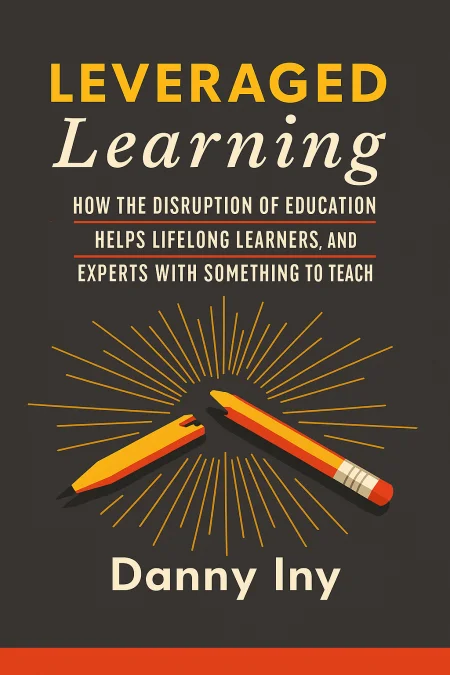
Leveraged Learning
How the Disruption of Education Helps Lifelong Learners, and Experts With Something to Teach
Book Edition Details
Summary
In today's fast-paced world, education is a never-ending journey, not a one-time event. "Leveraged Learning" by Danny Iny unveils a revolutionary blueprint for thriving in a landscape where traditional educational institutions falter. This book empowers both lifelong learners and experts ready to share their wisdom. As a learner, discover how to continually adapt and grow: navigate the shifting educational terrain, identify valuable learning opportunities, and cultivate the mental habits needed for sustained success. For experts, it's your guide to transforming expertise into profitable, impactful learning experiences. Iny explores the pitfalls of current educational systems and offers innovative alternatives that promise real transformation. Whether you're eager to learn or teach, this indispensable guide lights the way to mastering the art of modern education.
Introduction
The traditional promise of higher education—that four years of study would translate into lifelong career security and prosperity—has become one of the most expensive myths of our time. While students accumulate unprecedented levels of debt, employers struggle to find workers with relevant skills, creating a paradox that signals the fundamental breakdown of our educational system. This crisis extends far beyond rising tuition costs or graduate unemployment rates; it represents a complete misalignment between what educational institutions deliver and what the modern economy demands. The transformation reshaping our world—driven by artificial intelligence, automation, and rapid technological change—requires individuals capable of critical thinking, creative problem-solving, and continuous adaptation. Yet current educational models remain rooted in industrial-age assumptions about knowledge transfer and career preparation. The gap between educational outcomes and real-world needs continues to widen, leaving millions of learners trapped between obsolete credentials and uncertain futures. A new framework for learning must emerge, one that prioritizes practical transformation over theoretical accumulation, lifelong skill development over front-loaded degree programs, and expert-led instruction over institutionalized teaching. This examination reveals not just the magnitude of educational disruption, but the specific pathways toward sustainable, effective alternatives that can serve learners, employers, and society in an age of constant change.
The Crisis of Traditional Education: Signal Failure and Economic Disruption
Higher education has evolved from a rare privilege conferring genuine advantage into a ubiquitous commodity that fails to deliver promised outcomes. The traditional college degree once served as a reliable signal of competence, work ethic, and social belonging, but this signaling mechanism has deteriorated through over-saturation and disconnection from practical skills. When only five percent of the population held degrees, the credential provided meaningful differentiation; today, with nearly forty percent of working-age Americans holding college degrees, the signal has lost much of its discriminatory power while retaining its inflated cost structure. The substance behind the signal has eroded even more dramatically than the signal itself. Research consistently demonstrates that the majority of college graduates fail to develop critical thinking, complex reasoning, and written communication skills during their four-year programs. Meanwhile, employers rank education dead last among twenty factors they consider when making hiring decisions, preferring work ethic, attitude, and demonstrated competence over academic credentials. This fundamental mismatch explains why more than half of recent graduates remain unemployed or underemployed, while millions of job openings go unfilled due to skills shortages. The economic mathematics of higher education have become unsustainable for individual students and society as a whole. Average student debt exceeds thirty thousand dollars, with real costs approaching one hundred thousand dollars when accounting for interest payments and opportunity costs. Tuition increases have outpaced inflation by a factor of two for more than three decades, creating what can only be described as an educational bubble. The rise of corporate universities—nearly five thousand organizations that have concluded they must provide their own training rather than rely on traditional institutions—serves as a vote of no confidence in the existing system. This crisis extends beyond individual financial hardship to represent a broader failure of educational institutions to adapt to changing economic realities. The lecture-based, theory-heavy curricula developed for different eras cannot adequately prepare students for work requiring creativity, adaptability, and practical problem-solving. As the signaling value of degrees continues to decline while costs rise, the entire edifice of traditional higher education faces an existential reckoning that will reshape how societies approach skill development and career preparation.
The New Learning Landscape: From Just-in-Case to Just-in-Time Education
The technological revolution has fundamentally altered both how learning can be delivered and when it needs to occur. Traditional education operated on a "just-in-case" model, front-loading knowledge acquisition during early career years under the assumption that this information would remain relevant throughout one's working life. This approach made sense in relatively stable economic environments, but becomes counterproductive when the half-life of skills and knowledge has shortened to less than a decade. The emergence of semi-synchronous learning platforms enables a shift toward "just-in-time" education, where individuals acquire specific competencies precisely when they need them. The transition from real-time, location-dependent instruction to flexible, technology-mediated learning removes traditional constraints while introducing new possibilities. Students can access world-class expertise regardless of geographic location, consume content at optimal speeds for their learning styles, and integrate education into busy professional lives. This shift enables the granularization of learning into focused, outcome-specific modules rather than comprehensive degree programs. The Stanford 2025 project envisions replacing four years of concentrated study with six years of learning distributed across an entire career, reflecting this fundamental reorientation toward lifelong skill development. However, the move from mandatory to volitional education creates new challenges around motivation and completion. Massive Open Online Courses demonstrate both the potential and pitfalls of this transition, with enrollment in the hundreds of thousands but completion rates typically below fifteen percent. The absence of external structure and social accountability that characterized traditional classroom settings requires new approaches to engagement and persistence. Successful online education programs have learned to combine the flexibility of self-paced learning with elements of cohort-based progression and peer interaction. The most significant transformation involves the shift from information transfer to practical capability development. In an era when any factual knowledge can be accessed instantly through digital devices, education must focus on developing students' abilities to synthesize, analyze, and apply information rather than merely absorbing it. This evolution demands experiential learning approaches that emphasize real-world problem solving over theoretical knowledge accumulation. The new learning landscape rewards programs that produce demonstrable competencies and measurable behavior change rather than completed coursework or accumulated credit hours.
The Economics of Educational Transformation: Consolidation, Fragmentation, and Expert-Led Learning
The educational marketplace is simultaneously consolidating and fragmenting in response to changing economic pressures and technological capabilities. Foundational education and popular continuing education courses will likely consolidate around a small number of elite providers who can deliver world-class instruction at scale. Top universities possess the brand recognition, financial resources, and faculty expertise necessary to create comprehensive online programs that serve global audiences. Similarly, staffing firms have strong economic incentives to develop training programs that address widespread skill shortages, as their revenues directly correlate with their ability to place qualified workers. Meanwhile, specialized and niche educational needs are fragmenting into countless micro-markets served by individual experts and boutique providers. This fragmentation follows the economics of the "long tail," where digital distribution makes it economically viable to serve small, specialized audiences that would not support traditional institutional overhead. The combination of low barriers to entry and non-exclusive demand creates opportunities for thousands of subject matter experts to develop focused educational offerings for specific professional and personal development needs. Traditional higher education institutions face severe economic constraints that limit their ability to adapt to these new market dynamics. The bundled nature of degree programs has historically allowed popular introductory courses to subsidize advanced and specialized offerings with smaller enrollments. Unbundling education into discrete courses and competencies would drastically reduce revenue per student while leaving institutions with unchanged fixed costs for administration, facilities, and tenure-track faculty. The fact that only twenty-one cents of every tuition dollar actually funds instruction reveals how unsuited current institutional models are for competitive educational markets. The most promising educational innovations emerge from practicing experts who maintain current knowledge through direct engagement with evolving fields. Unlike traditional academics whose expertise may gradually become outdated through distance from practical application, these expert-practitioners possess both cutting-edge knowledge and the financial incentive to share their expertise. They represent the only sustainable source of continuing education that can keep pace with rapidly changing skill requirements. While they may initially lack formal teaching training, the premium placed on current, applicable knowledge makes expert-led education increasingly valuable compared to institutionally-provided alternatives that prioritize teaching credentials over subject matter currency.
Building Effective Learning: Knowledge, Insight, Fortitude, and the Six Layers Framework
Effective modern education must develop three interconnected capacities: foundational knowledge, insight generation, and personal fortitude. Knowledge acquisition, while necessary, represents only the baseline requirement for competence in any field. The challenge lies not in information transfer—easily accomplished through various media—but in helping learners encode information in ways that support both retention and application. This requires careful scaffolding that connects new concepts to existing understanding, spaced repetition that strengthens memory formation, and deliberate practice that develops fluency through focused effort on challenging aspects of skill development. Insight represents the synthesis of critical thinking and creativity necessary for navigating complex, novel situations. Critical thinking involves the systematic evaluation of claims, analysis of inferences, and weighing of decisions based on available evidence. Creativity encompasses the ability to generate novel solutions, recognize patterns across disparate domains, and adapt existing knowledge to new contexts. Together, these capabilities enable individuals to provide unique value in professional and personal contexts where predetermined solutions do not exist. The development of insight requires structured practice in problem-solving methodologies combined with sufficient incubation time for ideas to synthesize and mature. Fortitude encompasses the non-cognitive capacities that determine whether individuals can successfully complete educational programs and apply their learning in challenging real-world situations. Research consistently demonstrates that academic persistence correlates more strongly with motivation, self-regulation, and resilience than with measured intelligence. These capacities prove especially crucial in volitional learning environments where external structure and accountability are minimal. Effective educational programs must explicitly develop learners' abilities to manage their attention, persist through difficulty, seek appropriate support, and maintain motivation toward long-term goals. The Six Layers Framework provides a systematic approach to designing educational experiences that develop all three capacities effectively. Content must be carefully selected and organized to support specific learning outcomes rather than comprehensive topic coverage. Success behaviors must be explicitly taught and reinforced to ensure learners can navigate both the educational process and subsequent application of their learning. Delivery methods must engage learners actively rather than passively, incorporating opportunities for practice, feedback, and revision. User experience design must accommodate diverse learning preferences and contexts while maintaining appropriate levels of challenge and support. Accountability mechanisms must balance flexibility with structure, providing motivation without creating counterproductive pressure. Finally, support systems must offer appropriate assistance when learners encounter obstacles while encouraging independent problem-solving capabilities.
Summary
The convergence of economic necessity, technological capability, and changing skill requirements is driving a fundamental transformation in how societies approach human development and learning. Traditional educational institutions, constrained by legacy structures and misaligned incentives, cannot adapt quickly enough to serve either individual learners or broader economic needs. The future belongs to educational approaches that prioritize practical transformation over theoretical accumulation, leverage expert knowledge over institutional credentials, and support lifelong development over front-loaded degree programs. Success in this new landscape requires both learners and educators to embrace more personalized, outcome-focused, and adaptable approaches to skill development that recognize learning as a continuous process rather than a discrete phase of life.
Related Books
Download PDF & EPUB
To save this Black List summary for later, download the free PDF and EPUB. You can print it out, or read offline at your convenience.
By Danny Iny
