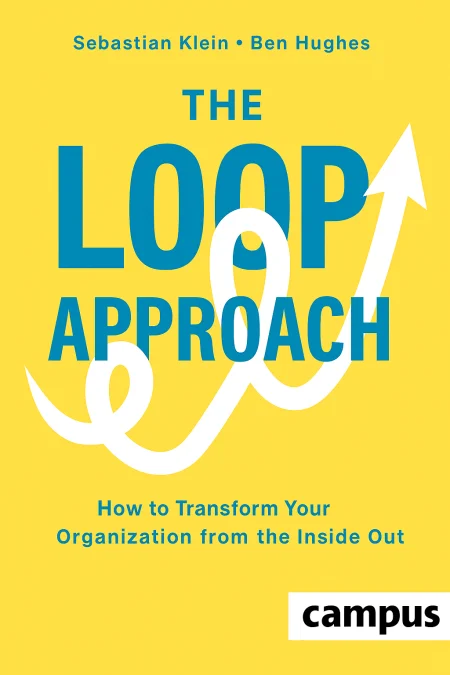
The Loop Approach
How to Transform Your Organization from the Inside Out
Book Edition Details
Summary
Picture a corporate behemoth, lumbering under its own weight, yearning for the nimbleness of a spry startup. In "The Loop Approach," Sebastian Klein and Ben Hughes unravel the paradox of agility within the entrenched structures of large organizations. This isn't just theory; it's a blueprint for transformation. With a fresh perspective, the authors dismantle the myth that startup methods can be copy-pasted into corporate frameworks. Instead, they offer a comprehensive toolkit—proven by titans like Audi and Deutsche Bahn—that breathes life into static giants. Inside, you'll find a treasure trove of checklists and actionable strategies, ready to rejuvenate any organization trapped in the inertia of its past. Here lies the promise of adaptability, a lifeline for businesses to thrive amidst the relentless tides of change.
Introduction
Sarah stared at her laptop screen in the dimly lit conference room, watching yet another endless email thread spiral into confusion. As a project manager at a mid-sized tech company, she had witnessed countless initiatives die in bureaucratic quicksand, brilliant ideas suffocated by layers of approval processes, and talented colleagues leave in frustration. The traditional corporate pyramid that once promised stability and clear direction now felt more like a prison, trapping human potential behind rigid hierarchies and outdated power structures. This scenario plays out in organizations worldwide as we stand at the threshold of a fundamental transformation in how humans collaborate and create value together. The industrial age model of command-and-control management is crumbling under the weight of rapid technological change, evolving employee expectations, and complex global challenges that demand agile, adaptive responses. Yet most organizations remain trapped in systems designed for a predictable world that no longer exists. This book offers a beacon of hope for those ready to break free from these constraints. Through practical tools, real-world case studies, and a proven methodology called the Loop Approach, readers will discover how to transform their teams and organizations from the inside out. The journey ahead promises not just improved efficiency and innovation, but the profound satisfaction of creating workplaces where human beings can truly flourish, contribute their unique gifts, and find deep meaning in their collaborative efforts.
From Pyramids to Purpose: Why Traditional Organizations Are Failing
The story of Zappos' transformation began in 2013 when CEO Tony Hsieh made a bold announcement that would shake the business world. The online shoe retailer, famous for its quirky culture and exceptional customer service, would eliminate all traditional management positions and implement a radical new organizational system called Holacracy. Employees would no longer have bosses in the conventional sense. Instead, authority would be distributed through clearly defined roles, and decisions would be made through structured processes that gave everyone a voice. Initially, the transformation seemed promising. Employees buzzed with excitement about the possibilities of self-organization, and business media hailed Zappos as a pioneer of the future workplace. However, as months turned into years, cracks began to appear. Many employees struggled to adapt to the new system, finding themselves lost without traditional hierarchical guidance. Some of Zappos' most talented people left the company, unable to navigate the complexity of the new structure. Critics began labeling the experiment a failure, pointing to declining employee satisfaction scores and operational challenges. What the critics missed, however, was that Zappos was courageously venturing into uncharted territory, conducting a real-world experiment that would provide invaluable lessons for organizations everywhere. The company's struggles weren't signs of failure, but rather the natural growing pains of evolution from an industrial-age model to something entirely new. Like early aviation pioneers who crashed their flying machines while learning the principles of flight, Zappos was discovering the fundamental laws of organizational transformation. Their experience revealed a crucial truth: the shift from hierarchical to network-based organizations isn't just a structural change, but a complete reimagining of how humans coordinate their efforts to create value. The old world of predictable markets and clear chains of command is giving way to a new reality where adaptability, purpose, and human connection become the primary drivers of success.
The Seven Habits Framework: Building Effective Self-Organizing Teams
Marcus had always been skeptical of management fads, but as the newly appointed team lead for a struggling software development group, he was willing to try anything. His team of eight brilliant engineers couldn't seem to coordinate their efforts effectively, despite having all the technical skills needed to succeed. Meetings ran in circles, deadlines slipped regularly, and frustration levels were reaching a breaking point. When the company introduced the Seven Habits framework as part of their organizational transformation, Marcus decided to give it a chance. The framework began with clear alignment, helping Marcus's team articulate not just what they were building, but why it mattered to their users and the company's mission. For the first time, each team member could see how their individual contributions connected to something larger than themselves. Next, they mapped out the fully-used potential within their group, discovering hidden skills and passions that had never been tapped. Sarah, whom everyone thought of as purely a backend developer, revealed her deep understanding of user experience design. Jim, the quiet one in the corner, turned out to have exceptional facilitation skills that transformed their chaotic meetings into productive collaboration sessions. As they distributed authority through clearly defined roles rather than vague job descriptions, something remarkable began to happen. Team members started taking ownership of specific domains, making decisions quickly without endless consultation cycles. Individual effectiveness improved as each person developed better systems for managing their work and commitments. Team effectiveness soared as they implemented structured meeting formats and communication protocols that actually served their needs rather than bureaucratic requirements. The group developed high adaptability, regularly reflecting on and adjusting their processes based on what they learned. Finally, they built genuine conflict and feedback competence, creating psychological safety where difficult conversations could happen without damaging relationships. The Seven Habits framework reveals a fundamental truth about human organization: effectiveness isn't achieved through rigid control structures, but through creating conditions where people can naturally coordinate their efforts around shared purpose. Like a jazz ensemble where each musician knows their part while remaining responsive to the collective improvisation, truly effective teams emerge when individuals are empowered to contribute their unique strengths within a framework of clear agreements and mutual accountability.
The Loop Journey: Three Modules for Organizational Transformation
When the leadership team at Deutsche Telekom decided to pilot the Loop Approach, they chose Emma's customer service department as their first testing ground. With forty-five employees spread across three shifts, the department was struggling with low morale, high turnover, and customer satisfaction scores that kept declining despite everyone's best efforts. Emma herself had been managing teams for over fifteen years, but she felt increasingly disconnected from the daily reality her people faced and frustrated by her inability to create meaningful change. The transformation began with the Clarity module, where Emma's team spent two intensive days exploring fundamental questions they had never been asked to consider. Why did their department exist beyond just answering phone calls? What unique value did each person bring to the team? How should responsibilities be distributed to match people's strengths and interests? Through facilitated exercises and structured conversations, the team discovered a shared purpose that went far beyond their job descriptions: they were the human face of a technology company, the bridge between complex digital services and real people trying to solve everyday problems. Team members began to see themselves not as call center operators following scripts, but as problem-solving advocates who could make genuine differences in customers' lives. The Results module focused on translating this newfound clarity into concrete improvements in how work actually got done. The team learned to organize their individual tasks more effectively, implemented new meeting structures that actually served their needs, and developed decision-making processes that didn't require escalation to Emma for every minor issue. The Evolution module completed the transformation by giving the team tools to continuously adapt and improve their own processes, provide meaningful feedback to each other, and resolve conflicts constructively rather than letting resentments fester. Six months after completing their Loop journey, Emma's department had become the highest-performing unit in the company, with customer satisfaction scores that exceeded all previous records and employee engagement levels that made other managers envious. The Loop Approach demonstrates a powerful principle: sustainable organizational change happens not through top-down mandates or elaborate restructuring plans, but through empowering teams to discover their own purpose, develop their own effectiveness, and evolve their own practices in response to the challenges they face together.
Scaling Change: Architecture for Enterprise-Wide Transformation
The transformation at Audi Business Innovation started small, with just three teams volunteering to pilot the Loop Approach. Within eighteen months, however, the program had expanded to over fifty teams across multiple divisions, creating what the company's leadership called "the most significant organizational change in our history." The key to this remarkable scaling wasn't a master plan imposed from above, but rather a carefully designed architecture that allowed change to spread organically while maintaining coherence and momentum. The scaling began with what the transformation team called "islands of success" – autonomous units willing to experiment with new ways of working while their colleagues watched with skeptical curiosity. These pioneer teams became living laboratories, testing and refining the Loop methodology while documenting their lessons learned. As word spread about improved team effectiveness, reduced stress levels, and more engaging work experiences, other teams began requesting their own Loop journeys. The transformation team created multiple parallel workstreams: facilitator training programs to build internal capacity, leadership development initiatives to help managers evolve their roles, communication campaigns to share stories and insights, and stakeholder management processes to maintain support from key decision-makers. Perhaps most importantly, they established what they called "the operating system" – a lightweight but comprehensive set of principles, practices, and protocols that provided consistency across all the transforming teams while allowing each group to adapt the approach to their specific context. This wasn't a rigid bureaucratic manual, but rather a living document that evolved based on collective learning from hundreds of team experiences. Regular communities of practice sessions allowed teams to share innovations, troubleshoot challenges, and celebrate successes together. The architecture for enterprise-wide transformation reveals a crucial insight about organizational change: it cannot be managed like a traditional project with clear beginning and end points, but must be approached as an ongoing evolution that emerges from the collective intelligence and commitment of the people within the system. Like a forest that regenerates itself through the interconnected relationships between countless individual organisms, organizational transformation succeeds when it creates conditions for distributed innovation, mutual support, and continuous adaptation rather than trying to control every aspect of the change process from a central command center.
Summary
The journey from hierarchical control to networked collaboration represents more than just an organizational restructuring – it's a fundamental shift in how we understand human potential and collective achievement. The Loop Approach offers not a rigid blueprint, but a living methodology that honors both the practical realities of getting work done and the deeper human needs for purpose, autonomy, and meaningful connection. Through the experiences of teams at Zappos, Deutsche Telekom, Audi, and countless other organizations, we see that transformation is possible when we trust in people's capacity to organize themselves around shared purpose and provide them with the tools and frameworks they need to succeed. The Seven Habits framework reminds us that organizational effectiveness emerges from the intersection of clear alignment, distributed authority, individual and team capabilities, adaptability, and authentic human relationships. The three-module Loop journey – Clarity, Results, Evolution – provides a pathway for teams to discover their own answers to the fundamental questions of collaboration: Why do we exist? How can we work together most effectively? How can we continuously improve and adapt to changing circumstances? The scaling architecture demonstrates that enterprise-wide transformation happens not through mandate and control, but through creating conditions where positive change can spread naturally from team to team, building momentum and coherence through shared learning and mutual support. Perhaps most importantly, this approach offers hope for a future of work that serves human flourishing rather than merely extracting value from human resources. When people are trusted to organize themselves around meaningful purpose, given the authority to make decisions in their areas of expertise, and supported with effective tools for collaboration and continuous improvement, they create results that exceed what any traditional hierarchy could achieve. The organizations that embrace this transformation won't just survive the uncertainties of our rapidly changing world – they'll thrive as beacons of what becomes possible when we design systems that bring out the best in human nature rather than trying to control and constrain it.
Related Books
Download PDF & EPUB
To save this Black List summary for later, download the free PDF and EPUB. You can print it out, or read offline at your convenience.
By Ben Hughes
